15 Best Novel AI Alternatives in 2026 (Tested, Free and Paid)
Published: 24 Jun 2026
You are deep into a scene. The dialogue finally sounds right. A character feels real for the first time in chapters. Then the model forgets her eye color, drops the motive you set up three pages back, or starts writing her like a completely different person. If that has happened to you on Novel AI, you are not alone, and you are exactly who this list is for.
Novel AI earned its loyal following for a reason. The Kayra model writes prose that sounds genuinely literary, and the anime art generator still holds up well against most competitors. But the platform has real limits too. The context window forgets details faster than most writers want, pricing climbs from ten dollars a month to twenty five for full access, and the interface expects you to learn Lorebooks and memory weighting before it behaves the way you need it to.
We tested 15 Novel AI alternative tools across the things that actually matter to fiction writers and roleplay creators. We generated the same kind of scenes on each platform, checked how long the AI remembered character details, compared pricing against real usage, and noted where content freedom either held up or quietly disappeared. This list is the result, with every entry built around what each tool genuinely does best.
Why So Many Writers Are Searching for a Novel AI Alternative
The complaints about Novel AI rarely come down to the quality of a single response. The friction builds over a long session or a multi chapter project, and it usually shows up in one of three places.
Memory is the biggest one. Novel AI’s context window on the mid tier plan holds around eight thousand tokens. That sounds like a lot until you are deep into chapter three and the AI has already forgotten your character’s eye color, her relationship to the antagonist, or a plot detail you set up two scenes back. Writers on Reddit describe this constantly, and fixing it means manually managing Lorebooks, Memory, and Author’s Note settings, which is more technical upkeep than most people want for what should be a creative process.
Price is the second issue. Novel AI runs three tiers: Tablet at ten dollars a month, Scroll at fifteen, and Opus at twenty five. If you write often or run long roleplay sessions, that monthly cost adds up fast, especially against tools that charge only for what you actually use or skip the subscription model entirely.
The learning curve is the third. Lorebooks, memory weighting, and prompt structuring are genuinely powerful once you understand them, but the interface does not make that easy for someone who just wants to write or roleplay without studying a small technical system first.
None of this makes Novel AI a bad tool. It means a real number of writers need something that remembers better, costs less, or simply fits their specific kind of project more naturally. That is exactly what the rest of this Novel AI alternative list is built to help you find.
How We Tested These Novel AI Alternatives
Every platform here went through the same basic evaluation. We generated similar scenes across a few genres on each tool, including a longer roleplay style session to test memory specifically. We tracked whether the AI remembered character details after twenty or more exchanges, evaluated prose quality on whether it read like natural writing rather than obviously generated text, and compared real monthly cost against what each tool actually delivers. We also weighed content freedom, since that matters enormously to a large share of people looking for a Novel AI alternative in the first place.
Quick Comparison Table: All Novel AI Alternatives at a Glance
| Tool | Best For | Free Option | Starting Price | Memory Quality |
| SmutFinder | Romance and erotica, zero setup | Fully free | Free | Strong within a single story |
| DreamGen | Long roleplay memory | Limited free | From $7.99/month | Excellent across sessions |
| Sudowrite | Professional manuscript writing | Free trial | From $19/month | Strong with Story Bible |
| AI Dungeon | Total beginners | Free tier with limits | From $9.99/month | Moderate |
| RedQuill | Community stories and remixing | Free tier | From $12.69/month | Moderate |
| NovelCrafter | Bring your own AI model | Free trial | From $10/month plus API costs | Excellent with Codex |
| Character.AI | Conversational roleplay | Free | Free, paid tier optional | Limited story control |
| KoboldAI Lite | Full backend control | Free, bring your own model | Free, pay for your own API | Depends on chosen model |
| Janitor AI | Community roleplay bots | Free | Free, paid tier optional | Moderate |
| Perchance | Free experimentation | Fully free | Free | Not built for long sessions |
| Campfire Writing | Heavy world building | Free trial | Standard or custom plans | Strong for planning |
| LivingWriter | Organizing long manuscripts | 14 day trial | Monthly or yearly billing | Organizational, not AI memory |
| Sakura AI | Anime style roleplay chat | Free tier | Subscription tiers | Moderate |
| Stable Diffusion | Free local art generation | Fully free | Free, self hosted | Not applicable, art only |
| ChatGPT | General brainstorming | Free tier | Paid tiers for more access | Limited for long fiction |
The Best Novel AI Alternatives, One by One
SmutFinder: Best Free Novel AI Alternative for Romance and Erotica
If the main reason you use Novel AI is romance or erotica specifically, SmutFinder does that one job better, and it costs nothing. Where Novel AI hands you a blank editor and expects you to understand tokens and Lorebooks, SmutFinder gives you a structured story creator: describe your scenario, set a spiciness slider, and generate. The whole process takes under a minute from idea to finished story.
In testing, the trope handling stood out the most. Tell it “enemies to lovers with forced proximity” and it understands the emotional arc that pairing actually needs, rather than treating the trope name as a vague label. Dialogue between characters also reads distinctly, which is not always true of general purpose tools.
Key Features
- Spiciness slider for controlling content intensity
- Trope based story generation that understands genre conventions
- Active community with tens of thousands of shared stories
- No signup friction to start generating
Pros
- Completely free with no subscription
- Genuinely fast from idea to finished story
- Strong dialogue and trope intelligence for romance specifically
Cons
- Narrower focus than Novel AI, with less support for sci-fi or literary fiction
- Less granular control over generation settings than Novel AI offers
Best for: Romance and erotica writers who want strong results without learning any technical settings.
DreamGen: Best for Long Roleplay Memory
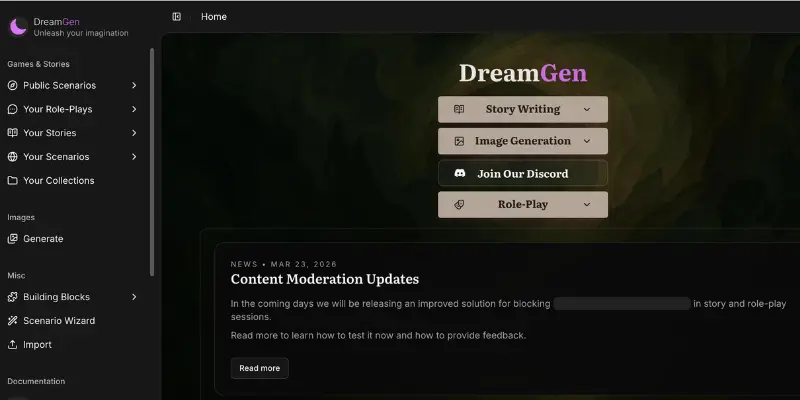
DreamGen was built to solve the exact problem most Novel AI users eventually run into: the AI forgetting who a character is partway through a long roleplay. Its memory system tracks characters, settings, relationships, and plot events across extended sessions, and in testing it holds onto details far longer than Novel AI typically manages.
The dedicated roleplay mode is the clear standout. You build detailed characters with backstories and personality traits, and the AI keeps those traits consistent across dozens of exchanges rather than slowly drifting into a generic voice.
Key Features
- Persistent memory system tracking characters and relationships
- Dedicated roleplay mode built around long session consistency
- Regularly updated models and features
- Strong, coherent prose quality
Pros
- Noticeably better long session memory than most competitors
- Roleplay mode feels purpose built rather than bolted on
- Actively maintained with frequent updates
Cons
- Prose quality is solid but not quite as polished as Novel AI’s top tier Kayra model for pure literary writing
- Smaller community than more established platforms
Best for: Roleplay creators who are tired of watching the AI forget their character halfway through a session. Among every Novel AI alternative on this list, this is the one built most directly around fixing that exact problem.
Sudowrite: Best for Professional Manuscript Writing
Sudowrite is not a story generator in the way Novel AI is. It is a writing assistant built specifically for professional fiction authors working on an actual manuscript, and that distinction matters a lot once you compare the two directly.
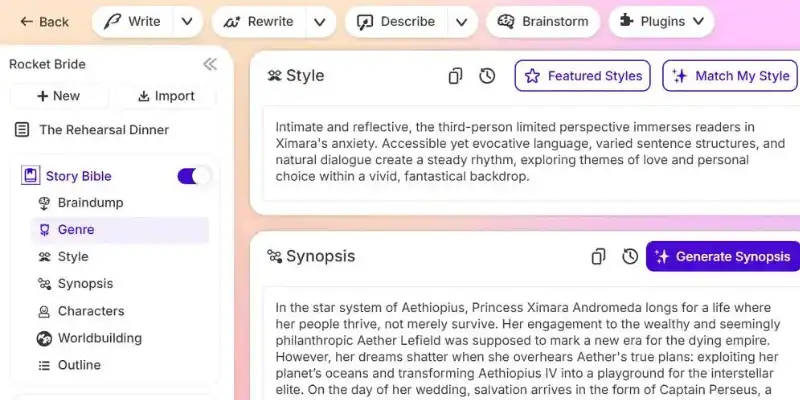
The Story Bible tracks characters, settings, and plot elements across an entire book rather than a single session. The Write tool generates prose that matches your established voice instead of drifting into something generic, and the Describe and Brainstorm tools help with individual scenes without taking over the narrative entirely.
Key Features
- Story Bible for tracking characters, plot, and world details across a full manuscript
- Describe tool for building sensory rich scene detail
- Brainstorm tool for working through specific plot or character problems
- Multiple style and tone settings to match an author’s existing voice
Pros
- Genuinely strong fiction writing assistance that holds up over long projects
- Story Bible significantly reduces the memory problems common in this category
- Feels closer to working with an editor than a generation tool
Cons
- Content filters block explicitly graphic material, unlike Novel AI’s more open approach
- Starts at a higher monthly price than Novel AI’s entry tier
Best for: Novelists and serious authors who want an AI that supports an actual manuscript rather than generating standalone scenes. It stands apart from most other Novel AI alternatives by working alongside your draft rather than replacing the writing process entirely.
AI Dungeon: Best Free Novel AI Alternative for Total Beginners
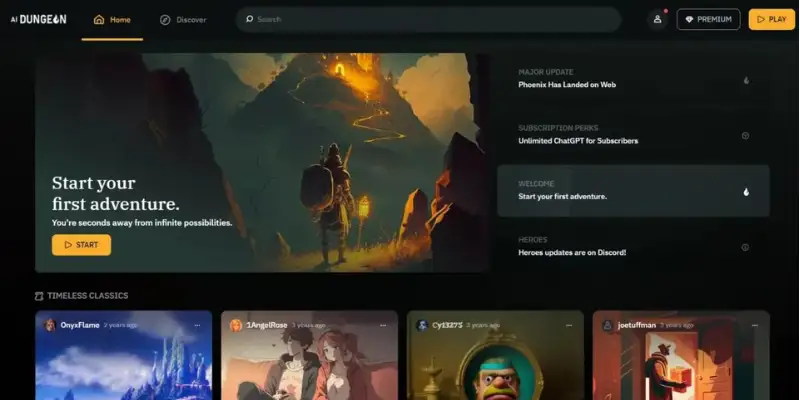
AI Dungeon practically started this category back in 2019, and it remains the easiest entry point for anyone who has never used an AI story generator before. The text adventure format, where you type an action and the AI continues the story, needs zero prompt engineering and zero settings to configure.
In testing, prose quality on the free tier trailed Novel AI noticeably, and memory was weaker than DreamGen’s. In one test run, the AI described a library as abandoned by message 35 despite the premise being that the books inside it were alive. The paid tiers improve this but still do not match Kayra level writing.
Key Features
- Choice driven interactive storytelling with zero setup
- Genre based templates to start a new adventure quickly
- Multiplayer options for shared stories
- Several membership tiers with different access levels
Pros
- Genuinely the fastest onboarding of any tool on this list
- Multiplayer mode adds a social layer most competitors lack
- Free tier is usable for casual experimentation
Cons
- Prose quality and memory both trail Novel AI on a direct comparison
- Costs can add up on higher tiers for heavy users
Best for: Complete beginners who want to try AI fiction without learning anything technical first. Those who want to compare similar text adventure tools can also look at other AI Dungeon alternatives.
RedQuill: Best for Community Stories and Remixing
RedQuill takes a different angle than most tools on this list by focusing on community and discovery rather than solo drafting. The platform hosts a massive library of generated stories across romance, fantasy, horror, and fan fiction, and its remix feature lets you take any public story and rework it with different characters or plot directions.
For readers who treat AI fiction as something to explore rather than something to draft from scratch, RedQuill’s browsable library is stronger than anything Novel AI offers. The tone handling is solid for atmospheric genres like gothic horror or slow burn romance, though it can resist shifting tone mid story once it locks in.
Key Features
- Massive library of community generated stories across genres
- Remix tool for reworking existing public stories
- Free tier alongside two paid membership levels
- Strong handling of consistent tone within a single piece
Pros
- Largest browsable story library in this category
- Remix feature genuinely encourages creative collaboration
- Good atmospheric consistency once a tone is established
Cons
- Resists mid story tone shifts, which limits flexibility on longer pieces
- Less depth for solo, from scratch drafting compared to Novel AI
Best for: Readers and casual writers who want to explore and remix community content rather than draft alone from a blank page.
NovelCrafter: Best for Bringing Your Own AI Model
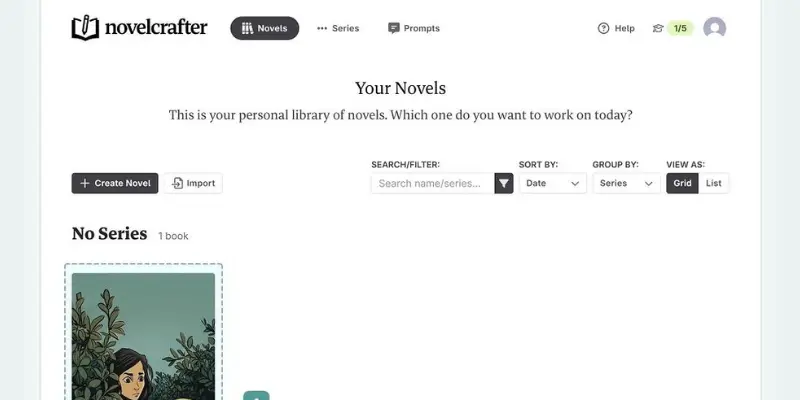
NovelCrafter takes the opposite approach from almost everything else on this list. It does not include its own AI model at all. Instead, you supply API keys from providers like OpenAI, Anthropic, or Google, and NovelCrafter provides the writing environment around whichever model you choose.
The Codex system is the real draw. Character sheets, location databases, plot threads, and world building documents all stay structured, searchable, and accessible to the AI during generation, which is genuinely one of the strongest story bible implementations available right now.
Key Features
- Codex system for structured character, location, and plot tracking
- Bring your own model through API keys from multiple providers
- Pay only for what you use through your chosen provider
- Built for large, complex fictional worlds
Pros
- Best in class organizational depth for lore heavy projects
- Full control over which underlying model generates your prose
- Pricing scales with actual usage rather than a flat subscription
Cons
- More setup required than platforms with a built in model
- Adds the cost and complexity of a separate API subscription
Best for: Technically confident writers managing a complex fantasy world or multi book series who want frontier model quality inside a dedicated writing environment.
Character.AI: Best for Conversational Roleplay
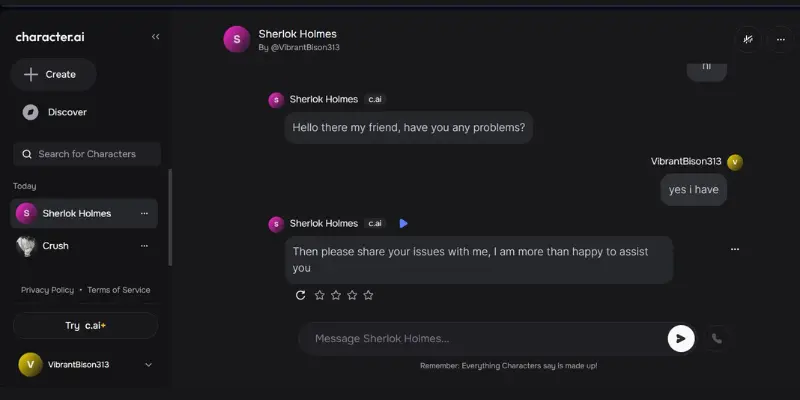
Character.AI focuses on dialogue and personality rather than structured plot, which makes it a strong fit for anyone whose main interest is talking with a consistent character rather than drafting a novel. The free tier is genuinely usable, and the platform runs on both web and mobile.
Where it falls short compared to Novel AI is direct story control. You are mostly steering through conversation rather than shaping scenes and chapters, so it suits a different kind of creative itch entirely.
Key Features
- Wide library of user created characters with distinct personalities
- Free to use, with an optional subscription for advanced features
- Mobile apps for iOS and Android
- Real time conversational responses
Pros
- Genuinely engaging character personalities
- Free tier covers most casual use cases well
- Available on mobile, unlike many competitors
Cons
- Limited control over overall plot or story direction
- Leans more conversational than structured storytelling
Best for: Writers and roleplayers more interested in character dialogue than plotted narrative. Anyone wanting to compare similar conversational tools can browse other Character.AI alternatives too.
KoboldAI Lite: Best for Full Backend Control
KoboldAI Lite is less a finished product and more a toolbox, and that is exactly the appeal for a specific kind of user. You are not locked into one AI model. You can connect your own API key, a local model, or a community hosted option, and tune the entire experience around your own budget and preferences.
The interface supports long form writing and roleplay with memory tools, world info entries, author’s notes, and full response editing, giving experienced users a level of control that closed platforms simply do not offer.
Key Features
- Bring your own backend, including local models or third party APIs
- Memory and world info tools for tracking story details
- Full response editing and branching support
- Browser based with no required account
Pros
- Total control over which AI model powers your writing
- No platform lock-in or forced subscription
- Deep customization for memory and world tracking
Cons
- Requires comfort with technical concepts like API keys and model routing
- Site stability can feel less polished than bigger consumer platforms
Best for: Technically comfortable writers who want full control over their model and setup rather than a one size fits all platform.
Janitor AI: Best for Community Roleplay Bots
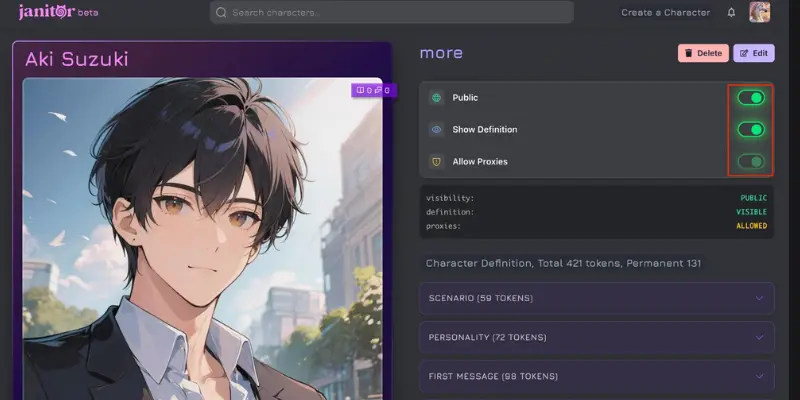
Janitor AI leans into community made character bots and a more open approach to customization than most mainstream platforms. The key difference from closed systems is model flexibility. You are not locked to one backend, and you can connect outside providers to tune the experience around your own preferences and budget.
This makes it a practical Novel AI alternative for users who care more about control and customization than a polished, guided experience.
Key Features
- Connect third party model providers for backend flexibility
- Large community of user made character bots
- Customizable character creation and scenario setup
- Accessible cost structure depending on chosen backend
Pros
- Strong customization for users who want to tune the backend themselves
- Large library of community bots to explore
- Open approach to roleplay content compared to mainstream chat platforms
Cons
- Requires some technical tolerance for terms like API keys and model routing
- Site stability can feel less predictable than bigger platforms
Best for: Roleplay focused users who have outgrown closed, mainstream chat systems and want more open customization. Those exploring this lane further can also look at other Janitor AI alternatives.
Perchance: Best Completely Free Novel AI Alternative
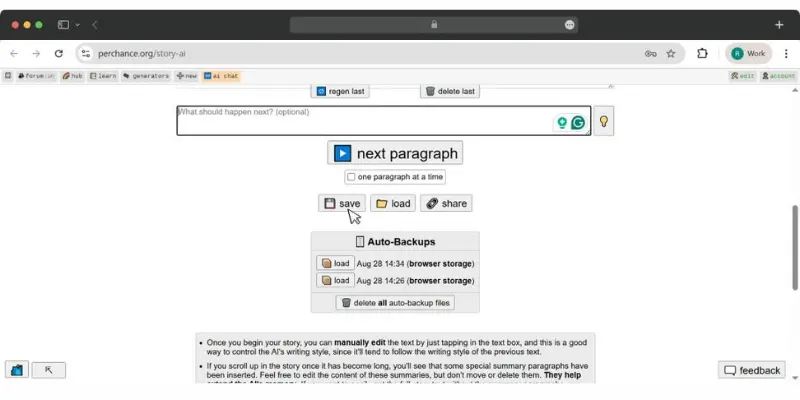
Perchance is the wildcard on this list. It is a completely free, community built platform where users create and share AI generators, including a massive collection of story generators, character creators, and scenario builders.
Quality varies a lot since each generator comes from an individual user rather than a centralized team, but the sheer variety is unmatched. If you have a hyper specific scenario in mind, there is a real chance someone on Perchance has already built a generator for it.
Key Features
- Thousands of community built story and character generators
- No account or payment required at any point
- Massive variety covering extremely specific scenarios
- No content restrictions on generators built by the community
Pros
- Completely free with zero signup friction
- Unmatched variety for niche or unusual scenarios
- Good for quick experimentation without commitment
Cons
- Quality varies significantly between individual generators
- Not built for sustained, long form narrative writing
Best for: Casual experimenters who want to test a very specific idea for free without any setup.
Campfire Writing: Best for World Building Heavy Projects
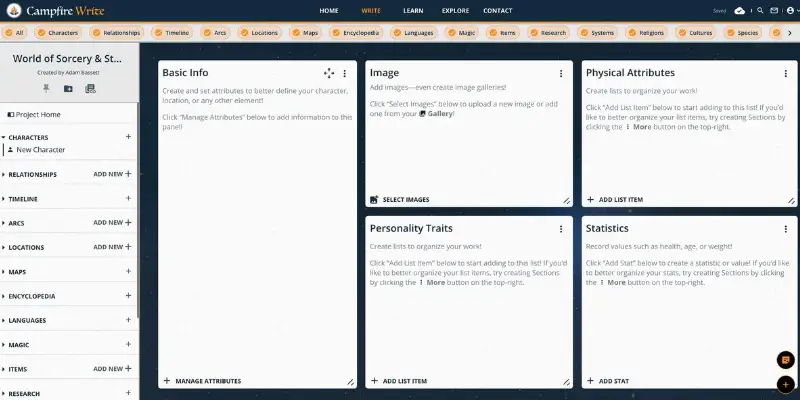
Campfire is built for writers whose stories live or die on consistent world building, particularly fantasy and science fiction authors managing large casts and complex timelines. Character profiles, relationship maps, and timeline tools all work together to keep a sprawling story straight.
It is worth noting this tool focuses more on organization and planning than AI text generation itself, so it pairs well alongside a generation focused tool rather than replacing one entirely.
Key Features
- Character profile and relationship mapping tools
- Timeline tools for tracking complex plots
- Free trial before committing to a paid plan
- Standard and custom subscription modules
Pros
- Excellent for managing complex, lore heavy stories
- Strong fit for long form fantasy and science fiction projects
- Free trial lets you test before paying
Cons
- Primarily an organizational tool rather than a generation tool
- Custom plan modules can get costly depending on what you add
Best for: Fantasy and science fiction writers managing large casts, timelines, and world details across a long project.
LivingWriter: Best for Organizing Long Manuscripts
LivingWriter focuses on structure first. Templates for novel and story organization, chapter management, and scene tracking make it genuinely useful for writers managing a long manuscript, even though its AI writing assistance is lighter than dedicated generation tools.
The fourteen day trial gives you a real chance to test the organizational workflow before choosing monthly or yearly billing.
Key Features
- Templates for novel and story structure
- Chapter and scene organization tools
- Cloud storage for ongoing projects
- AI assisted rewriting in different styles
Pros
- Genuinely useful for organizing longer, more complex stories
- Cloud storage keeps projects accessible across devices
- Clear, simple billing without confusing tiers
Cons
- Lighter AI generation features compared to dedicated writing tools
- Better suited to organization than raw drafting assistance
Best for: Writers who need to organize a long, multi chapter project more than they need raw AI generation power.
Sakura AI: Best for Anime Style Roleplay Chat
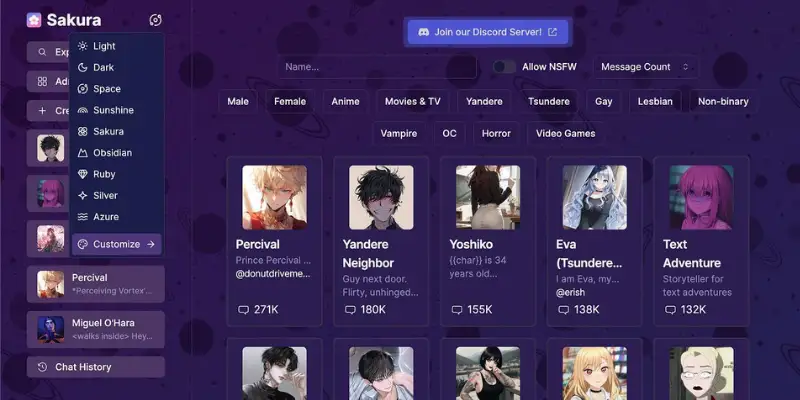
Sakura AI leans into anime aesthetics and character driven roleplay, putting it closer to Novel AI’s visual identity than most competitors on this list. The character creation tools let you build a detailed personality and appearance, and conversations stay reasonably consistent across a session.
The free tier covers casual use well, with paid tiers unlocking more advanced customization and generation limits.
Key Features
- Anime styled character creation and chat
- Customizable personality and appearance settings
- Free tier for casual ongoing use
- Subscription tiers for advanced features
Pros
- Strong fit for anime and stylized roleplay specifically
- Free tier is genuinely usable for casual sessions
- Simple enough for a new user to pick up quickly
Cons
- Less suited to traditional long form novel writing
- Memory across very long sessions is not as strong as dedicated roleplay tools
Best for: Fans of anime style character chat who want something close to Novel AI’s visual identity.
Stable Diffusion: Best Free Local Art Generation
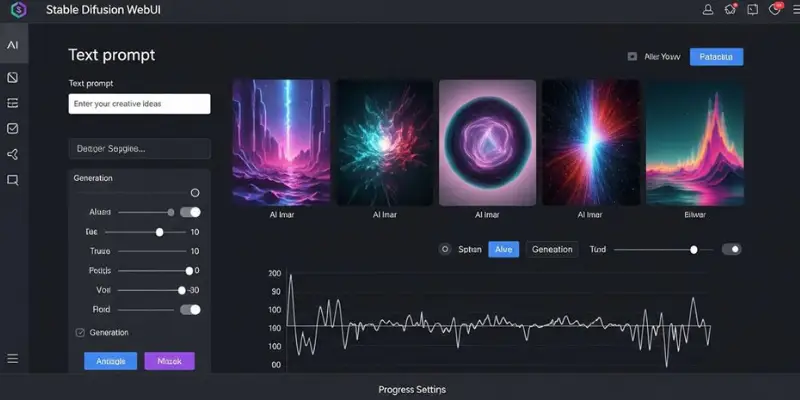
If Novel AI’s anime art generator is the feature you actually rely on most, Stable Diffusion deserves a serious look. It runs entirely on your own computer, with no content filters and no subscription once you have it set up, giving you complete control over the kind of art you generate.
The tradeoff is real. This requires technical setup and a capable graphics card, and there is no simple signup page to click through. For anyone comfortable with that barrier, it removes the cost and restriction questions entirely.
Key Features
- Fully open source and self hosted
- No content filters when run locally
- No subscription or credit system once set up
- Large community of custom models and add ons
Pros
- Completely free after initial setup with no ongoing cost
- No restrictions on the kind of art you generate
- Massive community support and custom model availability
Cons
- Requires technical setup and a capable graphics card
- Not a writing tool, so it only replaces Novel AI’s art side
Best for: Users who specifically want Novel AI’s anime art capability without any subscription or content restriction.
ChatGPT: Best for General Brainstorming
ChatGPT is not built specifically for fiction or roleplay, but its brainstorming ability makes it genuinely useful as a supporting tool. Plot suggestions, character ideas, and dialogue options all come quickly, even if it lacks the dedicated world building tools found in purpose built alternatives.
The free tier gives limited access to a capable model, with paid tiers unlocking more advanced versions and higher usage limits.
Key Features
- Conversational brainstorming for plot and character ideas
- Custom instructions to guide tone and style
- Available on web and mobile
- Free tier with paid upgrades available
Pros
- Fast, flexible brainstorming for any stage of a project
- Widely available and easy to start using immediately
- Useful as a supporting tool alongside dedicated fiction platforms
Cons
- Lacks dedicated story bible or world building tools
- Not specialized for long form fiction or roleplay memory
Best for: Writers who want a quick brainstorming partner rather than a dedicated fiction generation platform. Those who want a closer look at similar general purpose tools can also browse other ChatGPT alternatives.
Which Novel AI Alternative Should You Actually Pick
The honest answer depends on what is actually pushing you to look for a Novel AI alternative in the first place.
Leaving because of price? SmutFinder and Perchance both eliminate cost entirely. SmutFinder gives you a stronger quality within its romance and erotica focus. Perchance gives you wider variety across odd, specific scenarios.
Leaving because of memory problems? DreamGen has the strongest dedicated memory system in this entire list, and NovelCrafter offers an alternative path by letting you connect a frontier model with a much larger context window of its own.
Leaving because of the learning curve? SmutFinder and AI Dungeon both prioritize simplicity over depth, getting you from idea to story in under a minute with no settings to learn.
Leaving because you need manuscript level support? Sudowrite is built specifically for that job, and nothing else on this list comes as close for professional, published length fiction.
Leaving because of content restrictions? Novel AI itself is actually fairly permissive already, so if this is your reason, double check what specifically frustrated you. SmutFinder, RedQuill, DreamGen, KoboldAI Lite, and Perchance all offer real creative freedom for adult users if a specific feature or filter was the actual issue.
Not ready to leave at all? That is a completely valid outcome too. Novel AI’s Kayra model still produces some of the most literary sounding AI prose available, and for writers who have already learned the Lorebook system, the depth of control is genuinely hard to match.
Whatever pulled you toward this list, the Novel AI alternative landscape in 2026 is strong enough across price, memory, and content freedom that testing one or two of these against your actual project will tell you more than any single comparison ever could.
What Reddit Actually Says About Novel AI
Reddit’s writing communities are some of the most honest sources on this topic, since nobody there is selling anything. A few patterns come up again and again across r/NovelAi and broader AI writing communities.
- Memory complaints dominate the threads. The most repeated story is almost identical every time: a writer sets up a detailed scenario, and somewhere around message 30 to 40, the AI starts contradicting details it generated itself earlier in the same session. One frequently cited example involves a library that was supposed to be magical and alive, which the AI casually described as “abandoned” less than forty messages later.
- Price comparisons come up constantly. Threads regularly compare Novel AI’s Opus tier against cheaper or free alternatives, with several users noting that DreamGen and similar tools deliver comparable creative freedom for a fraction of the monthly cost.
- The Kayra model still gets real respect. Even in threads recommending alternatives, plenty of users say Novel AI’s prose quality at the top tier remains genuinely hard to beat for pure literary style, even if the platform around it frustrates them.
- New users ask about the learning curve before anything else. A common first question in beginner threads is simply how long it takes to get comfortable with Lorebooks, with most experienced users agreeing it takes a few real writing sessions before it clicks.
These patterns line up closely with what we found in our own testing, which is part of why memory, price, and ease of use anchor almost every comparison in this list.
Conclusion
Novel AI is not a bad platform. It built its reputation honestly, through prose quality and creative freedom that genuinely earned a loyal following. But no single tool fits every writer, and the specific frustration that brought you to this page, whether that is memory, price, or the learning curve, almost always points toward one or two clear answers rather than fifteen equal options.
If memory is the problem, DreamGen and NovelCrafter solve it more directly than Novel AI ever has. If price is the problem, SmutFinder and Perchance remove the question entirely. If the learning curve is the problem, nothing on this list is faster to start than SmutFinder or AI Dungeon. Pick based on the actual frustration, not the longest feature list, and the right Novel AI alternative for your specific project becomes obvious fairly quickly.
Frequently Asked Questions
Yes. SmutFinder, Perchance, Character.AI, KoboldAI Lite, and Stable Diffusion are all genuinely free to use, though KoboldAI Lite and Stable Diffusion both require connecting your own model or hardware. AI Dungeon, Janitor AI, RedQuill, and Sakura AI also offer usable free tiers with some limits.
DreamGen and NovelCrafter both stood out in testing for tracking characters, relationships, and plot details across long sessions without the drift that Novel AI users commonly report by chapter three.
DreamGen, Janitor AI, and Character.AI each suit roleplay well, depending on whether you want strong memory, backend customization, or pure conversational personality.
SmutFinder is built almost entirely around that use case, with trope based generation and a spiciness control that Novel AI does not offer in the same structured way.
Sudowrite, NovelCrafter, Campfire Writing, and LivingWriter are all built with traditional long form fiction writing in mind, each focusing on a different part of the process from drafting to organization.
Novel AI’s context window, particularly on the mid tier plan, holds a limited number of tokens. Once a session grows beyond that window, earlier details start dropping unless they are manually saved into Lorebooks or Memory settings, a complaint that comes up constantly across Reddit’s writing communities.
Content policies vary by platform and can change with new updates, so checking each tool’s current terms directly is worth the few minutes it takes. Novel AI itself already allows mature themes fairly openly, so a search for more permissive alternatives sometimes points to a different underlying frustration, like memory or price, rather than content restrictions specifically.
Stable Diffusion is the closest match for replacing Novel AI’s art generation specifically, since it is free, self hosted, and supports anime style models with no content filtering once set up locally.
This update adds SmutFinder and RedQuill, two platforms that gained significant traction in community discussions over the past few months, refreshes pricing across every tool on the list, and folds in the most recent Reddit feedback on memory and pricing complaints circulating in Novel AI’s own community.






- Be Respectful
- Stay Relevant
- Stay Positive
- True Feedback
- Encourage Discussion
- Avoid Spamming
- No Fake News
- Don't Copy-Paste
- No Personal Attacks
- Be Respectful
- Stay Relevant
- Stay Positive
- True Feedback
- Encourage Discussion
- Avoid Spamming
- No Fake News
- Don't Copy-Paste
- No Personal Attacks
