DreamGen Review 2026: Features, Pricing, Red Flags, and Honest Verdict
Published: 17 Jul 2026
DreamGen is a real, working AI story and roleplay platform. It is not a scam. It is built for writers who want long, uncensored fiction. Not for people who want a talking avatar girlfriend. The Scenario Codex and Steering tools are genuinely strong. The credit system and context drift are the real trade-offs.
DreamGen rating breakdown
Based on multiple hands-on reviews and user reports gathered for this dreamgen review, here is how it stacks up.
| Category | Score |
| Story and roleplay depth | 8.5 / 10 |
| Content freedom for 18+ users | 8.5 / 10 |
| Ease of use | 6 / 10 |
| Pricing clarity | 6.5 / 10 |
| Trust and transparency | 7.5 / 10 |
| Overall | 7.5 / 10 |
If you searched for a dreamgen review, you likely want a straight answer. Is it legit? Is it worth the money? This review answers both.
What Is DreamGen?
DreamGen is an AI writing and roleplay platform. It is text-first. No avatars, no voices, no video. Two modes sit at its core. A turn-based Roleplay mode. A Story mode for long-form fiction. That interactive-fiction idea is not brand new; AI Dungeon popularized it years earlier, and DreamGen picks up that same thread with far more structure and memory built in. It runs on its own fine-tuned models, not a wrapped version of a mainstream chatbot. That matters for one reason. Custom models mean fewer content filters getting in the way of a scene. This dreamgen review keeps coming back to one idea: DreamGen is built for writers first, companions second.
DreamGen V2: What Actually Changed
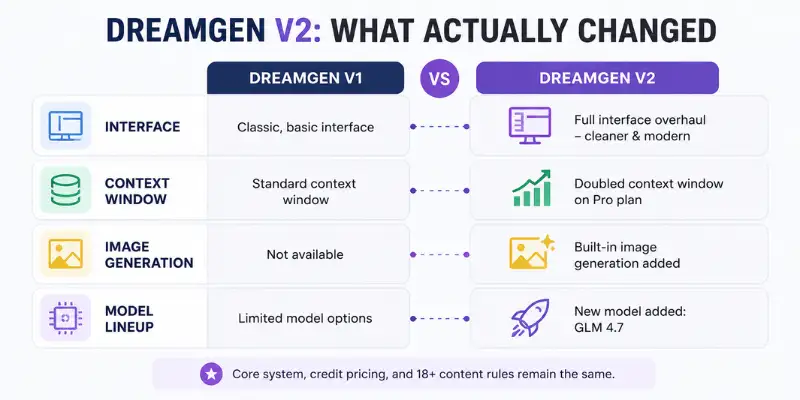
DreamGen launched a V2 beta in March 2026.
Here is what changed.
- A full interface overhaul
- A doubled context window on the Pro plan
- Built-in image generation
- A new model added to the lineup, GLM 4.7
Here is what stayed the same.
- The core Scenario Codex system
- The credit-based pricing structure
- The 18+ content rules
If you see the term dreamgen v2 or v2 dreamgen in search results, this is what people mean. It is an upgrade, not a full rebuild.
Is DreamGen an Uncensored AI Story Generator?
Short answer: yes, within real limits.
How People Search for This
People search this idea in a lot of different ways, and they all point to the same category of tool:
- Uncensored ai story generator
- Spicy story ai generator
- Dirty ai text generator free option
- Ai that writes explicit content
- Eros writer for romance-heavy fiction
- Ai spicy writer or ai story writer spicy enough for adult fiction
- A straight ai dirty story generator with no lecture attached
DreamGen sits near the top of that category, and it answers all of these the same way: yes, for verified adults, inside published rules.
What’s Allowed
DreamGen allows private, adult-themed writing for verified 18-plus users, including romance, violence, morally grey characters, and mature scenes that most mainstream chatbots refuse to touch.
What’s Off Limits
It is not a lawless explicit content generator. Certain lines stay firm no matter what plan you pay for:
- No content involving minors, in any context
- No non-consensual content using real people
- No public sharing of adult-rated material generated on the platform
So if you are hunting for an AI story generator explicit enough for serious fiction, without restrictions on tone or theme, DreamGen fits. If you are hunting for a tool with zero rules at all, no legitimate platform will actually offer that, and you should treat any site claiming otherwise as a red flag.
Writing NSFW on the Platform
There is no special trick to how to write nsfw here. You verify your age once, then write normally, and the Steering tool helps guide tone if a scene needs to shift.
Is There a DreamGen App?
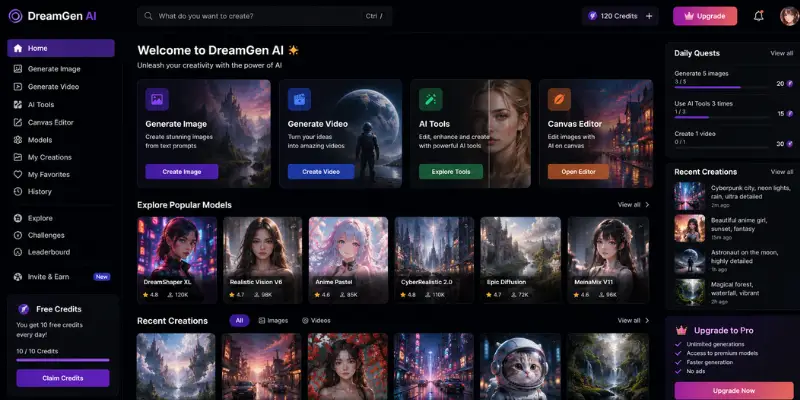
DreamGen runs in a browser. There is no separate downloadable app for phones or desktop right now, so bookmark the site instead of searching an app store.
A Free Alternative to Compare Against
If a lighter, free option is what you actually want, something like a perchance ai explicit story generator sits at the opposite end of the spectrum. It is quicker to try, but with far less memory, structure, and consistency than DreamGen’s Codex system offers.
Who Is DreamGen For?
DreamGen fits a specific type of user.
Good fit for:
- Writers who want long, coherent fiction with real plot memory
- Roleplayers who want multi-character scenes, not one chat partner
- Anyone burned out on constant content filters interrupting a story
- Power users comfortable with SillyTavern-style API setups
Not a great fit for:
- Anyone who wants a talking avatar or a girlfriend-style companion app
- Casual users who want tap-and-chat simplicity
- People who dislike credit-based, pay-as-you-go pricing
- Beginners who bounce off a slight learning curve on the first night
DreamGen vs Mainstream Chatbots: Why the Comparison Even Comes Up
Most people land on DreamGen after getting frustrated somewhere else.
A mainstream chatbot refuses a dark plot twist. It lectures instead of writing. It forgets a character’s name three messages later.
DreamGen was built around exactly that gap. Fewer filters, longer memory, and tools built specifically for fiction rather than general conversation.
That does not make it better at everything. General chatbots still win for quick research, coding help, or a fast factual answer. DreamGen is not trying to compete there. It is also not trying to be a companion app with a face and a voice; anyone who wants that side of the market tends to land on something like Candy AI instead, where presentation matters as much as the writing itself.
The fair way to frame it, and the framing this dreamgen review sticks to throughout: DreamGen is a specialist tool, not a general one.
Key Features in This DreamGen Review
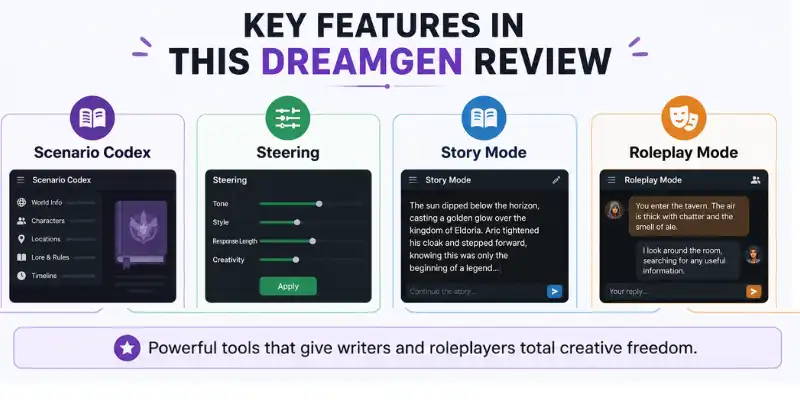
Here is what actually sits inside the platform.
Scenario Codex
The Codex is a pre-production layer. You set world rules, character backstories, and tone before you start writing.
This is DreamGen’s clearest advantage over simpler chat apps. The AI respects the rules of your world instead of improvising past them.
Setup takes real time, though. This is not a five-second character card.
Steering and Anchors
Steering lets you drop inline instructions mid-scene. Tell the AI to slow down, speed up, or shift a character’s mood, instantly.
Anchors lock in permanent facts. A betrayal plot point. A character’s secret. These persist across dozens of messages, even across model switches.
Roleplay Mode vs Story Mode
Roleplay mode is turn-based, built for back-and-forth scenes.
Story mode is collaborative long-form writing, closer to co-authoring a chapter than chatting.
Both modes share the same Codex and credit pool, so you are not locked into one style.
Models: Opus and Lucid
DreamGen runs on its own first-party model lineup rather than borrowing someone else’s chatbot. Lucid Base handles most everyday scenes and is fast and credit-cheap, good for snappy dialogue. Lucid Max and GLM 4.7 write denser, more literary prose at a higher credit cost, and GLM 4.7 became the default model for most paid users once the V2 beta rolled out. You can switch between them mid-conversation, based on what a scene actually needs.
Platforms like Venus Chub AI push that idea even further by letting you plug in an outside model entirely, though DreamGen keeps things simpler by sticking to its own tuned engines.
Community and Public Scenarios
DreamGen has a public library of over 100,000 user-built scenarios.
You can browse them for inspiration, or publish your own for others to try. Compared to a chat-first library like Janitor AI, the count here stays smaller, since raw character volume was never DreamGen’s focus; the community exists around scenarios and world-building, not sheer numbers.
Creators earn a credit rebate when someone else plays through their published scenario. It is a small but real incentive to share good work instead of hoarding it.
Performance: Does DreamGen Deliver on Its Promises?
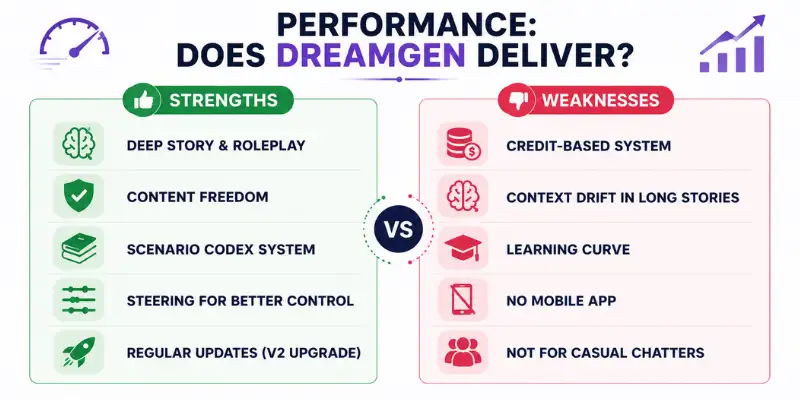
DreamGen’s core promise is long, coherent, uncensored fiction with real plot memory. Based on available testing and user reports, it delivers clearly on most of that. Long-form scenes hold their tone across a session, and the Codex genuinely cuts down on the need to repeat world rules mid-story. Steering shifts pacing or mood instantly without breaking immersion, and moving between Lucid and GLM 4.7 works cleanly, without the awkward reset you get on some competing platforms.
The gap shows up the longer a session runs. Multi-character scenes with five or more speakers get harder to track, and image generation, added in V2, still feels like a secondary feature bolted onto a text-first tool rather than something built in from the start. The general pattern in this dreamgen review matches what most hands-on testers report: strong at the thing it was built for, with one predictable weak spot the deeper you get into a story (more on that below).
Testing Notes: What Reviewers Actually Noticed
Several hands-on reviewers spent real time in DreamGen before publishing, running dozens of scenes across both modes. One tester logged roughly 60 scenes over two weeks before writing a verdict.
A few patterns show up again and again in their notes.
- Sign-up takes under a minute, and age verification is a simple 18+ confirmation
- The free trial is more generous than expected, one tester reached roughly 16 pages of text before hitting the limit
- Context drift is real. Around message 20 to 30, characters start forgetting small details
- The fix is manual: re-anchor the Codex, restate the key facts, and the story stabilizes again
- The interface still feels basic next to companion apps like Candy AI, which focus more on visual polish
- Switching between the small and large Opus models mid-scene works exactly as advertised, with no lag or awkward reset
None of this reads like a broken product. It reads like a writing tool with real strengths and one predictable weak spot, which is a more useful signal than a page full of five-star praise with no specifics behind it.
Green Flags and Red Flags
Green flags:
- Clear, dated privacy policy that states chat data is not used for model training. That single line matters more than most reviews give it credit for.
- A specific, published list of banned content categories, including a firm stance against any content involving minors. Vague rules are the real warning sign in this industry, not detailed ones.
- Free tier available with no credit card required. You can judge the writing quality before spending anything.
- Active Discord community and a development team that ships regular updates, visible in the V2 rollout itself.
- Own fine-tuned models instead of a thin wrapper around someone else’s chatbot. Fewer middlemen usually means fewer surprise content filters.
Red flags to know about, not necessarily deal-breakers:
- Age verification is self-declared only, a simple checkbox, which is standard across this entire category but still worth knowing before you assume otherwise.
- Credit pricing can feel confusing until you see real numbers laid out, which is exactly why this dreamgen review breaks the math down below.
- V2 is still in beta, so expect occasional rough edges as features settle.
- Marketing language leans heavily into “unchained” and “unrestricted,” which oversells things slightly compared to the real, published content rules.
Is DreamGen Free? Pricing Explained
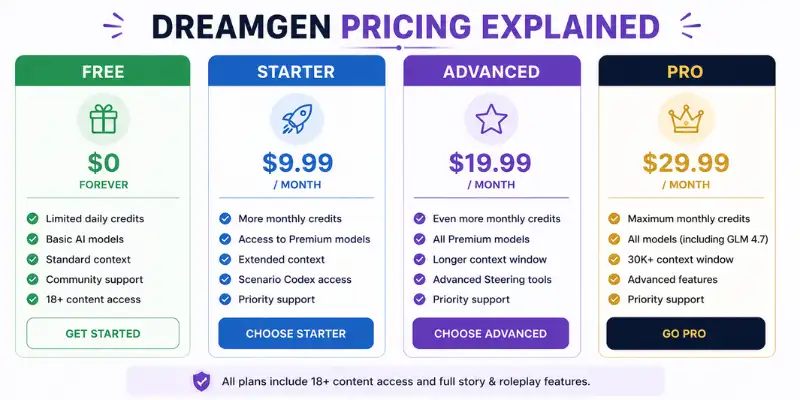
Yes, DreamGen offers a genuine free plan. No card required. The free tier includes a 4,000-token context window and a fixed monthly credit allowance. It is enough to test the interface. It is not enough for a serious, long project.
Here are the paid tiers.
| Plan | Price | Context window | What you get |
| Free | $0 | 4,000 tokens | No card required, fixed monthly credits, Lucid Base model |
| Starter | ~$7.83/mo | 4,000-5,000 tokens | More credits, access to more models |
| Advanced | ~$19.35/mo | 8,000 tokens | The tier most reviewers call the real sweet spot |
| Pro | ~$48.30/mo | Up to 30,000 tokens | Image generation, priority speed, discounted credit packs |
New users get 50 percent off the first month on any paid plan.
Credits burn based on tokens in and out, so heavy, detailed writing costs more than short exchanges. One tester burned through a full month of free credits in about four evenings of dense scene-writing.
That single detail matters more than the plan names. Budget based on how much you actually write, not the sticker price alone. Anyone weighing this against a flatter pricing model should also look at NovelAI, which skips the per-token metering in favor of a simpler unlimited-text approach, at the cost of some of DreamGen’s structure.
Is DreamGen Safe to Use?
Yes, in the ways that matter most for a review like this.
The privacy policy states chat content is never used to train models. Payments run through standard processors. You can delete your account and data with one request.
Content rules are specific, not vague. Anything involving minors triggers a permanent ban, not a warning.
As with any platform in this category, use a unique password, and avoid sharing real identifying details inside a story or scene.
Pros and Cons of DreamGen
Pros
- Genuinely deep story memory through the Scenario Codex
- Real content freedom for verified 18-plus users
- Multi-character scenes, a rare feature in this space
- Two switchable models for different writing needs
- Fast, generous free trial for testing
Cons
- Context drift after 20 to 30 messages, even on paid plans
- Credit system takes effort to understand at first
- Interface is plainer than companion-focused competitors
- Learning curve turns some casual users away on night one
- Image generation costs extra credits on top of the base plan
Real User Feedback
Feedback across independent write-ups lands in a consistent place.
Writers and serious roleplayers tend to stick around. They praise the Codex, the Steering tool, and the lack of constant content interruptions.
Casual users who expected a simple companion chat often bounce within the first session. The learning curve is the most repeated complaint in that group.
A smaller thread of feedback focuses on credits: satisfaction with the free trial, followed by mild frustration once heavy use starts eating into a paid plan fast.
Almost every independent dreamgen review this piece drew on agrees on one thing: the tool does what it claims for the audience it targets. The complaints come from people who wanted a different kind of app entirely, not from broken promises.
Before You Subscribe: A Quick Checklist
- Confirm you are comfortable with a credit-based, pay-as-you-write system
- Test the free plan first, and track how fast a real writing session uses credits
- Set up at least one Scenario Codex before judging the platform’s memory
- Expect some context drift past 20 to 30 messages, and plan to re-anchor manually
- Skip it if you actually want a voice-and-avatar companion app instead of a writing tool
Final Verdict: Is DreamGen Worth It in 2026?
DreamGen earns a solid recommendation for the right reader.
Writers who want long, coherent, uncensored fiction get real value here. The Codex and Steering tools are not gimmicks.
It falls short for anyone expecting a simple companion chat with a friendly interface and zero learning curve.
Our advice: test the free plan on one real scene, watch how the Codex handles memory, and judge the credit cost from there before paying for Advanced or Pro.
FAQs About DreamGen
Yes. A free plan exists with no credit card required, though the context window and credits are limited.
Yes. It has a dated privacy policy, published content rules, and an active development team, which are the standard trust signals for this category.
V2 is a March 2026 beta update. It brought a new interface, a bigger context window on Pro, built-in image generation, and a new model
Yes, private adult-themed writing is allowed for 18-plus users. Content involving minors is banned outright, with no exceptions.
Yes, DreamGen’s API is compatible with SillyTavern for users who want to run it through that interface instead of the native site.
Context drift is a known limitation, usually appearing after 20 to 30 messages. Re-anchoring key facts in the Codex fixes it.
For a quick, throwaway scene, a free tool can be enough. For a long story that needs to remember characters and plot points, DreamGen’s Codex and paid context windows do more work than a simple free generator can.
DreamGen, SpicyChat, and a handful of similar platforms all allow private adult content for verified 18-plus users, though each handles memory, pricing, and structure differently. This dreamgen review focuses specifically on how DreamGen’s approach compares.






- Be Respectful
- Stay Relevant
- Stay Positive
- True Feedback
- Encourage Discussion
- Avoid Spamming
- No Fake News
- Don't Copy-Paste
- No Personal Attacks
- Be Respectful
- Stay Relevant
- Stay Positive
- True Feedback
- Encourage Discussion
- Avoid Spamming
- No Fake News
- Don't Copy-Paste
- No Personal Attacks
