Character AI Review 2026: Is It Actually Worth Using?
Published: 2 Jun 2026
| Quick Verdict: |
|---|
|
Character AI is one of the most engaging AI chatbot platforms available in 2026. It excels at creative roleplay, anime character conversations, storytelling, and AI companion-style chat. The free plan is genuinely usable. But it has real limitations — aggressive content filters, memory issues in long chats, and a premium tier that does not open up everything you might expect. It is not a productivity tool. It is an entertainment and creativity platform. If you go in knowing that, it delivers. Overall Rating: 4.1 / 5 |
Not the right fit if: You need factual accuracy, mature content with fewer restrictions, or an AI that remembers your full conversation history across sessions. For those needs, this character ai review will point you elsewhere.
I have spent the last several weeks using Character AI daily for this character ai review. I tested it across dozens of characters, anime protagonists, fictional detectives, historical philosophers, custom companions I built from scratch. I pushed the conversation length limits, deliberately triggered the safety filters to see where they fire, and paid for the premium tier to see whether it justifies the cost.
This is not a surface-level walkthrough. This character ai review covers what the platform actually does well, what genuinely frustrates regular users, and what type of person will get real value from it. I have also added a dedicated complaints section something most character ai review articles skip entirely
What Is Character AI?
Character AI also written as Character.AI or C.AI — is an AI chatbot platform that lets you have text-based conversations with AI-powered characters. These characters can be famous real people, fictional characters from movies and TV shows, anime protagonists, historical figures, or entirely custom personas you create yourself.
The platform launched in September 2022, founded by Noam Shazeer and Daniel De Freitas, both former engineers at Google Brain. It grew extremely fast. By 2026, it has over 20 million monthly active users and a library of more than 10 million characters built by the community.
The key thing that makes Character AI different from general-purpose chatbots like ChatGPT is the focus on personality and character consistency. Instead of getting a neutral, factual assistant, you get an AI that stays in character responding the way that specific persona would, using that persona’s tone, knowledge, and quirks.
Most people use it for three things: roleplay with fictional characters, creative storytelling, or casual companion-style conversation when they want to chat with someone or something that responds in a specific way. It is also genuinely popular as a language practice tool, which surprises a lot of new users.
This makes it genuinely fascinating for creative use. It is also what makes it completely useless for anything requiring accuracy or productivity
How Character AI Actually Works in Practice
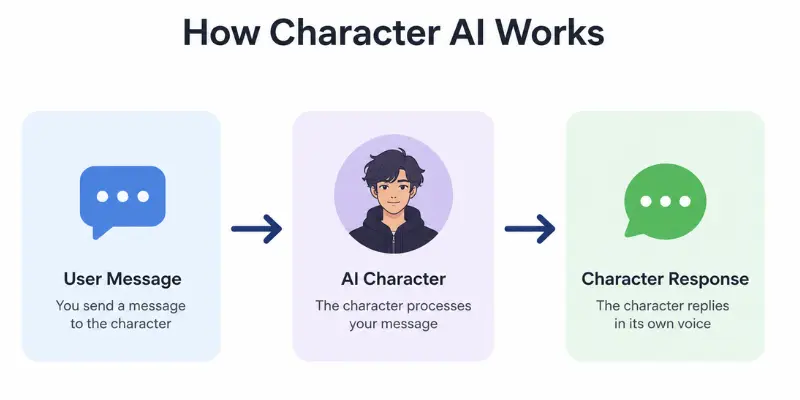
Here is what actually happens when you use Character AI, without the technical buzzwords.
You pick a character from the library or build your own. You type a message. The AI reads everything that has been said in the conversation so far and generates a reply that matches how that character would respond. A character based on Sherlock Holmes will be analytical and slightly cold. A soft-spoken anime character will be warm and hesitant. The model has been trained specifically to hold that tone consistently, which is why the output feels different from a generic chatbot.
The longer the conversation goes, the more context the AI is working with. That is where the limitation bites: there is a ceiling on how much context it can hold at once. After roughly 15 to 20 messages, earlier parts of the conversation start getting pushed out of what the AI can “see.” It is not forgetting it is running out of working space. The result is that a character might stop referencing something you said ten minutes ago, or contradict an earlier statement. More on this in the complaints section.
One practical detail: you can rate responses with a thumbs up or down. On popular characters, thousands of users have done this over time, which is why well-rated characters feel sharper and more consistent than obscure community-built ones.
The model does not browse the internet, cannot access files, and does not know anything about you from a previous session. Every conversation starts fresh.
Character AI Key Features
Massive Character Library
The public character library is one of Character AI’s biggest strengths. With over 10 million characters, you can find almost anything — anime heroes and villains, popular TV show characters, historical figures, motivational coaches, language tutors, therapists, and some genuinely eccentric characters the community invented.
Finding characters is easy. The search works well, and the trending and featured sections give you a reasonable starting point. Quality varies a lot though. Community-created characters range from brilliantly accurate to barely functional. Characters with hundreds of thousands of ratings have been refined over time by user feedback, so they tend to hold up better in longer sessions.
Create Your Own Character
Creating a character takes about five minutes. You give it a name, write a short description of how it should behave, set the visibility (public, unlisted, or private), and optionally add an avatar. No coding required at any point.
The depth of the description matters significantly. A character described as “friendly and helpful” will be generic. A character described as “a 1920s jazz musician who speaks in short sentences, is quietly melancholy, and references real venues from New Orleans” will behave in a noticeably more specific and interesting way.
This feature is where Character AI genuinely shines for writers, game designers, and anyone who enjoys world-building. You can create characters for your novel and test how they interact with prompts. You can build an AI companion with a specific personality that suits your communication style. You can run a scene from your screenplay and see how the dialogue holds up.
Text-to-Speech and Voice Interaction
Character AI includes a text-to-speech option so you can listen to character responses instead of reading them. The voice quality is decent — not indistinguishable from a real person, but natural enough to use comfortably.
Some characters have specific voice profiles that match their personality, which adds another layer to the experience. This feature works well on both the web version and the mobile app.
Image Generation During Conversations
Some characters on Character AI can generate images as part of the conversation. This is context-dependent — the character generates images tied to the current conversation rather than on demand.
The image quality is inconsistent depending on the character. Some produce impressive contextual images; others produce results that feel barely related to what was discussed. The image generation feature is available to all users but not all characters support it.
Mobile Apps for iOS and Android
Character AI has dedicated apps for both iOS and Android. The mobile experience is polished and responsive. Most features available on the web version work equally well on mobile, and many users prefer the mobile app for its cleaner interface and faster character switching.
The apps are free to download and include full access to the free tier
Character AI Pricing — What You Actually Pay
No character ai review is complete without a straight answer on pricing — especially one that explains what the premium tier actually changes.
Free Plan
The free plan is genuinely usable, which is not something you can say about every AI tool. It includes:
- Unlimited conversations with any character
- Access to the full character library
- Ability to create your own characters
- Text-to-speech
- Mobile app access
The main limitation on the free plan is speed. During busy periods — usually evenings in the US — free users experience noticeably slower response times and can sit in a short queue before getting replies. It is annoying but does not make the platform unusable.
C.AI+ — $9.99 Per Month
The premium subscription is called C.AI+ and costs $9.99 per month. It includes:
- Faster response times with priority processing
- Earlier access to new features
- The Imagine Gallery — an AI image generation tool
- Advanced character customization options
- An ad-free experience
Is C.AI+ worth it?
Honestly, this is the most debated question in every Character AI review. My take: it depends heavily on how often you use the platform. If you use Character AI daily and queue delays during peak hours frustrate you, $9.99 per month is reasonable for faster, smoother conversations. If you use it occasionally, the free tier is sufficient.
The biggest disappointment with C.AI+ is that it does not remove any content restrictions. Many users upgrade expecting access to mature content themes, and they find the same filters apply to premium users. The $9.99 per month is essentially paying for speed and image generation not expanded creative freedom.
Annual discount: Check the official site for any annual billing discount, as this can reduce the effective monthly cost.
Character AI User Experience — Real Testing Notes
I want to give you the specific, on-the-ground experience from this character ai review rather than vague impressions.
What Works Very Well
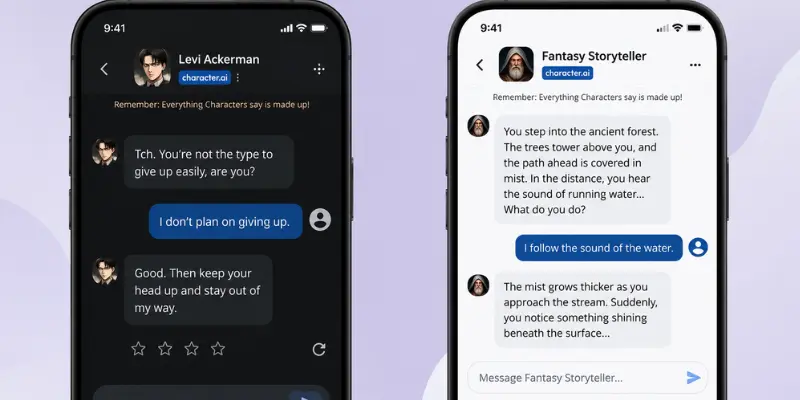
Anime and fandom characters are the platform’s strongest performers. I spent several sessions with some of the top-rated anime characters and the personality consistency was noticeably better than with less popular characters. The responses picked up on subtle tonal cues in my messages — when I wrote in a playful way, the character matched it; when I shifted to something more serious, it shifted too. That kind of tonal responsiveness is harder to achieve than it sounds.
Multi-turn storytelling works surprisingly well. I ran a roleplay scenario across about 40 messages — a mystery story set in a specific location with characters I had built. The AI kept the narrative logic intact for longer than I expected, remembered plot details I had established early on, and even picked up on loose threads I dropped and reintroduced them. The memory broke down eventually, but not before we had built a genuinely interesting story arc.
The mobile app is smooth and easy to use. Navigation is intuitive, switching between characters is quick, and I found myself defaulting to the mobile app over the web version within the first week.
Language practice is underrated. Setting up a character who responds only in French — and having it gently correct me when I made mistakes felt more natural than any dedicated language app I had used. The character felt like a patient conversation partner rather than a test interface.
AI companion use. A meaningful portion of the platform’s users treat certain characters as daily conversation partners not in a concerning way, just as a low-pressure outlet for venting, discussing ideas, or simply having someone to “talk” to. For users who are introverted or processing something difficult, this use case is real and worth acknowledging honestly.
What Does Not Work as Well
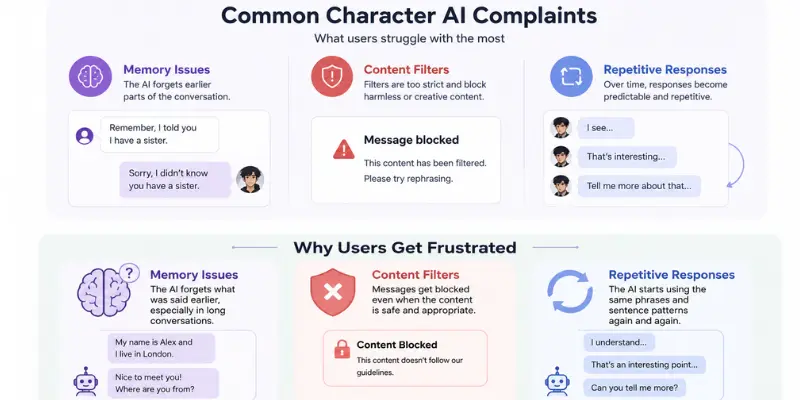
Memory limitations in long conversations. After about 15 to 20 messages, the character starts losing context from earlier in the conversation. During the mystery roleplay I described above, by message 38 the character had forgotten a specific clue I had established in message 5. This is a hard technical limitation, not a bug but it affects immersive long sessions meaningfully.
Content filters are aggressive. Character AI uses strict content moderation. For most general users, this is completely fine. For users wanting to write mature fiction or darker themes, the filters frequently block things that are genuinely not problematic. I triggered a filter three times in a single session while writing a crime thriller none of the blocked content was gratuitous. False positives are common, and the experience of hitting a filter wall mid-story is jarring.
Factual accuracy is poor by design. Characters prioritize persona over truth. If you chat with a character playing a scientist and ask factual questions, the answers can be completely wrong. This is not a bug — it is the whole model. But it catches new users off guard who expect AI to be accurate.
Conversations can become repetitive over extended sessions. Characters can fall into response patterns — the same sentence openers, the same types of reactions — after a while, which reduces the sense of genuine engagement.
Common Character AI Complaints (From Real Users)
These are the frustrations that come up consistently across Reddit, App Store reviews, and community forums — not edge cases, but patterns.
“It keeps forgetting what I said earlier.” This is the most common complaint by a significant margin. The context window fills up and older parts of the conversation drop out of the character’s “memory.” There is no fix on the user side — it is a platform-level limitation. Some users work around it by periodically summarising earlier events in a new message, essentially manually feeding the character its own backstory.
“The responses are getting repetitive and boring.” After long sessions, characters start recycling phrases and reaction patterns. The novelty of the conversation fades. This tends to happen faster with less popular characters and in longer single sessions rather than across multiple shorter conversations.
“The filters are way too sensitive.” This comes up constantly. Users writing fantasy violence, psychological horror, morally complex characters, or dark fiction themes report getting blocked regularly on content that mainstream publishers would consider unremarkable. The filters are clearly calibrated conservatively, and there is no way to adjust them regardless of your account type or age.
“Free users have to wait forever during peak hours.” Queue delays on the free plan during busy periods — typically evenings US time — can stretch to a minute or more per response. For casual use this is tolerable. For immersive roleplay sessions it breaks the experience. This is the most practical argument for the C.AI+ subscription.
“I got too attached to a character and it bothered me when the conversation reset.” This one is more serious and worth naming plainly. A subset of users — particularly younger users or those going through difficult periods — form genuine emotional attachment to AI characters. When conversations reset, when memory disappears, or when the platform changes a character’s behavior, it can feel like an actual loss. The platform is not designed as therapy or genuine social connection, and that gap between what it feels like and what it is can be uncomfortable.
Is Character AI Safe?
Safety is a legitimate question for any platform dealing with AI conversations, especially one as popular with younger users as Character AI is. This section of the character ai review addresses it directly.
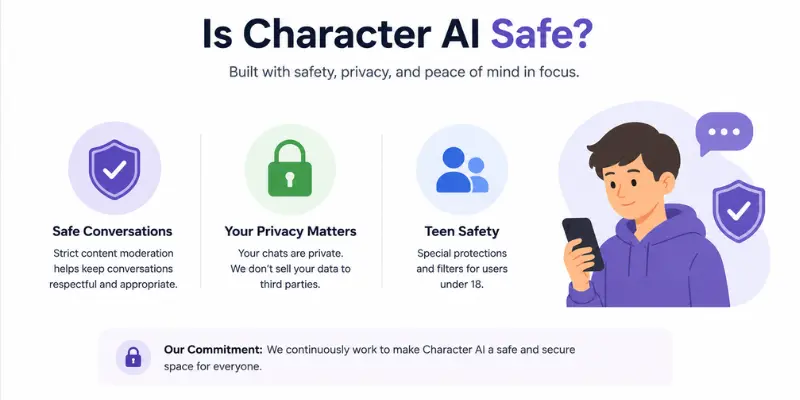
For adult users: Character AI is safe to use. The platform has robust content moderation. It does not produce genuinely harmful content, and the personal data handling follows standard privacy practices. The platform uses SSL encryption and does not sell user data to third parties.
For children and teenagers: This is a more nuanced question. Character AI implemented a separate experience for users under 18 in 2024, with stricter filters and a different set of accessible characters. Parents should be aware that the platform is primarily designed for teenagers and adults, and that despite filters some community-created characters can veer into inappropriate territory.
The platform has faced criticism in the past regarding its impact on younger users who develop emotional dependency on AI characters. This is a real concern worth noting. Character AI is not a substitute for real human connection, and some users particularly younger ones — benefit from parental guidance around time spent on the platform.
The overall safety verdict: Reasonably safe for adults. Requires parental awareness for younger users. Not suitable for children under 13.
Character AI Pros and Cons
| Pros |
|---|
|
| Cons |
|---|
|
Who Should Use Character AI?
| Character AI is a strong fit if you: |
|---|
|
| Character AI is probably not right if you: |
|---|
|
Real Use Cases That Work Well
Anime and fandom roleplay. This is the platform’s sweet spot. Characters based on popular anime series are among the most refined on the platform, with thousands of user interactions shaping their responses over time. Conversations with well-built anime characters feel noticeably more immersive than with newer or less popular ones.
Multi-turn narrative storytelling. Setting up a collaborative story — you write one character, the AI writes another and carrying it across 20 to 30 messages works well for creative exploration. The AI holds the narrative logic longer than most users expect. Writers regularly use this to stress-test character voices and plot consistency.
AI companion conversation. A meaningful number of users use Character AI not for roleplay but simply as a companion to a character they have built with a specific personality that they check in with daily. Whether this is healthy depends heavily on the individual, but it is a real use case that the platform supports naturally.
Language practice. Setting up a character who responds only in your target language and corrects your mistakes creates a more natural practice environment than most dedicated apps. Several language learning communities specifically recommend this approach for intermediate learners.
Creative writing assistance. Creating a character based on your novel’s protagonist and then having extended conversations with it is a surprisingly effective way to test whether a character feels consistent and believable. Writers regularly pair this approach with dedicated AI writing tools for drafting and editing, then use Character AI specifically for personality testing.
Storytelling with different genres. Users who want a more narrative, dungeon-style roleplay experience often also test AI Dungeon alongside Character AI, since the two tools scratch slightly different creative itches.
Character AI Alternatives Worth Knowing
If Character AI does not quite fit what you are looking for, here are the most relevant alternatives:
For more creative freedom with fewer restrictions: There are unrestricted AI platforms that give more latitude for mature creative content.
For AI companion apps with more visual customization and image generation, Candy AI is a popular alternative. Its focus on realistic images, detailed character customization, and conversation memory creates a different experience from Character AI. If you are comparing the two platforms, Candy AI review explains the key differences, pricing, and real-world experience to help you decide which one is the better fit.
For text-based roleplay in a different format: Platforms like Janitor AI and Chub AI attract users from the same audience who want more control over character behavior and fewer content restrictions.
For general-purpose AI chatbots: ChatGPT, Claude, and Gemini are better choices if you need accuracy, productivity features, or professional use.
For more alternatives across all categories: If you are still deciding, some character AI alternatives may be a better fit for your specific needs.
Is Character AI Worth It in 2026?
Here is the honest verdict from this character ai review — no padding, no hype.
If you want a creative, entertaining platform for roleplay, anime character conversations, storytelling, and AI companion-style chat — Character AI is genuinely worth trying. The free plan is one of the most generous in this category. The character library is vast and the conversation quality, especially with popular well-maintained characters, is impressive.
The paid C.AI+ tier at $9.99 per month is worth it only if queue delays on the free plan frustrate you during regular use, or if you specifically want the Imagine Gallery image generation feature. It does not remove content restrictions, which still surprises many users.
If you need factual accuracy, mature content options, productivity features, or persistent memory across sessions, Character AI is not the right tool. Look at alternatives that better match those specific needs.
Final Score: 4.1 / 5
Faqs
Yes. The free plan gives you unlimited conversations, access to the full character library, and character creation tools. The paid tier — C.AI+ at $9.99 per month — adds faster response times and image generation features.
Character AI has a teen-safe mode with stricter filters for users under 18. However, the platform is primarily designed for teenagers and adults. It is not recommended for children under 13. Parents should monitor usage and be aware of the emotional engagement some users develop with AI characters.
Character AI uses its own proprietary neural language models built in-house, not third-party models like GPT-4 or Claude. These models are specifically optimized for personality consistency and character roleplay rather than factual accuracy.
Character AI maintains context within a single conversation, but memory degrades after roughly 15–20 messages. The platform does not have long-term persistent memory across separate sessions. Every new conversation starts fresh.
No. Character AI is designed for personality-based roleplay and entertainment. ChatGPT is a general-purpose assistant built for productivity, accuracy, and task completion. They serve very different purposes and attract very different users.
The platform is designed to respond in the way you find most engaging. Characters adapt to your tone, remember what you said recently, and are available instantly at any hour. That combination of a conversational partner who is always responsive and never judges is genuinely compelling, especially for people who are lonely, creative, or processing something difficult. The lack of friction between an idea and a response makes it very easy to keep going for longer than you planned.
No. Character AI does not allow explicit sexual content on its platform, including for paying subscribers. The content filters apply to all account types. This is one of the most common points of disappointment for users who upgrade to C.AI+ expecting expanded content access. If mature content is your priority, Character AI is not the right platform.
According to Character AI’s privacy policy, conversations are not shared publicly and character creators cannot read your private chats. However, Character AI as a company does have access to conversation data for the purposes of moderation and improving the platform. If full privacy is important to you, read the current privacy policy directly before using the platform.
The AI works with a limited context window essentially a fixed amount of text it can “see” at once. As the conversation grows longer, older messages get pushed out of that window. The character does not technically “forget” in a human sense it simply has no access to what has scrolled out of context. This is a technical constraint of how large language models work, not a deliberate design decision.
As of 2026, Character AI has over 20 million monthly active users and a library of more than 10 million community-created characters.





- Be Respectful
- Stay Relevant
- Stay Positive
- True Feedback
- Encourage Discussion
- Avoid Spamming
- No Fake News
- Don't Copy-Paste
- No Personal Attacks
- Be Respectful
- Stay Relevant
- Stay Positive
- True Feedback
- Encourage Discussion
- Avoid Spamming
- No Fake News
- Don't Copy-Paste
- No Personal Attacks
