SoulGen vs MotionMuse: Which is Better for NSFW Video in 2026?
Published: 6 Jun 2026
SoulGen and MotionMuse are not direct competitors in the SoulGen vs MotionMuse AI comparison because they solve different problems. One is a character-focused image and video platform built specifically for NSFW creative work, while the other is a clean, fast, template-driven tool for animating still photos into short clips
But they end up in the same searches because people want NSFW video, both platforms offer it, and they are both accessible enough for beginners to actually use. The question is not which one is better in a general sense it is which one fits what you are genuinely trying to make. This SoulGen vs MotionMuse comparison works through both tools in full what they do, how the NSFW features actually work, what the free plans look like in real use, how the video quality stacks up, where each tool falls short, and who should pick which.
If you are still deciding whether MotionMuse is worth using at all before switching, the MotionMuse AI reviews break down real user experiences across different use cases.
What is SoulGen?
SoulGen started as a text-to-image generator built specifically for character creation. The idea was straightforward describe a character, get a high-quality image of that character in either realistic or anime style. Unlike general-purpose tools that try to do everything, SoulGen stayed focused and went deep on portrait and character quality.
That original focus still defines the platform. But since the SoulGen 2.0 update in late 2025, it has grown considerably. You can now generate video clips up to 20 seconds long, use a Face Swap tool to transpose faces between images, apply AI Outpainting to extend scenes beyond their original edges, and interact with your generated characters through SoulChat a companion feature that adds voice conversation to the experience.
The platform supports two main visual styles. Realistic mode produces photographic-quality portraits with detailed facial features, skin texture, and lighting. Anime mode covers everything from soft romance-style illustrations to explicit hentai. That dual-style support is one of SoulGen’s most searched-for capabilities, because most NSFW tools either do one or the other well, not both.
What SoulGen is Actually Good At
The strongest use case for SoulGen is character-based content creation. If your workflow involves building a consistent character, same face, same body type, same visual identity across multiple images and videos, SoulGen is built for that in a way that most other tools are not.
The FaceLock feature is the main reason for this. It pins a character’s facial identity across multiple generations, so you are not starting from scratch every time. For creators building a content series, a recurring character, or a visual brand around a specific look, this is a genuine differentiator. Most NSFW tools treat every generation as independent. SoulGen lets you build continuity.
The anime and hentai mode is also meaningfully better than what general tools offer. The illustrated style handles anatomy, proportions, and explicit content within that visual language better than tools that bolt on anime support as an afterthought. If illustrated adult content is part of your creative work, SoulGen is one of the few browser-based platforms that actually does it well.
SoulGen Pricing in 2026
SoulGen runs on a credit system. The free tier gives you one credit per day with watermarked, lower-resolution output. This is genuinely useful for testing the interface and judging image quality at a basic level, but NSFW features and video generation require a paid plan.
The Pro plan costs roughly $12.99 per month on a monthly subscription, or around $7.58 per month when billed annually. The annual plan is the one most users recommend because the per-month cost drops significantly and the credit allocation stretches much further.
What the credits actually cost per action is worth knowing before subscribing. Basic image generation costs 1 to 2 credits. Advanced edits like Face Swap or Outpainting cost 3 credits each. Video generation runs 10 credits per 5 seconds. At 100 credits per month on the standard Pro plan, that works out to roughly 50 standard images, or 10 five-second video clips, or some combination of the two. Heavy video users burn through that fast. There is a higher-tier plan with more credits, and add-on credit packs are available for purchase.
SoulChat — the companion feature — is included with the Pro plan as unlimited messaging. Free users get restricted access.
NSFW Depth on SoulGen
SoulGen’s NSFW support covers explicit nude generation from text prompts with control over body type, pose, scenario, and style. Anime and hentai content is supported natively. The FaceLock feature which maintains the same character face across multiple generations is one of the strongest reasons creators choose SoulGen over simpler tools. If you are building a series of images featuring the same character, or need visual consistency across multiple clips, FaceLock is a genuine differentiator.
The platform also handles scenario building better than most tools at this price point. You can describe a setting, lighting condition, clothing state, and physical scenario in a single prompt and the output reflects all of it. This is where prompt detail pays off vague descriptions produce generic results, but specific layered prompts produce outputs that closely match the intended scene.
One thing worth noting: following EU regulatory pressure in early 2026, some extreme content categories have been restricted even on premium plans. SoulGen has reportedly tightened certain policies. For most NSFW use cases this does not create a problem. For very specific edge categories, you may find limits that were not there in 2025
What is MotionMuse AI?
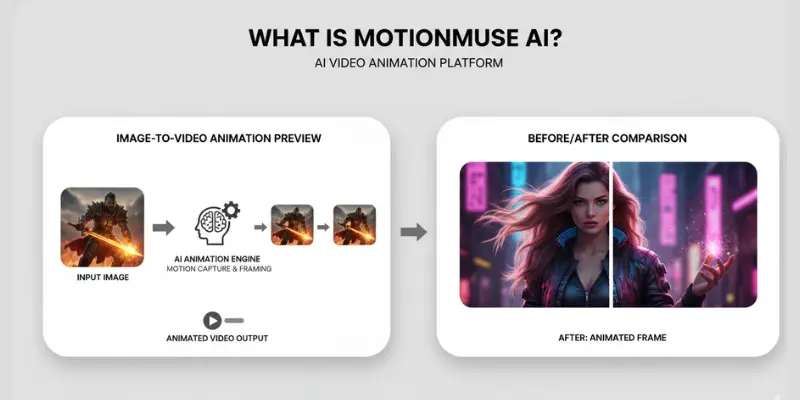
MotionMuse AI does one thing with real focus, it takes a still image and animates it into a short video clip. The platform launched in April 2025 and reached over 16 million monthly visits by January 2026, which reflects how accessible it is to pick up.
The core workflow is simple. Upload an image in JPG, PNG, or WebP format, pick a motion style from the daily-updated template library or write your own prompt, click generate, and download the result within minutes. Everything runs in your browser. No software to install, no editing skills required.
Videos are fixed at 4 to 6 seconds across every plan. That clip length cannot be extended it is a platform-level constraint, not a subscription limit. For social media content, NSFW animation clips, and short-form visual content, 4 to 6 seconds is usually enough. For anything requiring longer scenes or narrative sequencing, you will need a different tool.
What MotionMuse is Actually Good At
MotionMuse’s real strength is reliability and simplicity. The workflow from upload to finished clip is genuinely one of the smoothest in this category, no technical knowledge required, no prompt engineering skill needed in Easy Mode, no setup time. You bring a good image and the tool animates it cleanly.
The Expert Mode adds a layer of control that separates MotionMuse from even simpler tools. You can describe specific camera behavior, slow pan, atmospheric depth, directional zoom and the real-time preview window shows how the model interprets your prompt before you spend credits on the full render. This preview system is a practical time-saver that most comparable tools do not offer.
The daily-updated template library is also worth mentioning. Motion presets get refreshed regularly, which means the output styles stay current with social media trends. For creators producing content consistently, having access to new motion styles without building them from scratch is a real workflow advantage.
MotionMuse openly markets its NSFW capabilities. The platform has a dedicated NSFW video generator section, and the template library includes adult content motion styles. Custom model training is available as a paid feature, it lets you upload short videos to create a personalized animation template with your own style applied consistently.
The free plan gives 20 one-time credits at signup. Once those are used, a paid subscription starts at roughly $4.99 per month on annual billing, one of the lowest entry prices in the NSFW video space. For a full breakdown of what each plan includes, the MotionMuse AI pricing covers exactly what you get at each level including credit limits and rollover policy.
Where MotionMuse Falls Short
The clip length ceiling is the most consistent complaint. Four to six seconds is enough for a looping social post, but it is not enough for a scene that needs to develop. If the story you are telling requires more than a quick motion effect, MotionMuse cannot deliver it regardless of which plan you are on.
The second limitation is that MotionMuse improves nothing in your source image. Poor lighting, low resolution, awkward composition all of it carries through to the animated clip. The AI adds motion to what exists. It does not fix or enhance the underlying material. This means the quality ceiling for your output is set entirely by the image you upload.
The NSFW prompt filtering is also more conservative than many users expect. Explicit language in the motion prompt tends to get caught. The workaround of writing motion-focused prompts and letting the source image carry the adult content works reliably, but it is a constraint worth knowing before you buy.
SoulGen vs MotionMuse — Core Feature Comparison
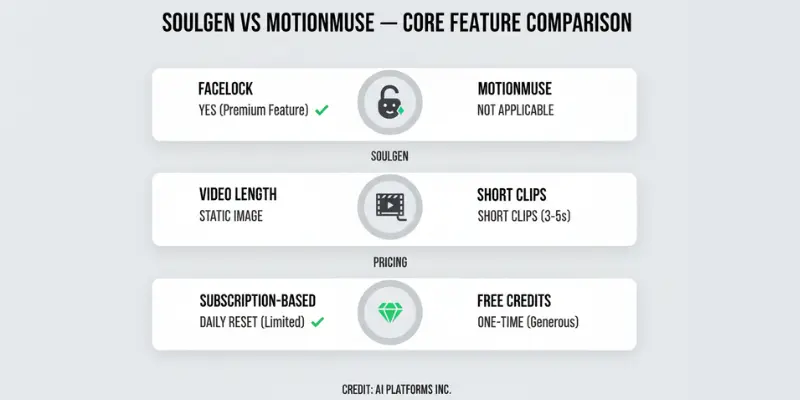
These two tools overlap less than people expect when they first search for them together. The table below shows where they diverge:
| Feature | SoulGen | MotionMuse AI |
| Primary focus | Character image + video generation | Image-to-video animation |
| Content styles | Realistic + anime/hentai | Realistic only |
| NSFW support | Yes — broad (some limits) | Yes — moderate prompt filtering |
| Video length | Up to 20 seconds | Fixed 4–6 seconds |
| Free credits | 1 credit/day (limited) | 20 one-time credits |
| Paid plan | ~$7.58/month (annual) | ~$4.99/month (annual) |
| Image generation | Yes | No |
| Image editing | Yes | No |
| Browser-based | Yes | Yes |
| Watermark (free) | Yes | Yes |
Advanced Features Comparison
| Feature | SoulGen | MotionMuse AI |
| Face consistency | Yes — FaceLock feature | No |
| Face Swap | Yes | No |
| AI Outpainting | Yes | No |
| Character reuse | Yes | No |
| Anime/hentai support | Yes | No |
| SoulChat companion | Yes | No |
| Custom model training | No | Yes (paid) |
| Template library | No | Yes — updated daily |
| Real-time preview | No | Yes (Expert Mode) |
| Credits expiry | No rollover noted | Yes — monthly reset |
The pattern is clear: SoulGen is a creation platform and MotionMuse is an animation platform. If you are trying to generate content, SoulGen is the tool. If you are trying to animate content you already have, MotionMuse is the tool.
Video Quality — Honest Comparison
SoulGen Video Quality
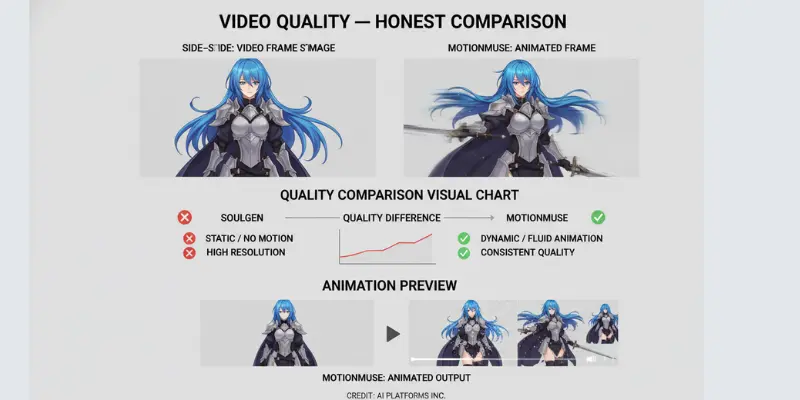
SoulGen’s video generation became genuinely competitive after the 2.0 update. The upgrade to 20-second clip support was significant, most tools in this price range cap out at 5 to 6 seconds. For character-based NSFW video, having that extra time to develop a scene makes a real difference in what is actually possible.
The quality is driven by the same model that handles image generation, which means the character detail, facial accuracy, and lighting consistency that SoulGen is known for carries through to video. Body movement and facial animation are both present. The output is strong enough to rank among the better options for character-based adult content at this price point.
The limitation is that SoulGen’s video feature is still newer than its image generation. Complex motion requests produce less coherent results than simpler animations. Consistency across a long clip is harder than consistency in a still image. A character walking slowly produces better results than a complex physical interaction. For the price range and target use case though, the quality holds up well.
One practical detail: video generation costs 10 credits per 5 seconds at max quality. On the standard Pro plan with 100 credits, that means 10 five-second clips per month before needing additional credits. Heavy video users will want a higher-tier plan or add-on credits from the start.
MotionMuse Video Quality
MotionMuse produces consistently clean, natural-looking clips. The AI reads depth and composition from your source image and applies movement accordingly meaning a high-quality source image consistently produces a good-looking animated result. Users report that clips generated with good source material often look convincing to people who do not know they are AI-generated.
The motion types — slow zooms, panning, atmospheric effects, flowing elements all translate well to NSFW source images. Expert Mode lets you describe specific motion styles with custom text prompts, and the real-time preview window shows expected animation behavior before the full render, which saves credits during iteration.
Where MotionMuse cannot compete with SoulGen is depth. MotionMuse applies motion to what is already there. It does not generate characters, maintain face consistency across multiple clips, or produce scenes from text descriptions alone. The image you upload is the ceiling of what the output can be.
Head to Head — Which Produces Better NSFW Video?
For character-driven NSFW video where the same character appears across multiple pieces: SoulGen wins clearly. FaceLock and the character generation system give SoulGen control that MotionMuse simply does not have.
For quick, reliable animation of a specific image you already have: MotionMuse wins on simplicity and predictable output. The consistency is genuinely better than most tools at this price point.
For anime and hentai styles: SoulGen is the only real option between these two. MotionMuse does not support illustrated or stylized content styles at all.
For clip length: SoulGen’s 20-second video support is a significant practical advantage over MotionMuse’s 4 to 6 second fixed ceiling. If your content needs more than a looping moment, SoulGen is the only choice between these two.
For cost per video: MotionMuse at $4.99/month is cheaper to start. But SoulGen’s credit system means image generation, editing, Face Swap, and video are all covered in one subscription, which makes the slightly higher annual cost reasonable when you account for what you are getting.
NSFW Content — Which Has More Freedom?
Both platforms support adult content, but the architecture of that support is completely different.
SoulGen’s NSFW Approach
SoulGen’s NSFW content is built around character control. You describe a character, choose a style, and the platform generates explicit imagery based on that description. The FaceLock system means you can establish a character once and generate multiple explicit images and clips with that same face and body type. This is the capability that most users cite when explaining why they chose SoulGen over simpler tools.
SoulGen allows nudity and explicit scenarios within its content policy. The specific limits particularly around extreme or non-consensual depictions are strictly enforced, and some categories that were accessible in 2025 have been restricted following regulatory changes. For mainstream NSFW use cases, SoulGen still offers considerable freedom. For very specific edge-case content, users report hitting limits that were not there before.
The anime mode gives SoulGen a second lane of NSFW content that most competitors do not offer. Realistic and illustrated explicit content from a single subscription at under $8 per month annually is a genuine value argument for the platform.
MotionMuse’s NSFW Approach
MotionMuse’s NSFW support is about animation, not generation. It does not create explicit characters from prompts you bring your own source image. The platform then animates it. This means the level of explicit content in the output depends entirely on what you upload.
The platform’s template library includes adult-oriented motion styles. Custom prompts work well when focused on movement rather than explicit description. Prompts that include explicit language directly tend to get filtered. The workaround users rely on is to let the source image carry the adult content and write the motion prompt around the type of animation you want — camera behavior, atmospheric effects, motion speed and direction.
This approach works reliably once you understand it, but it is a real constraint for users who expect the prompt to drive the explicit content the way SoulGen does.
Which Has More Creative Freedom Overall?
If explicit character creation, anime, hentai, and face consistency matter to you, SoulGen has more freedom and more tools to use it with. MotionMuse is useful for animating content you have already created, but it does not replace a generation tool.
If you want to see what exists at the more permissive end of the spectrum beyond both of these tools, the unrestricted AI video generator options include platforms and self-hosted tools with fewer content filters than either SoulGen or MotionMuse currently apply.
Free Plan — Which Lasts Longer in Real Use?
SoulGen’s free tier gives one credit per day. Watermarked, lower-resolution output. NSFW features and video generation are not accessible on the free tier, you need a paid plan to use the features that most users are actually there for. The free credits are enough to test the interface and basic image generation quality, but they are essentially a preview rather than a usable ongoing tool.
MotionMuse gives 20 one-time credits at signup. You do not get daily refreshes, but those 20 credits reflect the full paid-tier output quality. You get to see what the platform actually produces before deciding whether to pay which is a fairer test than a watermarked and restricted daily trickle.
At $4.99/month annually, MotionMuse has one of the lowest subscription prices among dedicated NSFW video tools. SoulGen’s annual plan at $7.58/month is still reasonable, but delivers meaningfully more features, image generation, editing, Face Swap, Outpainting, and companion chat which justifies the slightly higher cost for users who will actually use those features.
Prompt Strategy — Getting the Most from Each Tool
Writing Better Prompts for SoulGen
SoulGen responds well to detailed, layered character descriptions. The more specific you are about physical details, clothing state, pose, lighting, and scenario, the more accurately the output matches what you had in mind.
For NSFW content, explicit description in the prompt is fully supported and necessary to get explicit output. The platform was built to handle it. Vague prompts produce vague results — if you type “attractive woman” without further detail, the model fills in gaps on its own terms. Adding descriptors for hair color, body type, skin tone, expression, and scenario all significantly improve specificity.
For video specifically, describing the type of motion you want alongside the visual description gives better results. “Character walking slowly toward the camera, soft ambient lighting” produces a more direct result than describing only the character’s appearance. The motion direction and camera behavior need to be explicit in the prompt just as the visual details do.
The Face Swap and FaceLock tools are worth using if you plan to generate multiple pieces featuring the same character. Establishing a consistent face reference early in your workflow saves significant time later and prevents the inconsistency that comes from relying entirely on text prompts to recreate a face.
Writing Better Prompts for MotionMuse
MotionMuse rewards motion-specific language. The more precise your movement description, the more accurate the output becomes. ‘Gentle zoom with warm light bloom’ performs better than ‘zoom effect’ by a wide margin. ‘Slow pan right with subtle atmospheric haze’ gives the model a clearer instruction, while ‘soft camera push-in with shallow depth of field’ works better than simply saying ‘move closer.’ This level of specificity in camera language directly improves output quality in Expert Mode.
For NSFW content, the most reliable approach is to write the motion prompt as if you are directing a camera operator, focusing entirely on how the scene should move, while letting the source image handle the adult content
Which Tool is More Trustworthy?
This is a question that comes up often with NSFW platforms, and it is a fair one. Both platforms handle sensitive content and personal data, so the trust question is worth addressing directly.
MotionMuse has been independently reviewed and assessed. It collects minimum information, does not sell user data, and operates through standard browser-based infrastructure. If you want a thorough breakdown of what the platform does and does not do with user data and whether it is a legitimate operation, the MotionMuse AI legit assessment explains this in detail
SoulGen is generally described as safe to use through official channels, with encrypted data handling. It is a legitimate business that has been operating long enough to have a documented track record. Neither platform is anonymous, both require account creation, and NSFW content passes through their servers.
For both tools, using a dedicated email alias for signup is a reasonable precaution regardless of platform policy. This is standard advice for any NSFW platform, not a specific concern about either SoulGen or MotionMuse.
Who Each Tool is Actually For
SoulGen is the right choice if:
You want to create characters from scratch rather than animate existing images. SoulGen’s core function is generation, not animation of pre-existing content.
Anime, hentai, or manga-style content is part of your creative work. SoulGen’s anime mode is strong and fully NSFW-capable in a way that MotionMuse simply cannot match.
Character consistency across multiple images and videos matters to you. FaceLock is a real differentiator that MotionMuse does not come close to matching. If your content involves a recurring character, SoulGen is the only practical choice between these two.
You want longer video clips. SoulGen’s 20-second limit is three to four times longer than MotionMuse’s ceiling, which changes what kinds of scenes are actually possible.
You want image editing capabilities Face Swap, Outpainting, background replacement alongside video. SoulGen handles the full creative workflow. MotionMuse handles only the animation step.
You want companion chat through SoulChat alongside the visual generation tools. This is a feature that has no equivalent on MotionMuse.
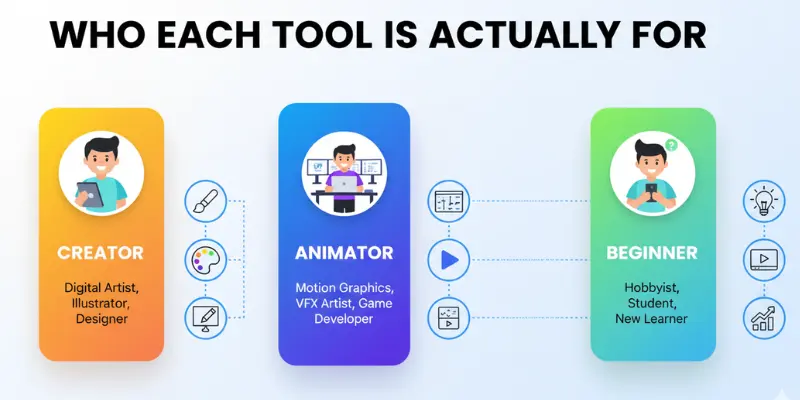
MotionMuse is the right choice if:
You have images you want to animate quickly. If the content already exists and you just need it to move, MotionMuse is the faster and more reliable path. The workflow is genuinely one of the smoothest in this category.
Price matters above everything else. At $4.99/month, MotionMuse is one of the cheapest subscriptions in the NSFW video space. If budget is the primary constraint, this matters.
You want a beginner-friendly workflow with templates that require no prompt knowledge. Easy Mode on MotionMuse is as low-friction as AI video tools get upload, select, generate, download.
Consistent, reliable output is more important than creative variety. MotionMuse produces the same quality of result every time, which matters for creators working at volume who need predictable outputs.
You want a custom model trained on your own motion style, a feature SoulGen does not offer. This is the one area where MotionMuse goes deeper than SoulGen on personalization.
Can You Use Both Together?
Yes, and for many creators this is actually the most effective setup.
The natural workflow is: generate your characters and scenes in SoulGen, download the best outputs, then bring them into MotionMuse for animation. SoulGen handles creation and visual consistency. MotionMuse handles the animation step. Together they cover a complete content production workflow without either tool trying to do something it was not designed for.
The combined monthly cost on annual billing roughly $12 to $13 for both covers NSFW image generation, character consistency, anime support, and reliable video animation. For creators who produce content regularly across multiple formats, running both is worth considering before choosing between them.
If you are looking beyond SoulGen vs MotionMuse AI, the full MotionMuse AI alternatives breakdown covers 21+ tools across free and paid options, including platforms that handle use cases neither tool covers well.
Pros and Cons
SoulGen
Pros: Character consistency through FaceLock across multiple generations the strongest feature for series creators Supports realistic and anime/hentai styles in one platform with full NSFW capability in both Video clips up to 20 seconds one of the longer limits available at this price range Face Swap, Outpainting, and background replacement tools built into the same subscription SoulChat companion feature with voice interaction included on the Pro plan Annual plan at roughly $7.58/month is strong value for the feature set Legitimate, verified platform with a documented track record
Cons: Free tier is extremely limited watermarked, restricted, and not useful for testing NSFW features specifically Video credit costs stack up fast 10 credits per 5 seconds on a 100-credit monthly plan leaves little room for heavy video use Some content categories restricted following early 2026 regulatory changes No custom model training on personal visual style No template library for quick motion presets Output consistency across long video clips is still developing compared to image generation quality
MotionMuse AI
Pros: Clean, consistent video output one of the most reliable in the entry-level space Very affordable paid plan at roughly $4.99/month on annual billing Beginner-friendly Easy Mode requires no prompt skills or technical knowledge Daily-updated template library keeps motion style options current Expert Mode with real-time preview saves wasted credits during iteration Custom model training available for personalized animation styles Fast generation most clips complete within minutes
Cons: Free credits are 20 one-time only no ongoing free access after signup Video length is fixed at 4 to 6 seconds and cannot be extended on any plan No image generation, editing, or character creation tools NSFW prompt filtering catches explicit language motion-focused prompts work better Credits expire monthly with no rollover Output quality depends entirely on source image quality the tool improves nothing in the source Does not support anime or illustrated content styles at all
Final Verdict — SoulGen vs MotionMuse AI
Neither SoulGen vs MotionMuse is universally better because both tools are built for different creative workflows and use cases.
SoulGen is the stronger choice if your focus is creating characters from scratch with consistent identity, generating longer NSFW videos, and working with both realistic and anime/hentai styles. Features like FaceLock, image generation, and character consistency make it ideal for users who want full creative control.
MotionMuse AI is better suited for users who already have images and want to quickly turn them into short, smooth animations. It offers a simpler workflow, lower entry cost, and reliable results with tools like Expert Mode, real-time preview, and template-based motion generation.
In most cases, the choice in SoulGen vs MotionMuse depends on your goal:
- Choose SoulGen for creation, consistency, and longer video outputs
- Choose MotionMuse AI for fast, easy, and predictable image-to-video animation
For many creators, using both together gives the best results SoulGen for generating characters and MotionMuse for animating them.
FAQS
For character-based NSFW video, especially with anime support and face consistency, SoulGen is the stronger platform. It generates characters from text, maintains faces across multiple pieces, and supports clips up to 20 seconds. MotionMuse is better for quickly animating images you already have at a lower monthly cost. They serve different workflows rather than competing directly.
SoulGen supports up to 20-second video clips following the 2.0 update. MotionMuse is fixed at 4 to 6 seconds across all plans and subscription tiers. This gap matters significantly for creators who want scenes that develop rather than just loop.
No. SoulGen’s free tier gives 1 credit per day with watermarked output, and NSFW features require a paid plan. The free tier is useful for testing basic image generation quality but does not unlock adult content or video generation.
No. MotionMuse works with realistic photographic content only. It does not have anime or illustrated style models. If anime or hentai is part of your creative work, SoulGen is the appropriate choice between these two tools.
SoulGen by a wide margin. The FaceLock feature maintains the same character face across multiple images and video clips. MotionMuse does not have any character consistency system, each generation is independent of the others.






- Be Respectful
- Stay Relevant
- Stay Positive
- True Feedback
- Encourage Discussion
- Avoid Spamming
- No Fake News
- Don't Copy-Paste
- No Personal Attacks
- Be Respectful
- Stay Relevant
- Stay Positive
- True Feedback
- Encourage Discussion
- Avoid Spamming
- No Fake News
- Don't Copy-Paste
- No Personal Attacks
