What Is AI Arbitrage? Meaning, How It Works, and Whether It Pays
Published: 13 Oct 2026
Search for “AI arbitrage”, and the results don’t agree. One page describes trading bots that hunt for price gaps between crypto exchanges. Another describes an agency that bills clients for work an AI tool finishes in an afternoon. A third shows how to scan retailer websites and resell products on Amazon. Each one calls itself AI arbitrage, and each one describes a different business.
That mix-up is why so many people chase the wrong version, or pay a course seller for one that doesn’t exist. Here are the three meanings of AI arbitrage side by side, how each one makes or loses money, and straight answers to the questions most readers have: does AI arbitrage really work, is it legit, and can you make money from it?
Short answer: AI arbitrage means using AI to profit from the gap between what something costs to produce or find and what the market will pay for it. Most often it refers to an agency model, where you deliver services with AI tools at a lower cost than you charge. It’s a real way to earn money. It isn’t passive, and it isn’t guaranteed.
What Is AI Arbitrage?
Arbitrage is buying something in one place and selling it in another to profit from a price difference. A pair of sneakers that costs $90 on one site and sells for $130 on another is a simple arbitrage example. The profit exists because of the gap, not because you made anything.
AI arbitrage adds artificial intelligence to one side of that gap. Either AI helps you spot the gap faster than a person could, or it lowers the cost of producing what you sell, widening the gap. Put simply, AI arbitrage is profiting from the difference between the low cost of AI-assisted work (or AI-found deals) and what someone is willing to pay.
That definition is broad because the term is. No regulator or standards body decides what counts, and people use it for at least three different things.
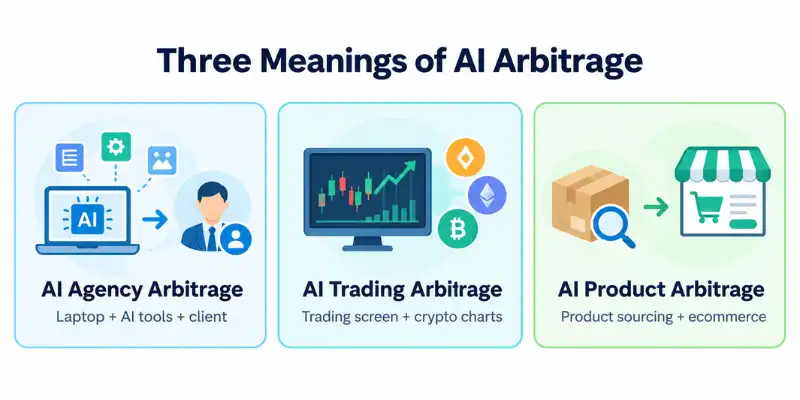
The Three Meanings of AI Arbitrage
| AI agency (service) arbitrage | AI trading arbitrage | AI product arbitrage | |
| What you do | Use AI tools to deliver services such as content, support, or lead research | Use software to trade price differences on the same asset across markets | Use sourcing software to find products cheaper at retailers than their resale price |
| Where profit comes from | The margin between your costs and what clients pay | Tiny price gaps multiplied by trading volume | Resale price minus purchase price, fees, and shipping |
| Main risk | Weak quality, client churn, heavy competition | Fees, slippage, faster rivals, scams | Wrong product matches, restricted brands, unsold inventory |
| What you need to start | Tool subscriptions, a niche, and a way to find clients | Capital on more than one venue and technical setup | Money for inventory and a seller account |
AI agency (service) arbitrage
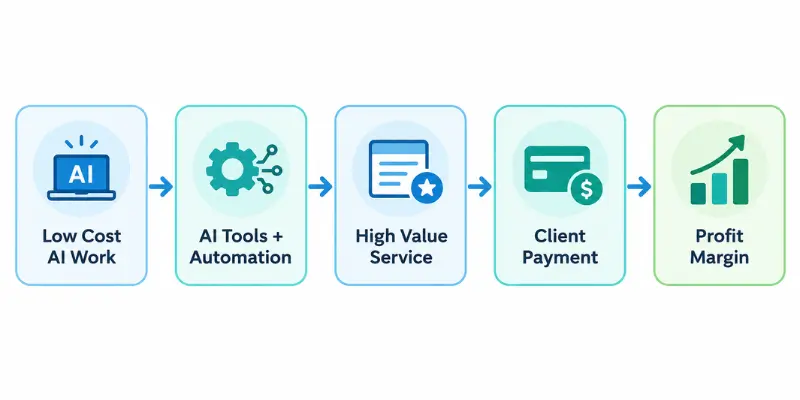
This is the version most people mean today, especially when they search for an AI arbitrage business or AI arbitrage agency. You use AI tools to produce marketing content, support replies, reports, or lead lists, then sell the finished result to businesses. The client pays for the outcome. Your costs are software plus the time you spend directing and checking the AI’s work. The “arbitrage” is the margin in between.
AI trading arbitrage
Here, software looks for price differences on the same asset across exchanges or trading pairs and trades both sides quickly. Crypto is the most common setting. The gaps are usually tiny and short-lived, so speed, fees, and capital matter more than the AI itself. It’s the hardest version for beginners, and the one scammers imitate most.
AI product arbitrage
Sellers use AI-assisted sourcing software to match products on retailer sites with marketplace listings such as Amazon, estimate profit after fees, and flag deals worth buying. You buy real inventory and carry the risk that it doesn’t sell. The software saves search time. It doesn’t tell you whether a product match is correct or whether you’re allowed to sell the brand.
In practice, it runs in three steps. The software gathers prices, fees, seller counts, sales rank, and price history for matching products. It then flags items where the resale price still leaves a profit after marketplace fees, shipping, and prep. You confirm the rest: that the match is exact (same size, colour, and pack count), that the price is stable, and that you’re allowed to sell the brand. Because many sellers use the same tools, easy deals disappear fast.
How AI Arbitrage Works in Practice
The agency version of AI arbitrage is the one most newcomers can realistically start, so here’s an illustrative example. The numbers are made up to show the logic. They aren’t real results.
Say you sell a local dental clinic a monthly package of 12 social posts and 4 email newsletters for $500. AI tools cost you about $60 a month across your clients, and you spend about 5 hours editing, fact-checking, and scheduling. If you value your time at $30 an hour, your cost is $60 plus $150, so $210. The gap is $290.
Two things stand out. First, the gap is real but small per client, so the business depends on repeating the workflow across several clients without quality slipping. Second, your highest cost isn’t software. It’s your time, plus the unpaid hours spent finding clients, handling revisions, and replacing the ones who leave. Anyone quoting AI arbitrage margins that ignore those costs is showing half the picture.
Agencies in this model usually price by outcome instead of by the hour because hourly billing shrinks revenue as work gets faster. A client who pays for “12 approved posts a month” doesn’t care that a draft took ten minutes, as long as the posts are good.
What Can You Sell With AI Arbitrage?
AI doesn’t create new kinds of services. It changes how existing ones get delivered, and that’s where the margin comes from. Common agency offers include:
- Content and creative work: blog and social posts, ad copy variations, and video scripts.
- Lead generation: outreach drafts such as AI email marketing sequences, plus lead research and sorting, with a person approving what goes out.
- Customer support: drafted replies, help-centre articles, ticket sorting, and an AI chatbot for common questions.
- Business operations: weekly reports, internal documentation, and CRM follow-ups.
- AI setup and training: helping a business pick tools, set rules for using them, and train staff, often as an ongoing retainer.
Most agencies package these as fixed offers instead of open-ended hours. Common structures are a monthly retainer tied to a defined outcome, tiered packages with clear deliverables, a one-time setup fee plus monthly upkeep, or a base fee with a performance bonus. Clear scope protects your margin when a client asks for extras.
What Is AI Arbitrage Trading?
AI arbitrage trading uses software, sometimes with machine learning, to find and trade price differences for the same asset across markets or trading pairs. The three common forms are:
- Cross-exchange arbitrage: buy on the exchange where an asset is cheaper and sell where it’s more expensive.
- Triangular arbitrage: move through three trading pairs on one exchange (for example, USDT to BTC to ETH and back) when the three prices briefly disagree.
- Statistical arbitrage: trade assets whose prices generally move together when the gap between them stretches.
Fees decide whether any of this pays. For example, if you pay 0.05% in fees on each side of a trade, the price gap must exceed 0.10% before you break even, and that’s before slippage (the price moving while your order fills) and transfer costs. Large trading firms chase the same gaps with faster connections and lower fees, so the gaps that last long enough for a hobbyist bot to catch tend to be thin. Independent data on how many retail arbitrage bots turn a profit is hard to find, so treat any percentage in marketing material with suspicion.
AI helps in three places: it scans more markets than a person can watch, judges which price gaps are real and which come from stale data, and sizes trades to the liquidity that’s actually available. It can’t lower your fees, remove slippage, or create gaps that aren’t there.
One filter helps with any AI arbitrage trading pitch. In a legitimate setup, a bot connects to your own exchange account through API keys limited to trading, so it can’t withdraw your funds. If a platform asks you to deposit money with them and promises daily returns, that isn’t arbitrage. It fits the pattern regulators warn about, covered below.
Does AI Arbitrage Really Work?
It depends on what you mean by “work” and which model you’re using.
- Agency model: it works when you sell a real outcome to real clients and review the AI’s output before it reaches them. It stops working when you sell generic output that clients could get from the same tools. The AI isn’t a secret, so your edge is niche knowledge, quality control, and sales.
- Trading: it works for well-funded, technically skilled operators with low fees. For most individuals, fees, slippage, and competition leave little room.
- Product resale: it works when you verify every lead yourself. More sellers use the same sourcing tools, so easy deals get crowded, and margins tighten.
- “Automated income” promises: these don’t hold up. The FTC has taken action against several schemes that sold AI-powered passive income (details below).
So the honest answer is that AI arbitrage works in some forms, for people who treat it as a business with costs, clients, and risk. It doesn’t work with the click of a button.
How Can You Make Money With AI Arbitrage?
For most people, the agency model is the most realistic way to start AI arbitrage because it needs little capital. Here’s a practical order of steps—none of this guarantees income.
- Pick one niche and one problem. “Social posts for dental clinics” or “weekly reports for online stores” are easier to sell than “AI services for everyone.”
- Find where AI genuinely saves time. Common candidates include first drafts, summaries, data cleanup, support replies, and lead research, and AI writing tools cover the writing side. If the output needs heavy rework, your margin disappears.
- Build a repeatable workflow. Collect each client’s brand voice, examples of good work, and a list of things never to say, then write down your prompts, your review checklist, and your delivery format. Once the manual version works, AI automation and no-code AI agents can connect the steps.
- Keep a human in the loop. Check facts, tone, and anything legal or financial before it reaches a client.
- Package a fixed outcome. Define what’s included, how many revisions you allow, and the turnaround time. Clear scope protects your margin.
- Price the outcome, then calculate your real margin. Include software, your time, and your unpaid sales hours.
- Land one paying client first. Outreach, referrals, and freelance platforms can all work for a first project, and AI tools can speed up delivery.
- Track time saved, client revisions, and results, then adjust the workflow.
Two cautions. First, copyright: the US Copyright Office’s January 2025 report says work generated entirely by AI isn’t protected, and that prompting alone doesn’t count as human authorship, while human selection, arrangement, or edits can qualify (see the Copyright Office’s announcement of its report). Ask a lawyer how to handle ownership in client contracts. Second, don’t paste confidential client data into a tool until you understand how it stores and uses it.
Other ways to make money with AI don’t follow this model.
RELATED POSTS
How to Make Money With AI (Complete Beginner Guide)
Is AI Arbitrage Passive Income?
Not fully. You can automate drafting, scheduling, and reporting, but the business can’t run itself. Clients still need to be found, output still needs checking, and tools change. Setups sold as hands-off, such as AI-run blogs, video channels, or online stores, still need someone to choose the niche, review quality, and fix what breaks. Work gets lighter once your workflow is stable, but “passive” overstates it, and passive-income promises are exactly what regulators have targeted (see the scam section below).
Can I Make Money From Arbitrage?
Yes. Arbitrage is a long-established, generally legal way to earn money, and it exists wherever the same thing sells at different prices. Whether you make money depends on three things: the gap after all costs, how many people are chasing it, and how fast you can act.
Gaps close as more people pile in. That’s why AI arbitrage margins in crowded niches keep shrinking. Legal trouble usually comes from fraud, breaking a marketplace’s rules, or trading on illegal information, not from the arbitrage itself.
Is AI Arbitrage Legit or a Scam?
The idea behind AI arbitrage is legit. Plenty of the offers built on it aren’t. Keep the concept and the pitch separate.
Regulators have been specific about this. In January 2024, the CFTC issued a customer advisory warning that scammers use AI trading bots and crypto arbitrage algorithms to promise huge returns. It said claims of high or guaranteed returns are red flags and that AI can’t predict the future or sudden market changes.
The FTC has also acted against AI-linked income schemes (see the FTC’s business opportunity cases). A court temporarily halted Click Profit after the FTC alleged it promised “passive income” through an AI-powered system, and in August 2025 the FTC announced a proposed settlement that would permanently ban its owners from the industry. The FTC also sued FBA Machine over alleged guaranteed earnings from AI-powered online storefronts. The case summary puts consumer losses at over $15.9 million, and the owner agreed in July 2025 to a permanent ban from selling business opportunities. The FTC also sued Air AI over alleged deceptive claims about earnings and refund guarantees, and in March 2026 it announced a proposed settlement that would ban the company from marketing business opportunities.
Red flags to watch for in any AI arbitrage offer:
- Guaranteed, fixed, or “risk-free” returns
- A requirement to deposit money on their platform
- Income screenshots instead of verifiable client results or account statements
- Pressure to recruit others or buy a higher tier
- “Done for you” or fully passive claims
- Vague refund terms, or refunds that depend on conditions you can’t control
- No named business, verifiable address, or track record
How to read AI arbitrage reviews and Reddit discussions
Useful reviews describe specifics: what was bought, what happened, and how long it took. Be careful when reviews appear only on the seller’s own site, or when the reviewer earns a commission from the registration URL. Forum posts can surface firsthand complaints, but a single comment isn’t proof in either direction. Search the company name with the word “complaints” and look for the same issue repeating across independent sources.
Should you pay for an AI arbitrage course?
Maybe, but ask first:
- Can the instructor show verifiable client work or account records beyond screenshots?
- Is the curriculum specific (workflows, templates, sales scripts) or mostly motivation?
- Are the refund terms in writing, and could you realistically use them?
- Are you buying skills, or a “business opportunity” with an income promise attached?
Many of the skills involved, such as prompt workflows, client outreach, and pricing, you can learn from free material. A course that guarantees results is making a claim, and that claim deserves the same evidence standard as any other.

AI Arbitrage Salary and Income: What’s Realistic?
“AI arbitrage” isn’t a standard job title, so there’s no reliable salary figure to quote. An agency owner earns profit, which is revenue minus tools, contractors, taxes, and unpaid time, and it can be close to zero in the first months. A trader’s results depend on capital and costs. People who build arbitrage systems for trading firms are paid on standard engineering and finance pay scales, which isn’t what most searchers expect.
To estimate your own potential, use this formula:
(clients x monthly price) – (software + contractors + your hours x your hourly rate) = monthly profit
Run it with conservative numbers and include the hours you spend finding clients. If it only works with optimistic assumptions, the business doesn’t work yet.
Is There an AI Arbitrage App or Software?
There’s no single AI arbitrage app. What you need depends on the model. Agencies typically use general AI assistants, writing tools, and automation platforms. Trading setups use a bot or framework that connects to exchanges through API keys. Product resellers use sourcing and price-history tools. An app that guarantees automatic profits in exchange for a deposit fits the scam pattern described above.
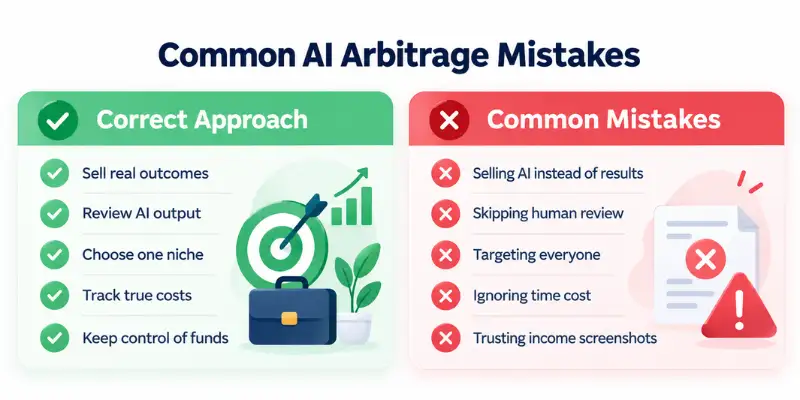
Common AI Arbitrage Mistakes
- Selling “AI” instead of an outcome. Clients buy results, not tools.
- Skipping human review. AI can state wrong facts with confidence, and one embarrassing error can cost you the client.
- Targeting everyone. A broad offer is hard to explain and easy to ignore.
- Counting software costs but not your time. Time is usually the higher cost.
- Trusting income screenshots. They show a number, not a business.
- Sending money to a platform you don’t control. Keep custody of your own funds.
- Scaling before the workflow is stable. More clients magnify a weak process.
- Relying on one tool. If a tool changes its pricing, limits, or access, your delivery can stall, so keep a backup option.
The Bottom Line on AI Arbitrage
AI arbitrage isn’t one thing, so start by deciding which one you mean. If you want something you can begin with little capital, the agency model is the realistic option: choose a narrow niche, build a workflow you trust, sell a defined outcome, and work out your real margin. If the opportunity in front of you involves depositing money with a platform that guarantees steady returns, walk away. The idea is sound. The pitch is where most of the risk sits.
A useful first step this week, write down one niche, one problem an AI arbitrage service could solve, and what you’d charge. If you can’t explain why someone would pay for it, no tool will fix that.
FAQs
It means using AI to profit from a gap between cost and price. Usually, that means using AI tools to deliver a service for less than you charge.
Generally, yes. Arbitrage itself is legal. Fraud that borrows the name isn’t, and marketplaces and exchanges have their own rules you need to follow.
Yes, with the agency model, which needs little capital but does need client-finding and quality control. Trading is harder to enter safely.
It depends on the model. An agency needs tool subscriptions and your time. Trading needs capital on at least two venues so you can act before a gap closes. Product resale needs inventory money plus seller fees. Start small and risk only what you can afford to lose.
Not really. You can automate parts of the work, but you still need clients, quality control, and upkeep.
No. Crypto arbitrage is one setting for the trading version. The agency and product versions have nothing to do with crypto.
It can be, but easy margins are shrinking because more people use the same tools. Profit tends to come from a narrow niche, careful quality control, and honest cost tracking, not from the tools themselves.
A bot connected through API keys that allow only trading can’t withdraw money because exchanges let you set permissions separately. Keep withdrawal permission off and revoke keys you stop using. The real risk is a platform that holds your deposit, since no API setting protects money you’ve already sent them.






- Be Respectful
- Stay Relevant
- Stay Positive
- True Feedback
- Encourage Discussion
- Avoid Spamming
- No Fake News
- Don't Copy-Paste
- No Personal Attacks
- Be Respectful
- Stay Relevant
- Stay Positive
- True Feedback
- Encourage Discussion
- Avoid Spamming
- No Fake News
- Don't Copy-Paste
- No Personal Attacks
