AI in Procurement: How It Works, Why It Matters and What It Can Do for Your Business
Published: 11 Jun 2026
Procurement teams are under more pressure than ever. They are expected to cut costs, reduce supplier risk, avoid compliance issues, and make faster decisions all at the same time.
But here is the honest reality: many procurement teams still rely on spreadsheets, manual approvals, and inbox-based supplier communication. That creates delays, errors, and blind spots that cost businesses real money.
This is exactly where AI in procurement changes things. Not in a vague, theoretical way but in practical, measurable ways that companies like Amazon, Siemens, Walmart, and Coca-Cola are already using today.
This article breaks down what AI in procurement actually is, how it works, which technologies matter, and what you need to know before your team starts using it
What Is AI in Procurement?
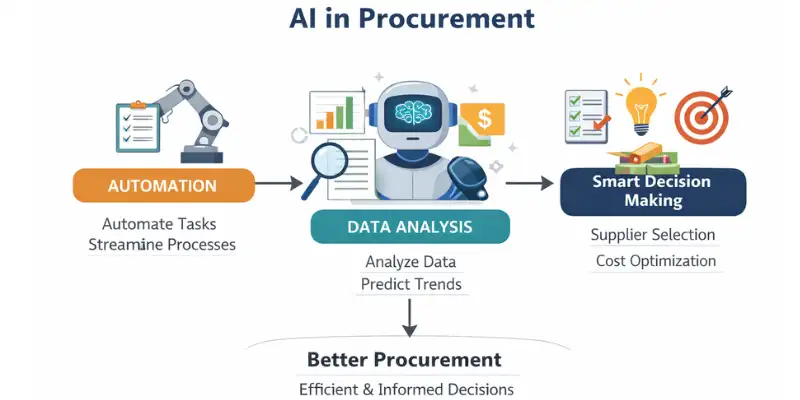
AI in procurement refers to using artificial intelligence technologies such as machine learning, natural language processing, and generative AI to automate, improve, and speed up the purchasing process inside an organization.
In simple terms, it means letting AI handle the routine, data-heavy, or error-prone parts of procurement so that your team can focus on strategy, relationships, and decisions that actually need a human.
Procurement involves a lot of moving parts: finding suppliers, evaluating their performance, negotiating contracts, processing orders, managing invoices, and monitoring risk. These tasks generate enormous amounts of data and AI is built to work with that kind of volume.
The IBM Institute for Business Value found that 59% of Chief Procurement Officers believe applying AI in procurement to predictive spending and sourcing analytics is now important for their organizations. That number is growing fast.
Core Applications of AI in Procurement
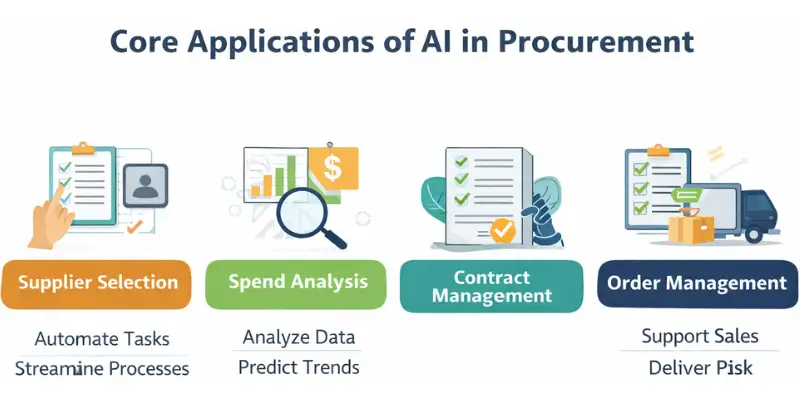
AI in procurement has several key applications:
- Supplier Selection: AI helps find the best suppliers by analyzing their performance, pricing, and reliability.
- Spend Analysis: It evaluates company spending and identifies areas to save costs.
- Contract Management: AI tools can automatically review contracts, ensuring compliance and detecting any issues.
- Order Management: AI tracks orders and delivery schedules, improving inventory management and reducing errors.
Why AI in Procurement Is Getting Serious Attention in 2026
A few years ago, AI in procurement was mostly discussed at industry conferences. In 2026, it is being implemented.
Here is what has changed:
AI tools are now affordable and accessible. Platforms like SAP, Coupa, Ivalua, and IBM watsonx Orchestrate have built AI directly into procurement workflows. You do not need a data science team to benefit from them.
Data volumes have gotten too large for manual handling. A mid-sized business might process thousands of invoices, supplier communications, and purchase orders every month. No team can manually catch every anomaly or optimization opportunity in that volume.
Supplier risk has become more complex. Global supply chains face geopolitical disruptions, climate events, and compliance changes faster than traditional monitoring can track.
Generative AI has made conversational procurement possible. Teams can now ask questions in plain language, get contract summaries instantly, and generate purchase orders automatically.
The result: AI in procurement has shifted from a nice-to-have to a real operational advantage.
Understanding how AI works at a foundational level helps teams evaluate these tools more clearly before committing to a platform.
How AI in Procurement Actually Works
AI in procurement does not replace your procurement team. It gives them better tools.
Here is a straightforward breakdown of how AI fits into each part of the procurement process:
Supplier Selection
AI analyzes supplier databases, historical performance data, pricing patterns, and delivery records to help procurement teams identify the best suppliers for each need. Instead of manually reviewing spreadsheets, teams get ranked recommendations based on actual data.
Spend Analysis
AI tools process all purchasing data across departments and categories to identify where money is going and where it is being wasted. This includes flagging duplicate purchases, identifying off-contract spending, and finding categories where better negotiation is possible.
Contract Management
AI reads and analyzes contracts automatically. It extracts key terms, flags unusual clauses, identifies compliance risks, and tracks renewal dates work that previously took legal or procurement teams hours per contract.
Purchase Order Processing
AI-powered systems extract information from purchase orders, validate them against approved vendors and pricing, and process them without manual data entry. This reduces errors and speeds up cycle times significantly.
Invoice Processing and Accounts Payable
This is one of the most common starting points for AI in procurement because the ROI is immediate and measurable. AI matches invoices to purchase orders automatically, catches discrepancies, and routes exceptions for human review only when needed.
Supplier Risk Management
AI monitors supplier data continuously, financial health, delivery performance, news mentions, compliance records, and geopolitical exposure and alerts procurement teams before small problems become supply chain disruptions.
Demand Forecasting
By analyzing historical purchasing patterns alongside external signals like market trends, seasonal demand, and economic indicators, AI in procurement helps teams anticipate what they will need and when reducing both stockouts and over-ordering.
Key AI Technologies in Procurement
AI in procurement uses different technologies to make the buying process faster and smarter. These technologies help businesses save time, money, and make better decisions. Let’s look at some of the key technologies in AI procurement.
Machine Learning in Procurement
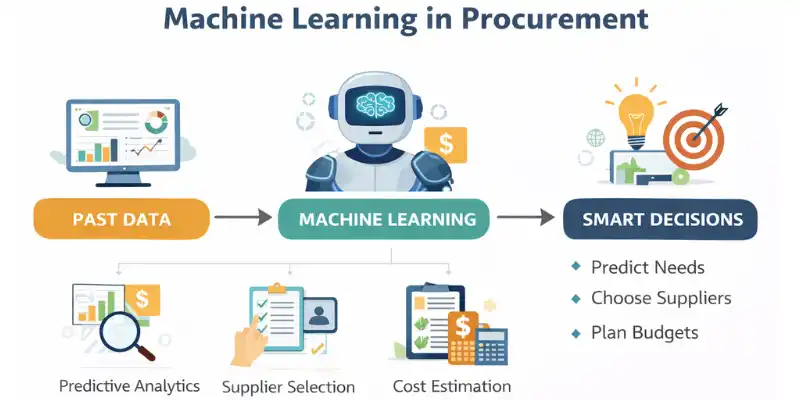
Machine learning teaches systems to recognize patterns in data and improve their predictions over time. In AI in procurement, ML does the heavy lifting behind demand forecasting, supplier scoring, spend categorization, and anomaly detection.
For example, an ML model trained on three years of purchasing data can predict which product categories are likely to see price increases next quarter giving your team time to lock in favorable contracts.
Machine learning does not need to be programmed with rules. It finds the patterns in your data and applies them automatically. This makes it especially powerful for procurement teams with large, complex spending histories.
Natural Language Processing in Procurement
Natural language processing (NLP) allows AI systems to read, interpret, and generate human language. In AI in procurement, NLP is what makes contract analysis, chatbot-based supplier communication, and document extraction actually work.
When an AI tool reads a 40-page supplier contract and extracts all payment terms, penalty clauses, and renewal conditions in seconds, NLP is doing that work. The same technology powers virtual assistants similar to how modern AI chatbot tools handle natural language queries that let procurement staff ask questions in plain English and get structured answers immediately.
Deep Learning and Document Processing
Deep learning extends ML pattern recognition into more complex data types including scanned documents, handwritten invoices, and unstructured email content. For procurement teams that still receive paper-based or image-format documents, deep learning makes those documents processable by AI.
Getting clean, structured training data is a critical step before any AI in procurement system can perform well.
Generative AI in Procurement
Generative AI has changed what is possible in AI in procurement more than any other development in the past three years.
Where traditional AI analyzes existing data, generative AI creates new content based on patterns it has learned. In procurement, this means:
Creating first drafts of purchase orders based on requested items and approved supplier lists Summarizing lengthy contracts or RFPs into plain-language briefings Generating supplier evaluation reports from raw performance data Suggesting negotiation strategies based on historical deal terms Answering sourcing questions in natural language without requiring database queries
A recent IBM IBV report found that 77% of Chief Supply Chain Officers and Chief Operating Officers believe generative AI can identify potential geopolitical and climate risks and recommend proactive risk mitigation.Agentic AI the next step beyond generative AI takes this further. AI agents in enterprise workflows are now being applied to procurement specifically, allowing systems to take autonomous actions: scheduling supplier reviews, triggering reorders when inventory falls below thresholds, and routing contract approvals without human initiation for routine tasks.
Real-World AI in Procurement — What Companies Are Actually Doing
These are not hypothetical examples. These are documented uses of AI in procurement from organizations operating at scale.
Amazon
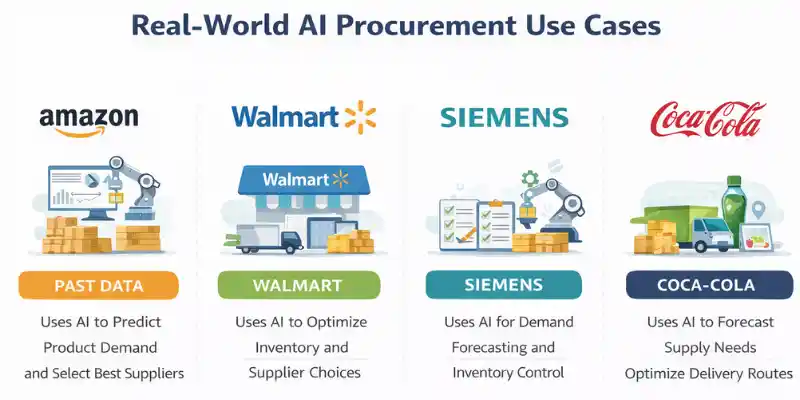
Amazon uses AI in procurement to forecast demand at a product and regional level. Their AI systems predict what inventory will be needed at which fulfillment centers, when to reorder, and which suppliers can best meet those needs given current performance data. The result is a procurement operation that adjusts continuously rather than relying on periodic manual reviews.
Walmart
Walmart applies AI in procurement and supplier management across thousands of product categories simultaneously. Their systems monitor supplier performance, flag delivery delays before they affect store shelves, and adjust sourcing decisions in near real-time based on customer purchasing patterns.
Siemens
Siemens uses AI in procurement to manage demand forecasting, inventory control, and supplier evaluation across a complex global supply chain. Their AI tools help prevent over-purchasing by aligning procurement decisions with production needs more precisely than manual methods allow.
Coca-Cola
Coca-Cola uses AI in procurement to predict ingredient and packaging demand, identify the best suppliers for each regional need, and optimize delivery routes to reduce procurement-related logistics costs. AI allows their procurement team to respond to supply disruptions faster and with more confidence.
These examples share a common thread: AI in procurement is not replacing strategic thinking. It is removing the data bottlenecks that slow it down.
Many organizations also approach this as part of a broader outsourcing and vendor management strategy.
Benefits of AI in Procurement — What Changes in Practice
The benefits of AI in procurement show up in specific, measurable ways. Here is what organizations typically experience after implementation:
Faster Processing Times
Tasks that take procurement teams hours or days — invoice processing, contract review, supplier evaluation — take seconds with AI. Cycle times across the procurement process shorten significantly.
Reduced Costs
AI in procurement identifies off-contract spending, flags duplicate purchases, surfaces better supplier options, and improves demand forecasting accuracy all of which reduce unnecessary procurement spend. Most organizations report cost savings within the first year of implementation. For teams interested in how AI-driven cost reduction connects to broader business profitability, understanding how to make money with AI covers relevant ground.
Fewer Errors
Manual data entry is one of the biggest sources of procurement errors. AI-powered invoice processing and order management eliminate most manual entry, reducing the mistake rate to near zero for routine transactions.
Better Supplier Decisions
AI in procurement provides teams with a complete, continuously updated picture of supplier performance, risk exposure, and market positioning. Decisions that used to rely on incomplete data and intuition become data-driven.
Earlier Risk Detection
AI monitors supplier financial health, delivery performance, and external risk signals continuously. Problems that used to surface as supply disruptions get flagged weeks earlier giving teams time to act.
More Strategic Focus for Your Team
When AI in procurement handles invoice matching, spend categorization, and routine supplier communication, procurement professionals can spend more time on negotiation, relationship management, and strategic sourcing decisions that create real value.
This shift is part of a broader pattern of how AI is changing the workforce across industries.
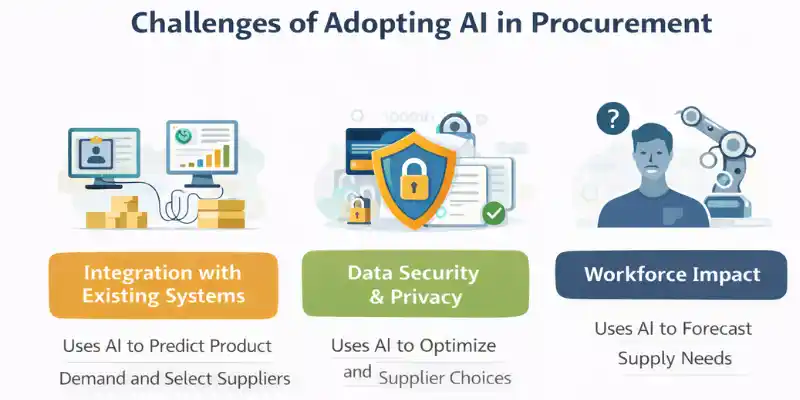
The Challenges — What to Expect When Implementing AI in Procurement
AI in procurement delivers real benefits, but implementation comes with genuine challenges. Being honest about them helps organizations plan better.
Integration with Existing Systems
Most procurement teams work with legacy ERP systems, established supplier portals, and departmental tools that were not built with AI integration in mind. Connecting AI tools to these systems requires technical work, time, and often specialized expertise. This is the most commonly underestimated challenge in AI in procurement projects.
Data Quality
AI is only as good as the data it learns from. If your procurement data is inconsistently categorized, incomplete, or spread across siloed systems, your AI implementation will reflect those problems. Before deploying AI in procurement, most organizations need to invest in data cleaning and standardization.
Data Security and Privacy
Procurement data includes sensitive supplier pricing, contract terms, and financial information. AI systems that process this data need strong security infrastructure. Organizations in regulated industries face additional compliance requirements around how procurement data is stored and processed, and strong data security practices should be established before AI deployment begins.
Change Management
Procurement teams are often skeptical of AI in procurement, particularly when it changes familiar workflows. Successful implementation requires training, clear communication about what the AI does and does not do, and visible leadership support. Without this, adoption rates stay low and ROI suffers.
Cost of Implementation
Enterprise AI procurement platforms represent significant investments. Organizations need to evaluate ROI carefully identifying which use cases will deliver the fastest and most measurable returns before committing to broad deployment.
The role of a Chief AI Officer is increasingly relevant here, as organizations need senior leadership specifically accountable for AI adoption decisions, including in procurement.
How to Start with AI in Procurement — A Practical Approach
For organizations that want to move beyond discussion and into implementation, a staged approach tends to work better than trying to transform everything at once.
Start with invoice processing or spend analysis. These are high-volume, repetitive, data-heavy tasks where AI in procurement delivers immediate, measurable results with relatively low integration complexity. The ROI is fast and visible.
Use quick wins to build internal support. When your team sees AI processing 1,000 invoices in the time it used to take to process 50, skepticism typically decreases. Early wins create organizational momentum for broader AI in procurement rollout.
Expand to supplier risk management and demand forecasting once the data foundation is clean. These use cases deliver the most strategic value but require better data quality and deeper system integration.
Evaluate generative AI and agentic AI capabilities as your team’s confidence and data maturity grows. No-code AI agents are making it increasingly practical for procurement teams to deploy AI-powered workflows without needing a dedicated development team.
Having a clear AI strategy in place before starting helps ensure that AI in procurement investments connect to broader business objectives rather than becoming isolated tool deployments.
AI in Procurement vs Traditional Procurement — What Actually Changes
Supplier Evaluation Traditional procurement: Manual review of past orders and reputation AI in procurement: Continuous, data-driven scoring across multiple performance dimensions
Spend Analysis Traditional procurement: Periodic manual reports AI in procurement: Real-time, automated categorization and anomaly detection
Contract Review Traditional procurement: Manual reading by legal or procurement staff AI in procurement: Automated extraction of key terms, risks, and renewal dates
Demand Forecasting Traditional procurement: Historical averages and manual estimation AI in procurement: ML-powered forecasting incorporating multiple internal and external data signals
Invoice Processing Traditional procurement: Manual data entry and matching AI in procurement: Automated matching with exception-based human review
Risk Monitoring Traditional procurement: Reactive problems surface as disruptions AI in procurement: Proactive AI flags early warning signals before disruptions occur
What’s Coming Next for AI in Procurement
The trajectory for AI in procurement is clear, and the pace of change is accelerating.
Agentic AI will take autonomous action. Rather than just providing recommendations, AI agents will execute approved procurement actions triggering purchase orders, initiating supplier outreach, escalating risk alerts without requiring human initiation for routine tasks.
Sustainability tracking will become standard. Chief supply chain officers and chief operating officers see major opportunities in using AI in procurement for sustainability and compliance across procurement ecosystems. AI tools that automatically assess supplier carbon footprints, compliance with environmental standards, and ESG performance will become standard.
Predictive procurement will get more precise. As AI models accumulate more data across more organizations and supply chains, their forecasting accuracy will improve significantly making AI in procurement less reactive and more anticipatory.
AI in procurement and HR operations are increasingly connected.] As organizations automate procurement workflows, the workforce strategy behind those changes including retraining and role evolution often falls to HR to manage.
AI and humans will work together more fluidly. The vision is not AI replacing procurement professionals. It is AI handling the volume and routine so that procurement teams can focus on the decisions, relationships, and negotiations where human judgment creates the most value.The connection between AI in procurement and broader operational systems is also growing. AI and IoT integration is becoming increasingly relevant for organizations managing physical inventory and supply chain infrastructure where connected sensors feed real-time data directly into AI-powered procurement decisions.
Conclusion
AI in procurement is not a distant promise. It is already delivering measurable results for organizations that have implemented it thoughtfully.
The practical benefits of faster processing, fewer errors, better supplier decisions, earlier risk detection are real and documented. The challenges around integration, data quality, and change management are also real and worth planning for.
The organizations getting the most from AI in procurement right now are not the ones that deployed AI everywhere at once. They are the ones that started with a specific, high-volume problem, demonstrated clear results, and then expanded from a position of confidence.
If your team is still spending significant time on invoice matching, manual spend reports, or reactive supplier risk management, those are strong signals that AI in procurement can help and that starting the conversation now makes sense.
Faqs
AI in procurement refers to the use of artificial intelligence technologies including machine learning, natural language processing, and generative AI to automate, improve, and accelerate procurement tasks such as supplier selection, spend analysis, contract management, invoice processing, and risk monitoring.
AI in procurement helps by automating repetitive tasks, analyzing large volumes of data faster than humans can, improving demand forecasting accuracy, detecting supplier risks earlier, reducing invoice processing errors, and giving teams better information for negotiation and sourcing decisions.
The main technologies are machine learning for pattern recognition and forecasting, natural language processing for contract analysis and document processing, robotic process automation for repetitive task automation, deep learning for complex document processing, and generative AI for content creation, summarization, and conversational interaction.
Amazon uses AI in procurement for demand forecasting and supplier selection. Walmart uses it to monitor supplier performance and adjust sourcing decisions in real time. Siemens uses AI for inventory control and demand alignment. Coca-Cola uses AI in procurement to optimize ingredient sourcing and delivery logistics.
The main challenges are integrating AI with legacy procurement systems, ensuring data quality before deployment, managing data security and privacy, handling organizational change management, and evaluating ROI before committing to enterprise implementation.
No — AI in procurement is automating routine and data-heavy tasks, not strategic judgment. Most organizations find that their teams shift toward higher-value work: supplier relationship management, strategic sourcing, and negotiation. AI handles volume. Humans handle strategy
s handle strategy.
How do I start with AI in procurement? Most organizations start with invoice processing or spend analysis — high-volume tasks where AI in procurement delivers fast, measurable results. Once those are working, they expand to supplier risk management and demand forecasting, then evaluate more advanced generative and agentic AI capabilities.
Generative AI in procurement refers to AI tools that create new content such as purchase order drafts, contract summaries, supplier evaluation reports, and sourcing recommendations based on patterns learned from existing data. It also enables conversational interfaces that let procurement teams ask questions in plain language and get structured answers.



- Be Respectful
- Stay Relevant
- Stay Positive
- True Feedback
- Encourage Discussion
- Avoid Spamming
- No Fake News
- Don't Copy-Paste
- No Personal Attacks
- Be Respectful
- Stay Relevant
- Stay Positive
- True Feedback
- Encourage Discussion
- Avoid Spamming
- No Fake News
- Don't Copy-Paste
- No Personal Attacks
