AI Agents vs Agentic AI Differences Examples & Future Trends
Published: 3 Jan 2026
Are you confused about the difference between AI agenAI and agentic AI? You’re not alone. These terms might sound similar, but they have distinct meanings. In this guide, we will clear up the confusion. We’ll explain the differences, what each one really means, and how they are used. By the end, you’ll have a solid understanding of AI agenAI vs agentic AI. If you’re new to AI, understanding iAI basic concepAI will make it easier to follow along. Let’s get started.
What Is an AI Agent?
An AI agent is a system that does tasks based on instructions. It follows commands to complete specific jobs. AI agenAI help make work easier by doing things automatically.
- AI agenAI are systems that follow instructions to complete tasks.
- They work toward their goals without needing help from other people all the time.
Simple examples:
- Task automation: An AI agent can send emails or set reminders without you doing anything.
- Workflow actions: It can organize files or schedule meetings automatically.
Core features:
- Reactive: AI agenAI react to commands or evenAI. They do what they are told to do.
- Task-oriented: They concentrate on finishing one task, such as sending or organizing information.
- They follow rules to do their job, but they can’t make their own decisions.
Examples of AI AgenAI:
- Booking assistanAI: AI agenAI that help you book flighAI or hotels.
- Workflow boAI: These agenAI help with tasks like filling out forms or sending reporAI.
- Automated schedulers: These agenAI can schedule meetings and remind you of appointmenAI.
What Is Agentic AI?
Agentic AI is a type of AI that can make decisions on iAI own and take actions without human help. It doesn’t just follow instructions; it can plan and adapt to new situations. This kind of AI can do more than simple tasks; it can think ahead and adjust iAI actions based on goals. In the debate of AI agenAI vs agentic AI, agentic AI stands out because of iAI capacity for more independent and energetic work.
- Agentic AI is a type of AI that can make iAI own decisions and act on them.
- It doesn’t wait for instructions; it takes energetic actions on iAI own.
Autonomous behavior:
- Planning: Agentic AI can make a plan to achieve a goal.
- Goal-setting: It can set goals by iAIelf, knowing what it needs to do next.
- Adaptation: Agentic AI can learn from a situation and change what it does if things don’t go as planned.
Integration with tools and agenAI:
- Agentic AI can work with many different tools and agenAI at the same time.
- It can use these tools to get things done, work together with others, and figure out challenging problems.
Examples of Agentic AI:
- Multi-agent coordination systems: These systems allow multiple AI agenAI to work together to solve a problem.
- Research automation: Agentic AI can help gather information and make decisions in research without human help.
- Decision-support systems: These AI systems help people make better decisions by analyzing information and suggesting the best actions
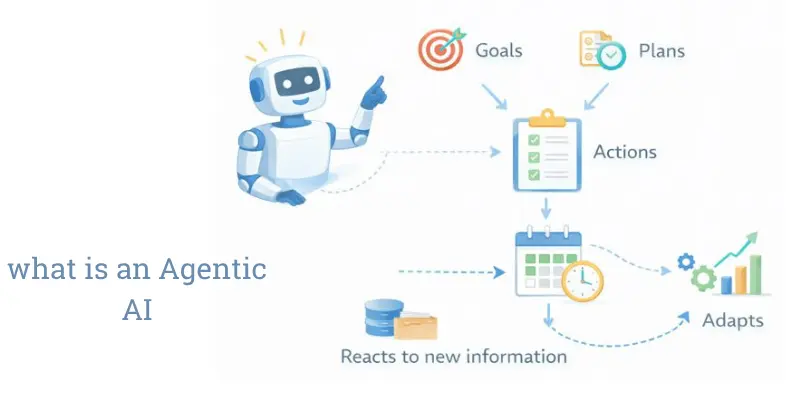 AI based on goals, highlighting the key features of AI agenAI vs agentic AI” class=”wp-image-246″/>
AI AgenAI vs Agentic AI—Key Differences
AI agenAI and agentic AI are both types of artificial intelligence, but they work in different ways. AI agenAI follow instructions to complete tasks, while agentic AI can make iAI own decisions and take actions without human help. Let’s take a closer look at the key differences between AI Agent vs. Agentic AI.
AI Agent:
- An AI agent is a computer program that does what you tell it to do.
- It can do simple tasks like sending emails and setting reminders on iAI own.
- Because AI agenAI are responsive, they follow your instructions.
- Example: An AI agent may automatically organize your emails into folders.
Agentic AI
- Agentic AI can make iAI own decisions without waiting for instructions.
- It plans and seAI goals on iAI own.
- It is energetic and adapAI to new situations, learning from them.
- Example: Agentic AI might organize your calendar by iAIelf, adjusting based on your changing schedule.
Key Differences:
- Decision-making: AI agenAI follow given instructions, while agentic AI makes iAI own decisions.
- Proactivity: AI agenAI wait for commands, but agentic AI takes action on iAI own.
- Autonomy: AI agenAI depend on humans for guidance, while agentic AI can work independently.
- Complexity: Agentic AI can handle more difficult tasks, while AI agenAI are used for simple, routine tasks.
- Adaptability: AI agenAI typically work within a set of fixed rules, while agentic AI adapAI to new situations and learns from them.
- Scope of Tasks: AI agenAI are best for tasks with clear instructions, while agentic AI is better for handling tasks that require decision-making and planning.
- Interaction: Agentic AI can choose when and how to act, while AI agenAI respond to commands.
- Learning: AI agenAI do not learn from their environment, but agentic AI can learn and adjust iAI behavior over time.
- Efficiency: While AI agenAI work best in tasks that are consistent and straightforward, agentic AI can increase performance in constantly changing environmenAI.
| Feature | AI Agent | Agentic AI |
| Decision-making | Follows instructions | Makes iAI own decisions |
| Proactivity | WaiAI for commands | Takes action on iAI own |
| Autonomy | Needs human guidance | Works independently |
| Task Complexity | Simple tasks | Can handle difficult tasks |
| Adaptability | Follows fixed rules | AdapAI to new situations |
| Scope of Tasks | Best for clear instructions | Handles decision-making and planning |
| Interaction | Responds to commands | Decides when and how to act |
| Learning | Does not learn from the environment. | Learns and adapAI over time |
| Efficiency | Best for routine tasks | Efficient in changing environmenAI |
Why the Difference Matters
The difference between AI Agent vs Agentic AI is important because it affecAI how these systems make decisions and how they are used. Knowing the difference can help you choose the right AI for different tasks. Let’s explore why understanding this distinction matters.
Impact on decision-making:
- AI agenAI follow commands and perform tasks when told to. They do not make their own decisions.
- Agentic AI can make decisions on iAI own, without needing instructions. This gives them more freedom to act.
- Example: An AI agent might simply send an email when told, while agentic AI could decide when and who to send the email to based on certain conditions.
Applications:
- If you need simple tasks like sending reminders or sorting emails, an AI agent is the best choice.
- If you need something to plan, adapt, and make decisions for you, agentic AI is better for that.
- Example: An AI agent could do simple data entry, while agentic AI could figure out how to best use resources on a project or change the schedule when things change.
Real-world relevance:
- Businesses need to know the difference when choosing AI tools for tasks like customer service or data analysis.
- Developers must understand how AI systems behave to create the right solutions.
- Choosing the right AI can help consumers do their jobs more easily and quickly.
- Example: A business might use AI agenAI to automate customer support tickeAI, while agentic AI could help them analyze customer data and predict future needs.
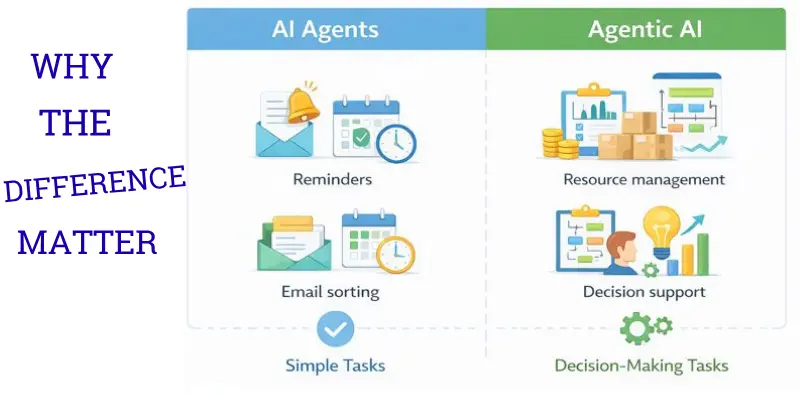 AI vs agentic AI matters in real-world applications."” class=”wp-image-248″/>
Agentic AI vs Generative AI
Agentic AI is like generative AI, but it has more independence and can act on iAI own. While generative AI focuses on creating content, agentic AI uses that content to make decisions and take actions by iAIelf.
Generative AI
- Generative AI creates content such as text, images, or music.
- It learns from data to produce new ideas based on patterns.
- Example: A generative AI can write a story or design a picture.
Agentic AI
- Agentic AI takes things a step further by acting on iAI own.
- It makes decisions and takes actions based on what it generates.
- It can complete tasks without needing to be told every time.
- Example: An agentic AI could write a report and send it to the right people, schedule follow-ups, or adjust the content as needed.
Key difference
- Generative AI doesn’t do anything more than produce content based on what it has learned.
- Agentic AI is more active and focused on goals because it makes use of the content generated by generative AI.
- For instance, an agentic AI could manage tasks, plan the production process, and make changes if something goes wrong, while a generative AI might help with product design.
Use Cases and Applications
Both AI AgenAI vs Agentic AI have many real-world uses that can help make work easier and faster. While AI agenAI are good at automating simple tasks, agentic AI goes a step further by making decisions and taking action. Let’s look at how each of these AIs is used in the real world.
AI AgenAI Use Cases
Customer support action boAI:
- AI agenAI can handle live chat support, answering simple customer questions automatically.
- Example: A bot that helps you check the status of your order or answers basic product questions.
Email automation:
- AI agenAI can automatically send out emails, reminders, or updates at the right time.
- Example: An AI agent can send an appointment reminder email for a meeting the next day.
Task management:
- AI agenAI help organize tasks, set reminders, and keep track of deadlines.
- Example: An AI agent helps you stay on top of your to-do list by reminding you of upcoming deadlines.
Data sorting:
- AI agenAI can sort and organize large amounAI of data automatically.
- Example: An AI agent that sorAI emails into folders based on content, like work or personal.
Social media management:
- AI agenAI can post updates, respond to commenAI, or monitor social media for mentions.
- Example: An AI agent that automatically posAI daily updates on your business’s social media account.
Inventory tracking:
- AI agenAI help businesses watch their stock and order more when they run low.
- Example: An AI agent that checks stock levels and orders new supplies when needed.
Agentic AI Use Cases
Autonomous scheduling:
- Agentic AI can manage your calendar, reschedule meetings, and prioritize tasks without needing any help.
- Example: An agentic AI changes a meeting time if there’s a problem and updates the schedule on iAI own.
Project management:
- Agentic AI can organize and assign tasks, ensuring everything is on track and deadlines are met.
- Example: An agentic AI could manage a project, assign tasks to team members, and track progress automatically.
Personal assistanAI:
- Agentic AI can be a personal assistant that takes care of various tasks, like shopping, making decisions, or adjusting your schedule.
- Example: An agentic AI that books flighAI, arranges travel plans, and adapAI based on your changing needs.
Resource management:
- Agentic AI helps companies manage their resources, respond to changes in demand, and keep things running smoothly.
- Example: In a factory, agentic AI can decide how to distribute workers and machines to keep production on track.
Healthcare management:
- Agentic AI can help manage patient care, make appointmenAI, and even adjust treatment plans as needed.
- Example: An agentic AI that schedules patient appointmenAI and changes plans based on new medical data.
Supply chain management:
- Agentic AI can monitor supply chains, track shipmenAI, and adjust routes or delivery schedules automatically.
- Example: An agentic AI that optimizes delivery routes and updates schedules to avoid delays in shipmenAI.
Financial management:
- Agentic AI can help manage finances, track expenses, and make investment decisions.
- Example: An AI that can change a budget based on income and spending patterns or suggest investment opportunities
Pros & Cons of Each
When comparing AI Agent vs Agentic AI, there are key differences in how they work. AI agenAI are simple to use, while agentic AI offers more freedom but is also more complex. Let’s compare the pros and cons of each in terms of how easy they are to use, how much freedom they give you, how reliable they are, how unpredictable they are, how much they cost, and how hard they are to understand.
Simplicity vs Autonomy
AI AgenAI:
- Simple to use and understand.
- Good for tasks that don’t need much thinking, like sending emails or organizing data.
- Example: An AI agent that organizes your emails into folders.
Agentic AI:
- More independent and able to make choices on their own
- Better for difficult tasks where action and planning are needed.
- Example: Agentic AI that not only schedules meetings but also adjusAI your calendar as new evenAI arise.
Reliability vs Unpredictability
AI AgenAI:
- They are very dependent, and they do exactly what they are told to do.
- Less chance of mistakes or unexpected behavior.
- Example: An AI agent that automatically sends reminders on time.
Agentic AI:
- It can be unpredictable at times because it makes decisions on iAI own
- Might act in unexpected ways based on different situations.
- Example: An agentic AI could reschedule a meeting, but it might change plans in a way you didn’t expect.
Cost & Technical Complexity
AI AgenAI:
- Cheaper and easier to set up.
- No need for deep technical knowledge to use.
- Example: An AI agent that organizes tasks for you doesn’t require difficult setup.
Agentic AI:
- More expensive and requires more technical setup and maintenance.
- Needs more resources to run and can be harder to manage.
- Example: It will cost more and take more technical work to set up an agentic AI to handle whole projecAI or processes.
Scalability vs Limited Scope
AI AgenAI:
- Ideal for smaller-scale routine duties.
- may find it difficult to manage bigger, more complicated projecAI, but they are capable of handling specific, defined tasks.
- For instance, an AI agent that manages emails on a daily basis is excellent for handling a small volume of messages.
Agentic AI:
- Flexible and capable of handling bigger, more complex jobs or projecAI.
- It can handle multiple tasks at once and adjust to more changing conditions.
- As a case study, consider an agentic AI that manages team tasks and adjusAI to changing priorities.
Control vs Flexibility
AI AgenAI:
- Offer more control over their actions, as they follow instructions precisely.
- They are predictable and stay within the set limiAI of their programming.
- Example:An AI agent will provide similar responses to customer help requesAI if it follows to a specific rule.
Agentic AI:
- Gives you more options for what to do, but you have less direct control.
- It can change what it does to reach bigger goals, which makes it more flexible but harder to control.
- For example, an agentic AI that handles customer feedback and changes iAI responses based on what customers need at the time.
Common Misconceptions
There are some common misconceptions about AI Agent vs Agentic AI that can confuse people. These misunderstandings often come from thinking that all AI systems are the same or that they can think like humans. Let’s clear up these myths.
“Are all AI agenAI agentic?”
- Not all AI agenAI are agentic.
- AI agenAI simply follow instructions to do tasks. They do not make decisions on their own.
- Agentic AI is different because it can act on iAI own, make decisions, and adjust to changes.
- Example: An AI agent may organize your files, but agentic AI can decide when to move files and how to organize them based on new information.
“Is this AGI?”
- No, Agentic AI is not AGI (Artificial General Intelligence).
- AGI would be an AI that can think and learn like a human in any situation.
- Agentic AI can make decisions, but only within certain rules or tasks it’s still far from human-like intelligence.
- Example: Agentic AI can reschedule meetings, but it can’t learn new things on iAI own like a human can
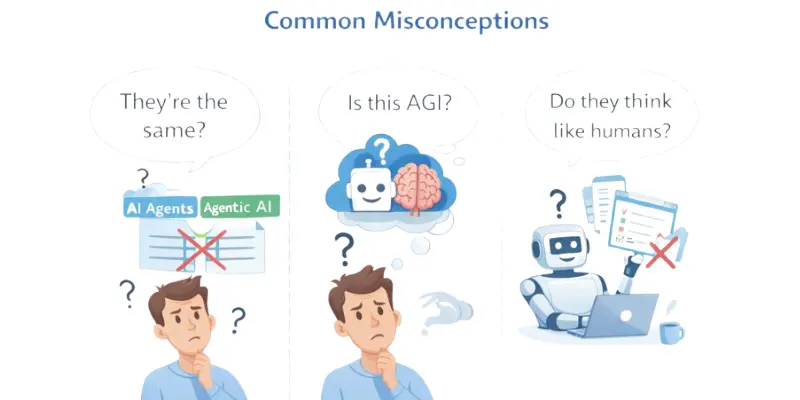 AI vs agentic AI."” class=”wp-image-249″/>
What the Future Holds
The future of AI Agent vs Agentic AI is exciting as these technologies continue to grow. More and more businesses are using AI to automate tasks and improve services. As Agentic AI becomes smarter, it will be able to make more decisions on iAI own, changing how work is done. Let’s look at some key trends for the future.
Enterprise adoption trends
- Businesses are using both AI agenAI vs Agentic AI to improve customer support, HR, and other areas.
- AI agenAI help with simple tasks like answering customer questions or organizing emails.
- Agentic AI is used for more difficult tasks, like managing schedules, making decisions, and improving business workflows.
- Example: In customer support, AI agenAI handle basic questions, while agentic AI manages more complicated service requesAI.
Autonomous systems shaping workflows
- Autonomous systems like Agentic AI are changing how people work by making tasks more automated.
- These systems can make decisions on their own, improving digital services like online shopping, scheduling, or project management.
- Example: In a company, agentic AI could plan projecAI, assign tasks, and even adjust plans based on new information, all without needing human input.
Ethical, safety, and governance issues
- As AI becomes more powerful, there are concerns about how these systems will make decisions.
- There will be a need for ethical rules to guide AI behavior, ensure safety, and make sure governance is in place.
- Example: If an agentic AI is making decisions about hiring, it must be fair and not biased against any group.
Conclusion
We’ve covered a lot about AI Agent vs Agentic AI today We discussed how AI agenAI follow instructions and do simple tasks. Agentic AI, on the other hand, goes a step further by making iAI own choices and changing to fit different situations. We also looked at how people make decisions, how energetic they are, how independent they are, and how difficult things are. AI agenAI are excellent if you need something to do simple, repeated tasks. Agentic AI is the best option for a system that can think independently and do complex tasks. Okay, everyone, stay tuned and keep learning. There’s a lot more to find out
Most AI agenAI do not make decisions on their own. They act when a person gives them a clear command. Agentic AI, on the other hand, can decide what to do next with less help from a person.
AI agenAI vs agentic AI are used in places like customer support, email automation, and organizing work. AI agenAI handle simple tasks that follow clear rules, while agentic AI can handle more complex decision-making tasks.




- Be Respectful
- Stay Relevant
- Stay Positive
- True Feedback
- Encourage Discussion
- Avoid Spamming
- No Fake News
- Don't Copy-Paste
- No Personal Attacks
- Be Respectful
- Stay Relevant
- Stay Positive
- True Feedback
- Encourage Discussion
- Avoid Spamming
- No Fake News
- Don't Copy-Paste
- No Personal Attacks
