The Powerful Role of a Chief AI Officer: A Comprehensive Guide
Published: 29 Dec 2025
Are you interested in what a Chief AI Officer does? You’re not the only one who doesn’t know what this job is all about. It’s still pretty new. This guide will help you understand what a Chief AI Officer does and clear up any confusion you may have. You’ll learn about their main duties, how they fit into a business, and why the job is becoming more important. Let’s explore the core of the matter.
What is a Chief AI Officer (CAIO)?
A Chief AI Officer is a leader in a company who makes sure AI is used in the right way. They help the company use AI to solve problems and improve its business. They make sure that AI works well and is in line with the company’s goals.
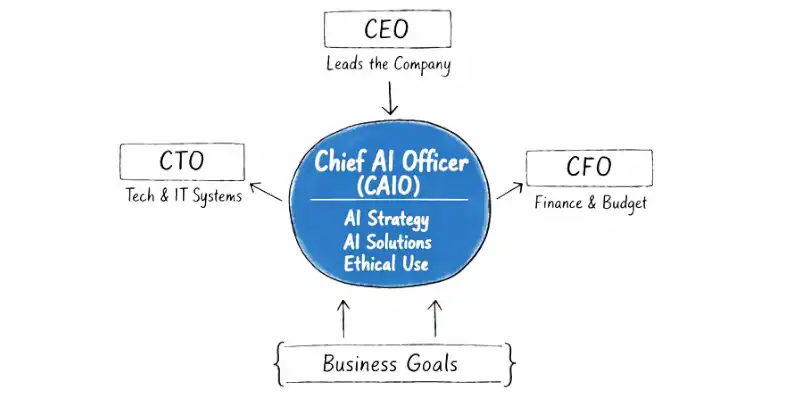
Key Responsibilities of a Chief AI Officer
- Strategy AI plan: The Chief AI Officer makes a plan for how the company will use AI. This helps the business grow and stay ahead of the competition For example, the CAIO might decide to use AI to improve customer service or sell more goods.
- Ensure ethical AI use: Ensure that AI is used in a fair and legal manner: The Chief AI Officer is responsible for ensuring that AI is utilized fairly and legally. This means making sure it doesn’t hurt anyone or make things unfair. For example, they made rules to ensure that AI doesn’t treat one group unfairly when it comes to hiring or promotions.
- Work with Other Teams: The CAIO works with other company leaders, like the CIO and CTO. They all work together to use AI in different parts of the business. For instance, they could work with the marketing team to make ads that are specific to each person using AI.
- Manage AI Talent: They find and train the right people to work with AI. This makes sure that the team knows how to do both professional and business things. For example, the Chief AI Officer helps put together a group of experts who can use AI to make new goods or services.
The Chief AI Officer is crucial for making sure that AI is used to its full potential. They are responsible for encouraging the company to use AI in a smart, fair way that helps everyone.
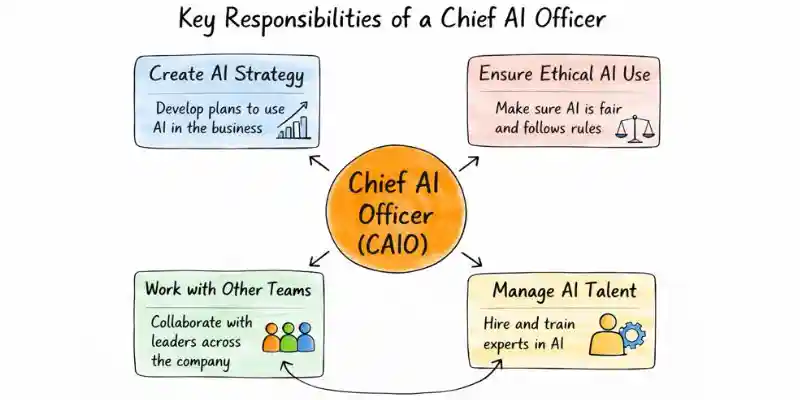
Why Businesses Need a Chief AI Officer (CAIO)
A Chief AI Officer (CAIO) is an important leader who helps businesses use artificial intelligence (AI) in the best ways possible. AI can change how a company works, making it faster, smarter, and more efficient. Here’s why businesses need a CAIO.
Helping the Business Grow
A CAIO helps the business grow by using AI to improve products, services, and customer experience.
- AI helps provide specific suggestions that boost sales.
- AI tools might improve marketing by looking at consumer data.
- Doing the same things over and over again lets businesses focus on being creative and coming up with new ideas.
For example, a retail store’s CAIO uses AI to suggest products to customers based on their needs, which boosts sales.
Staying Competitive
To stay ahead in business, you need AI. A Chief AI Officer makes sure that the company uses the best AI tools to stay ahead of the competition.
- A CAIO keeps the business up-to-date by keeping an eye on AI trends.
- They help use AI in ways that make things work better and faster.
- They look for chances where AI can help.
For example, in the car industry, a CAIO uses AI to speed up the design of cars, which helps the company stay ahead of its competitors.
Using AI Responsibly
People need to use AI in a safe and fair way. A CAIO makes sure that AI tools are safe, accurate, and moral.
- They make sure that AI systems are clear and easy to understand.
- Their main goal is to stop AI from making decisions that are biased.
- They make sure that customer information is safe and secure.
For example, AI in healtAIare makes sure that AI tools used for diagnosis are fair and correct, which keeps patients safe.
Improving Customer Service
AI can help businesses give their customers better and faster support. A CAIO is responsible for using AI to make customer service better.
- AI chatbots can quickly answer questions from customers.
- Virtual assistants can do everyday tasks, which frees up human agents.
- AI lets companies respond right away, which makes their customers happy.
An example of this is a CAIO in e-commerce that uses an AI chatbot to answer common customer questions and offer help 24 hours a day, 7 days a week.
Streamlining Operations
AI can help businesses run more smoothly. A CAIO helps find ways that AI can save time and money.
- AI tools can do things that would take people a long time to do.
- When machines break down, predictive AI can stop things from going wrong.
- AI helps make things better and less likely to go wrong.
For example, a CAIO at a factory uses AI to figure out when machines need repairs, which cuts down on downtime and saves money.
Building a Strong AI Strategy
A CAIO makes a clear plan for how the whole business will use AI. They show different departments how to use AI correctly.
- They tell the company which AI tools to use.
- They make sure that AI works toward the company’s goals.
- They help teach workers how to use AI well.
For example, A CAIO in a financial company comes up with a plan to use AI to find fraud, which makes transactions safer for customers.
How Chief AI Officer (CAIO) Roles are Structured in Businesses Today
The Chief AI Officer (CAIO) plays a crucial role in guiding businesses through AI adoption. However, many companies face common challenges in structuring this role effectively. Here’s a simplified breakdown of these challenges and how to fAI them.
Unclear Responsibilities
- Problem: The CAIO’s job might not be clear, which could make it challenging for people to understand what they are supposed to do and what power they have.
- For example, a CAIO is hired to use AI to improve customer service, but they don’t have the money or power to do anything about it.
- Solution: Make sure the CAIO knows exactly what their job is, set clear goals, and provide them the tools and power they need to carry out AI projects.
Difficulty Aligning AI with Company Goals
- Problem: AI projects may not align with the company’s main objectives, wasting resources.
- Example: A retail company’s CAIO focuses on inventory management, while the company is more focused on expanding online sales.
- Solution: Ensure the CAIO works closely with leadership to align AI strategies with the business’s goals.
Cross-Department Collaboration Challenges
- Problem: Departments might not want to work together on AI projects or they might put them off.
- For example, a CAIO in finance has trouble getting operations to use AI fraud detection tools.
- Solution: The CAIO should help departments talk to each other and become involved in AI planning to encourage teamwork.
Lack of Expertise and Resources
- Problem: AI projects can fail if they don’t have the right team or money.
- For example, a CAIO in healtAIare has trouble using AI to help patients because there aren’t enough data scientists or infrastructure.
- Solution: Make sure the CAIO has the right tools, skilled workers, and a budget set aside for their work.
Resistance to Change
- Problem: Workers may be afraid that AI will take their jobs, which will slow down its use.
- For example, workers at a manufacturing company don’t want AI-powered maintenance tools.
- Solution: To show that AI will improve work, not take jobs, focus on training and communication.
How to Create the Ideal Structure for a Chief AI Officer (CAIO)
A strong Chief AI Officer (CAIO) role is essential for using AI effectively. Here’s how businesses can build a solid CAIO structure:
Define Clear Responsibilities
- Problem: Confusion happens when roles are not clear.
- Solution: Provide the CAIO the power to run AI projects and set clear goals.
For example, a retail CAIO might use AI to make personalized recommendations and keep track of inventory.
Align AI with Company Goals
- Problem: AI projects might not be in line with what the business wants to do.
- Solution: Make sure that AI projects are in line with important business goals, such as boosting sales or making the customer experience better.
For instance, a CAIO in finance works to identify fraud to help the company reach its security goals.
Build a Skilled AI Team
- Problem: AI projects can take longer if people don’t know what they’re doing.
- Solution: Hire skilled AI and data scientists to carry out the plans.
For example, a healtAIare CAIO puts together a team to make AI tools that help with accurate diagnoses.
Encourage Cross-Department Collaboration
- Problem: Departments might not want to work together.
- Solution: The CAIO should ensure that all teams work together on AI projects.
For example, a manufacturing CAIO brings together IT, HR, and operations to work on AI for predictive maintenance.
Focus on Continuous Learning
- Issue: AI technology changes quickly.
- Solution:To keep up with new AI trends, you should encourage training and learning
.For example, a CAIO in tech sends their team to AI workshops to keep up with the latest news.
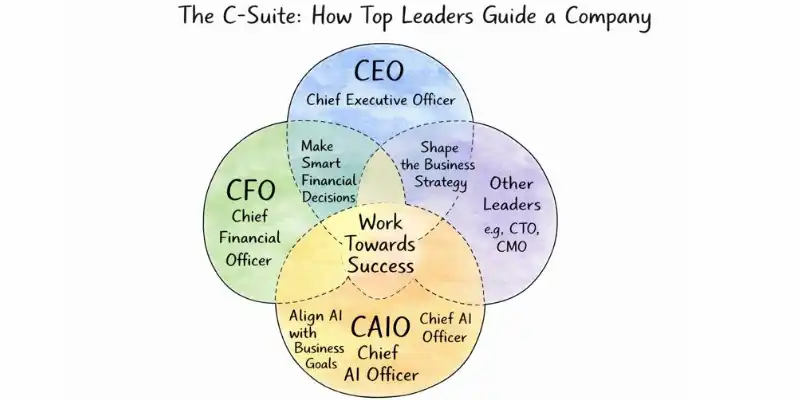
The C-Suite: How Top Leaders Guide a Company
The C-suite is the group of top executives in a business. These people, like the CEO, CFO, and CAIO, work together to run the business, make important choices, and plan for the future. Let’s look at what each of these leaders does and how they work together.
CEO (Chief Executive Officer)
The CEO is the head of the company. They’re responsible for setting the overall direction and vision for the business.
What They Do:
- The CEO makes important choices that will shape the company’s future.
- They are responsible for the company, help other leaders, and make sure everything goes well.
- They also speak for the company to the public, investors, and customers.
.Example:
The CEO of a company might decide to expand into a new country to grow the business, guiding the whole company toward that goal.
CFO (Chief Financial Officer)
The CFO takes care of the company’s finances. They make sure the business has the money it needs to grow and run smoothly.
What They Do:
- The CFO is responsible for the budget and planning for the company’s finances.
- They monitor spending, costs, and profits to ensure the business remains on course.
- They help the CEO make choices based on money information.
Example:
If a company wants to launch a new product, the CFO will assess the costs and help decide if it’s a good investment.
CAIO (Chief AI Officer)
The CAIO focuses on how artificial intelligence (AI) can help the company improve its products and services.
What They Do:
- The CAIO comes up with plans for how to use AI to help the business.
- They run AI projects to make things run more smoothly and make the customer experience better.
- They make sure that AI is used in a responsible and moral way.
Example:
The CAIO at an online store might lead a project to use AI to recommend products based on what customers are likely to want, improving the shopping experience.
How the C-Suite Works Together
The CEO, CFO, and CAIO may have different jobs, but they all work closely together to guide the company. Each leader brings something unique to the table, and they need to collaborate to make the best decisions for the business.
Collaboration:
- The CEO leads with the vision and goals.
- The CFO makes sure there’s enough money to support those goals.
- The CAIO uses technology like AI to help the company stay competitive and efficient.
Example:
If the company wants to improve customer service, the CEO approves the idea, the CFO ensures the budget, and the CAIO leads the project using AI tools.
The Role of an AI Governance & Risk Management Board
An AI Governance & Risk Management Board helps a company use AI safely and fairly. The board makes sure AI follows the right rules and manages risks like ethical problems and data security.
What the Board Does
The board makes sure AI is used in the right way by:
- Making AI Fair: It makes sure that AI doesn’t treat people unfairly.
- Keeping Data Safe: It keeps the AI’s data safe.
- Following the Rules: It makes sure that AI does what it’s supposed to do.
Example:
If a company uses AI to hire people, the board ensures the AI is fair and doesn’t favor certain groups. It also makes sure the data is protected.
Managing Risks
The board helps reduce risks by:
- Looking for Problems: It checks if AI could cause issues like bias or security risks.
- Setting Rules: It creates guidelines for safe AI use.
- Regular Checks: It checks AI systems regularly to make sure they work right.
Example:
In healtAIare, the board ensures AI makes correct decisions and protects patient information.
Keeping AI in Check
The board makes sure AI:
- Is Fair: It stops AI from making decisions that are unfair.
- Keeps Data Safe: It keeps customer data safe.
- Following the rules: It makes sure that AI follows the rules.
.Example:
For an AI chatbot, the board makes sure it respects privacy and gives fair answers.
The Role of an AI Delivery Hub in a Company
An AI Delivery Hub is a team that makes AI projects happen. They take AI ideas and turn them into real, working solutions that help the company.
What the AI Delivery Hub Does
The team focuses on:
- Designing AI Systems: They plan how the AI should work.
- Building AI Systems: They create the AI system based on the plan.
- Testing AI Systems: They check if the AI works well in real life.
How the Hub Works
Engineers and AI experts in the hub:
- Build AI Solutions: They make AI systems that help businesses solve their problems.
- Talk to Other Teams: They talk to people in other departments to find out what they need.
- Check to see if it works: They test the AI systems to make sure they do what they’re supposed to do.
Example:
If a company wants AI to recommend products to customers, the AI Delivery Hub would build and test the system to make sure it works smoothly.
Turning Ideas into Action
The AI Delivery Hub takes ideas and makes them real. They:
- Build the Solution: Turn the AI project into something useful.
- Keep Improving: They update the AI based on feedback.
Example:
In a bank, the hub creates an AI system that detects fraud in real-time to protect customers.
Business AI Integration Cells: Bringing AI to Different Areas
AI Integration Cells help iIntegrating AI in business Cells are groups that use AI in different parts of a business, such as marketing, sales, or customer service. The Chief AI Officer (CAIO) is responsible for these cells and makes sure that AI tools are made to meet the needs of the company and make things run more smoothly.
What They Do
- Customize AI for Teams: They create AI tools that help specific departments like marketing or sales.
- Work with Other Teams: They talk to different departments to understand their problems and build AI solutions.
- Make AI Work in Real Life: They ensure AI tools are useful and help improve business operations.
The CAIO makes sure these AI projects align with the company’s strategy and lead the AI efforts across all departments.
How They Work with Other Teams
AI Integration Cells don’t work alone. They collaborate with other departments to ensure AI fits their needs:
- Understand Needs: They meet with teams to learn about their challenges.
- Create AI Tools: They design AI solutions that solve problems, like forecasting sales or improving customer service.
- Test and Improve: They make sure AI systems work well and improve them over time.
The CAIO ensures that these tools are created efficiently and fit within the company’s goals.
Example:
If the marketing team needs help with customer insights, the AI Integration Cell, guided by the CAIO, would create an AI tool that analyzes customer data and suggests targeted campaigns.
Real-Life Examples
Here’s how these cells help:
- Sales: AI helps the sales team figure out which leads are most likely to make a purchase.
- Customer Service: AI makes chatbots that answer common questions, freeing up agents to deal with more difficult ones.
- Products: AI suggests products to customers based on what they’ve bought in the past, which leads to more sales.
Talent Development and AI Literacy Engine: Preparing Employees for the Future
The Talent Development and AI Literacy Engine teaches people how to use AI and what it is. This group shows workers how to use AI tools and methods to improve their jobs so that they are ready for the future. The Chief AI Officer (CAIO) is responsible for making sure that everyone in the company learns how to use AI.
What the AI Literacy Engine Does
The AI Literacy Engine helps employees understand and use AI by:
- Teaching AI Basics: The team provides training on how AI works, so everyone can understand it.
- Building Practical Skills: Employees learn how to use AI tools in their jobs to make work easier and faster.
- Preparing for the Future: The team keeps employees up-to-date with new AI trends, helping them stay ready for future changes.
How It Helps Employees
The AI Literacy Engine supports employees by:
- Workshops and Training: Offering classes or online sessions to teach employees about AI.
- Hands-On Experience: Giving employees the chance to use AI tools directly in their work.
- Ongoing Support: Providing help and guidance as employees learn to use AI systems.
Example:
In a customer service team, the AI Literacy Engine might train employees to use AI-powered chatbots that answer customer questions. This helps employees do their jobs faster and more effectively.
Why AI Literacy Matters
Having AI knowledge is important for everyone in the company:
- Improves Performance: AI tools can help employees work faster and more accurately.
- Builds Confidence: Employees feel more confident using AI if they understand how it works.
- Encourages New Ideas: Understanding AI allows employees to find new ways to use it to solve problems.
- Example: People on a marketing team might use AI to look at customer data and make ads that are more relevant to them. If they know how to use AI, marketing teams can utilize these tools more effectively to boost sales and improve campaigns.
Key Metrics to Measure the Success of a Chief AI Officer (CAIO)
A Chief AI Officer (CAIO) leads AI projects in a company. To see how well they’re doing, businesses can use a few key metrics that show the impact of AI. These metrics help track things like better efficiency, cost savings, and happier customers.
Improved Efficiency
One way to measure success is by looking at how much AI improves efficiency. AI can automate tasks, speed up work, and reduce mistakes.
What to Track:
- Time saved by using AI for tasks.
- How much faster things get done with AI.
Example:
If AI is used to answer customer questions, and response times go down, this shows improved efficiency.
Cost Savings
AI can help save money by reducing the need for manual work or cutting down on mistakes.
What to Track:
- How much money the company saves by using AI.
- Lower costs in areas like operations or marketing due to AI.
Example:
If AI helps manage inventory better and reduces waste, the company can save money on excess stock.
Customer Satisfaction
AI could help a marketing team look at customer data and make ads that are more relevant to them. Marketing teams can use these tools to boost sales and improve campaigns if they know how to use AI.
What to Track:
- Customer feedback or satisfaction ratings.
- How loyal customers are (measured by Net Promoter Score).
Example:
If AI recommends the right products to customers and they’re happy with the service, it shows AI is improving satisfaction.
Speed of AI Adoption
Speed of AI adoption tracks how quickly the company starts using AI tools. The faster it happens, the quicker the company benefits from AI.
What to Track:
- How long it takes to start using AI after a decision is made.
- How many departments start using AI.
Example:
The company is quickly adopting AI by using tools in marketing, sales, and customer service
Quality of AI-Driven Decisions
AI helps make better decisions. The quality of AI-driven decisions can be measured by how good the AI’s predictions and recommendations are.
What to Track:
- How accurate the AI’s decisions are.
- How well AI helps make better business choices.
Example:
If AI is used to forecast sales, and the forecasts are accurate, it shows that AI is helping make good decisions.
Return on Investment (ROI)
ROI shows if the money spent on AI is bringing good results back to the company.
What to Track:
- The profits or savings from AI compared to how much was spent on it.
Example:
If the company spends money on AI to make supply chain management better and it saves a lot of money, the ROI shows if it was worth it.
Chief AI Officer (CAIO) Job Description: Simple Overview
The Chief AI Officer (CAIO) is the person in charge of a company’s AI projects. They lead the AI strategy, manage AI systems, and make sure AI is used the right way. The CAIO works with other teams to help the company grow by using AI.
Main Responsibilities of a CAIO
Lead AI Strategy
- The CAIO creates a plan for how AI can help the business.
- They work with the CEO and other leaders to make sure AI supports the company’s goals.
Example:
A CAIO at a retail company might create a plan to use AI to suggest products to customers based on their shopping habits.
Manage AI Projects
- The CAIO oversees the AI projects from start to finish.
- They lead teams of AI experts, like data scientists and engineers, to make sure AI projects are completed successfully.
Example:
A CAIO may lead a project to build a chatbot that answers customer questions on the website.
Ensure Ethical Use of AI
- The CAIO makes sure that AI is used fairly and follows all the rules.
- They check that AI systems are safe to use and don’t make unfair choices.
Example:
In hiring, the CAIO ensures the AI tool used to screen job applicants doesn’t favor one group over another.
Work with Other Departments
- The CAIO works with teams like marketing, sales, and customer service to use AI in different parts of the business.
- They make sure AI tools fit each department’s needs.
Example:
A CAIO might work with the marketing team to create an AI tool that helps target ads to the right customers.
Build AI Talent
- The CAIO hires AI experts and helps train employees on AI.
- They create programs to teach employees how to use AI tools.
Example:
A CAIO may set up training for employees to learn how to use AI systems for better decision-making.
How the CAIO Helps the Company Grow
The CAIO helps the business in several ways:
- Improves Efficiency: AI can automate tasks, saving time and money.
- Enhances Customer Experience: AI can personalize customer experiences, like product recommendations.
- Supports Better Decisions: AI helps the company make smarter, data-driven decisions.
The Role of an AI Officer Compared to Other Leadership Roles
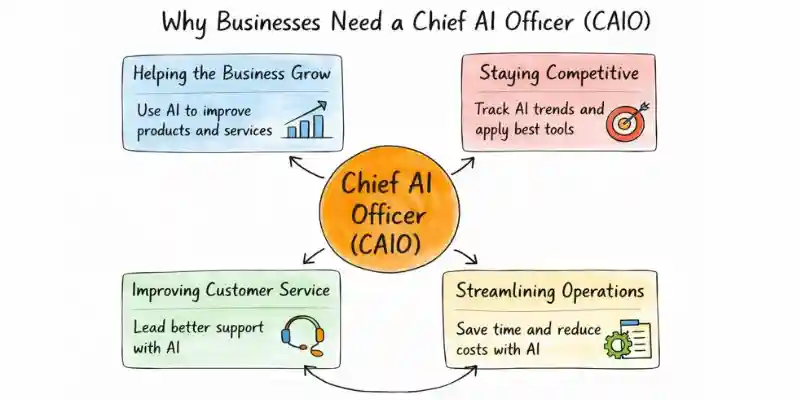
The AI Officer focuses on using artificial intelligence (AI) to improve the company. While the AI officer has their own responsibilities, they work closely with other leaders, like the CEO, CTO, and CFO, to help shape the company’s strategy. Here’s how their roles differ but also work together.
AI Officer vs. CEO (Chief Executive Officer)
- CEO: The CEO leads the company and sets big goals and vision.
- AI Officer: The AI Officer makes sure AI helps achieve those goals, like improving customer service or automating tasks.
Example:
If the CEO wants to expand the company, the AI Officer might use AI to understand new markets and customer needs.
AI Officer vs. CTO (Chief Technology Officer)
- CTO: The CTO manages the company’s technology, like IT systems and software.
- AI Officer: The AI Officer focuses specifically on AI tools and how they can improve the business.
Example:
The CTO might upgrade the company’s IT systems, while the AI Officer develops AI tools that help with customer engagement or efficiency.
AI Officer vs. CFO (Chief Financial Officer)
- CFO: The CFO manages the company’s finances and budgets.
- AI Officer: The AI Officer shows how AI can save money and improve business efficiency.
Example:
If the CFO wants to reduce costs, the AI Officer might suggest automating tasks with AI to save money on labor.
How the AI Officer Complements Other Leaders
The AI Officer works with the CEO, CTO, and CFO to help the company use AI in the best way. While each leader has their own focus, they all work together to meet the company’s goals.
Example:
In a retail business, the AI officer helps the CEO come up with AI strategies for sales, works with the CTO on technology, and keeps an eye on costs with the CFO.
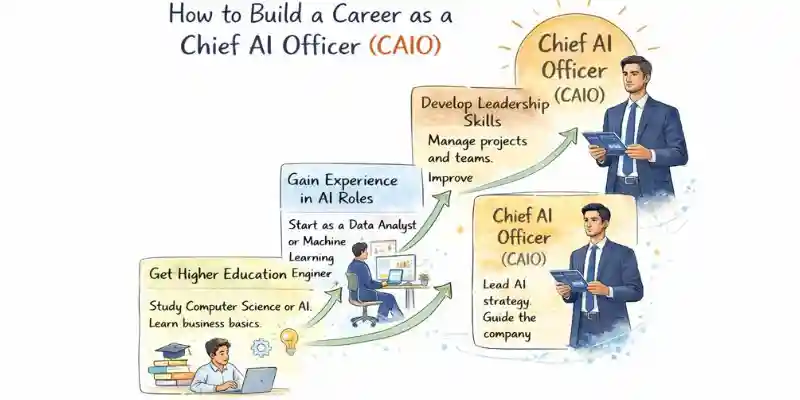
How to Build a Career as a Chief AI Officer (CAIO)
Becoming a Chief AI Officer (CAIO) is an attractive career opportunity for anyone with an interest in AI and business. Here’s how you can advance to this leadership position.
Get the Right Education
- Technical Education: A degree in data science, computing, or artificial intelligence (AI) is essential.
- Business Education: An MBA or business courses will assist you in better grasping corporate strategy.
A robust foundation requires a balance of technical and commercial understanding.
Build Strong AI Skills
- Learn data science, machine learning, and programming languages (such as Python and R).
- Working on AI projects allows you to gain practical experience.
Practice creating AI models or contribute to open-source projects.
Gain Experience in AI Roles
- Start with positions such as data analyst, robotics engineer, or AI developer.
- To gain leadership experience, consider moving to a mid-level role such as an AI project manager.
Tip: Look for leadership possibilities in AI initiatives to help you improve your abilities.
Understand the Business Side of AI
- Discover how AI may help with company objectives such as sales, customer service, and cost savings.
- Collaborate with other divisions to ensure that AI initiatives meet business needs.
Participate in collaborative efforts to better understand diverse business segments.
Develop Leadership Skills
- Practice leading AI teams and projects.
- Focus on language when explaining AI principles to non-technical executives.
To develop these talents, consider taking leadership or management training.
Stay Updated and Build a Network
- Continue to learn about emerging AI trends and technology.
- Network with other AI specialists at conferences or via online groups.
Join AI forums and meetings to expand your professional circle.
The Future of AI Leadership: The Evolving Role of the CAIO
As AI advances, the function of the Chief AI Officer (CAIO) will evolve. Companies will require fresh leaders with plans to keep up with AI advances. Here’s how the CAIO’s role will develop:
Bigger Role in Business Strategy
The CAIO will assist in developing the company’s overall strategy, ensuring that AI meets business objectives across all divisions.
Example:
A CAIO may collaborate with the CEO to apply AI to increase sales or enhance customer service.
Focus on AI Ethics
The CAIO will guarantee that AI is utilized fairly and responsibly, according to ethical principles and legislation.
Example:
A CAIO ensures that AI hiring tools are fair and equal.
Leading AI Innovation
The CAIO will study novel AI technologies and determine how to use them to better the business.
Example:
The CAIO may implement AI techniques to improve customer experience or automate tasks.
AI Leadership in Different Areas
AI leadership will grow, with AI professionals from other departments collaborating under the CAIO’s direction.
Example:
An AI marketing Leader may focus on AI-powered marketing, whereas the CAIO ensures that AI is employed throughout the organization.
More Collaboration with Other Leaders
The Chief AI Officer will collaborate closely with the CEO, CFO, & CTO to ensure that AI fits with business objectives.
Example:
The CAIO works with the CFO in showing how AI may save costs or increase efficiency.
Developing AI Talent
The CAIO will create and educate teams to guarantee that the organization has the necessary AI skills.
Example:
The CAIO creates training programs to assist employees in applying AI in their employment.
Conclusion
So far, we’ve learned a lot about the function of the Chief AI Officer (CAIO). We’ve spoken about how the CAIO is in charge of directing AI efforts, assuring moral use of technology, promoting creativity, and collaborating with other leaders to link AI with business goals. This function is becoming more vital as AI expands and impacts many aspects of the company. My own recommendation? If you want to be a CAIO, you need to start developing a combination of technical and business talents right away. Understanding both sides will prepare you to lead your organization to success in the future. Alright, everyone, stay tuned for additional insights and keep learning.
A Chief AI Officer (CAIO) is responsible for a company’s AI strategy and implementation. They are responsible for AI projects, improve business processes, and make sure AI is used in a moral way.
The CAIO uses AI to make things run more smoothly, cut costs, and make the customer experience better. They make sure that AI projects are in line with business goals and that they are carried out successfully.
A CAIO needs technical knowledge of AI, machine learning, and data science, along with strong leadership, communication, and strategic thinking skills
The CTO manages overall technology in the company, while the CAIO focuses specifically on AI strategies and solutions to improve business functions
The salary for a CAIO typically ranges from $150,000 to $300,000 per year, depending on experience, company size, and location
A CAIO needs a degree in computer science, data science, or business, along with experience in AI roles and leadership positions.
The CAIO drives innovation by introducing AI technologies that improve processes, automate tasks, and create better customer experiences.
Industries like technology, healtAIare, finance, and retail need CAIOs to manage AI projects and drive business improvements.
A CAIO has to deal with problems like making sure AI is used ethically, managing its complexity, and getting teams to use AI solutions.
The CAIO works with the CEO, CFO, and CTO to ensure AI aligns with the company’s strategy and meets business goals across departments.





- Be Respectful
- Stay Relevant
- Stay Positive
- True Feedback
- Encourage Discussion
- Avoid Spamming
- No Fake News
- Don't Copy-Paste
- No Personal Attacks
- Be Respectful
- Stay Relevant
- Stay Positive
- True Feedback
- Encourage Discussion
- Avoid Spamming
- No Fake News
- Don't Copy-Paste
- No Personal Attacks
