SillyTavern Review 2026: Is It Really Worth the Hassle?
Published: 7 Aug 2026
You may have come across SillyTavern somewhere online. Maybe on Reddit, maybe in a Discord chat where someone says it is one of the best free AI roleplay tools out there. But then someone else warns you that getting it set up can be a real headache. And honestly, both sides have a point.
Both of them are right, honestly. That mix of hype and warning is exactly why this SillyTavern review exists.
I spent real time inside SillyTavern. I tested it with different backends, poked around the character card system, and read through what actual users say about it in their own communities. This is not a rewrite of the official website. It is a plain, honest look at what SillyTavern does well, where it falls short, and whether it earns a spot on your computer in 2026.
| Quick SillyTavern Review Rating |
|---|
|
★★★★☆ 4.2 / 5
|
What Is SillyTavern?
SillyTavern is a free, open-source interface for AI roleplay. It is not an AI model like ChatGPT or Claude. Instead, it connects you to the AI model you choose and gives you more control over the chat.
Think of it as a dashboard for your AI characters. The model generates the responses, while SillyTavern manages the roleplay experience.
Is SillyTavern an AI Model?
No. SillyTavern does not generate responses on its own. You connect it to an AI backend, which does the actual text generation.
With SillyTavern, you can:
- Choose between different AI models and backends
- Create and customize character cards
- Manage memory and lorebooks
- Control prompts and context settings
- Run models locally on your own computer
- Use different models without being locked into one provider
In simple terms, SillyTavern is the interface and control layer; your chosen AI model provides the responses.
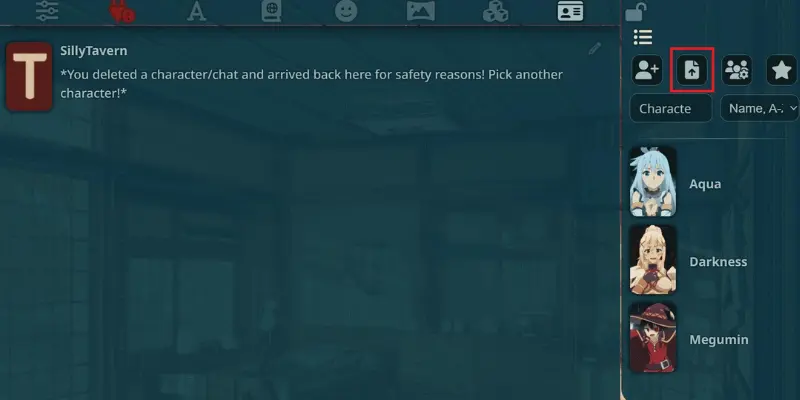
How SillyTavern Works: Installing It Step By Step
Setup is the part most SillyTavern reviews skip past quickly. Let’s slow down here.
What You Need Before You Start
- A computer running Windows, macOS, or Linux
- Node.js version 18 or higher (version 20 is the current pick)
- Git, so you can pull the project files
- Either an API key for a cloud model, or a GPU with at least 6GB of VRAM for local models
None of this is rare or expensive. Most of it is free to download. The SillyTavern community has also written clear notes for each system.
Installing SillyTavern
- Open your terminal or command prompt.
- Clone the project from its GitHub repository.
- Move into the SillyTavern folder.
- Run the start script for your system: Start.bat on Windows, or start.sh on macOS and Linux.
- Your browser opens on its own at localhost:8000.
At that point, SillyTavern is running. But it has no brain yet. You still need to connect a backend. If you use a cloud model, paste your API key into the settings panel. If you run something local, launch a tool like KoboldCPP or LM Studio first. Then point SillyTavern at it.
Give yourself 15 to 30 minutes for your first setup. It is not hard once you have done it. But the first try takes some patience. This is the biggest reason casual users give up on SillyTavern before they ever try it properly.
SillyTavern Features That Actually Matter
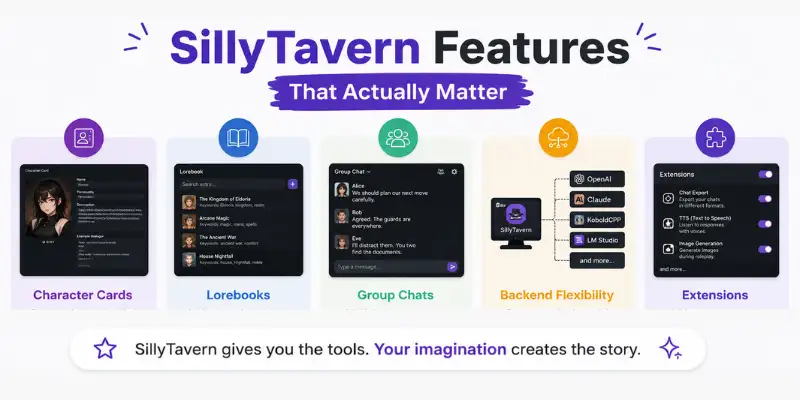
SillyTavern has a long feature list. A handful of these are the real reason people stick around, and any honest SillyTavern review has to spend time on each one.
Character Cards
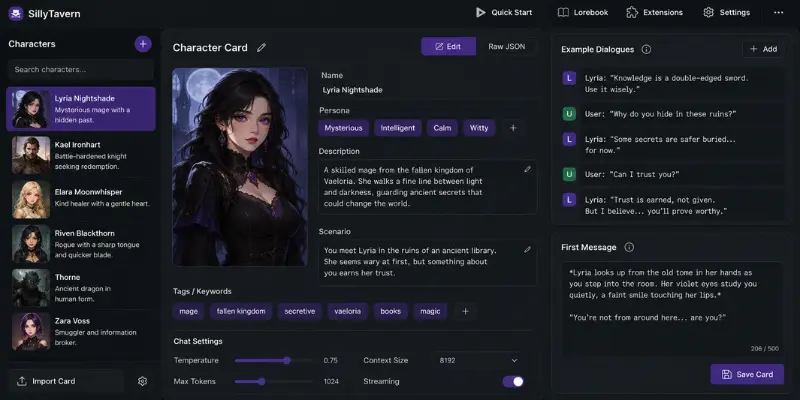
Every character in SillyTavern lives inside a card. It is usually a PNG or JSON file. That card holds the character’s description, personality, opening message, and a few example exchanges. Those examples teach the model how the character talks.
Cards with strong example dialogue work much better than a short, vague description. You can build your own cards from scratch. Or you can pull from community sites where creators share their work. Places like Chub.ai and similar character card communities host thousands of ready-made personas if you would rather skip the blank page.
World Info and Lorebooks
Lorebooks act like a memory bank for your story. You set keywords. When those words show up in chat, related background details get pulled in on their own. If you are building a fantasy kingdom or a long plot, this keeps facts straight without repeating yourself every few messages.
Group Chats
SillyTavern lets several characters talk in the same scene. This is rare among roleplay tools. It opens the door to group adventures or a full cast bouncing off each other in one thread.
Backend Flexibility
This is the feature that defines SillyTavern. You are not stuck with one AI company. You can connect Claude and similar assistants for careful, well-written replies. You can switch to the ChatGPT ecosystem for a different tone. Or you can run a fully local model for uncensored, no filter AI roleplay with nobody watching over your shoulder. Swapping backends takes a few clicks once your API keys are saved.
Extensions and Add-ons
SillyTavern connects to Stable Diffusion or DALL-E for character portraits. It adds text-to-speech so characters can speak. It also supports document uploads for extra context. None of this is required. But it turns a simple chat window into something closer to a small visual novel.
What Changed in SillyTavern for 2026
The project ships updates almost every month, so the SillyTavern of early 2025 looks dated next to what runs today. A few changes stand out this year.
Newer reasoning models now get proper tool-call support, which helps with multi-step scenes where a character needs to “think” before answering. Voice options grew too, with more text-to-speech providers built into the settings panel instead of bolted on through an extension. Document memory also got sharper, so pasted lore or backstory sticks around in longer conversations instead of fading out after a dozen messages.
None of these updates change what SillyTavern fundamentally is. They just close the gap between it and the polished hosted apps a little more each year.
SillyTavern System Requirements in 2026
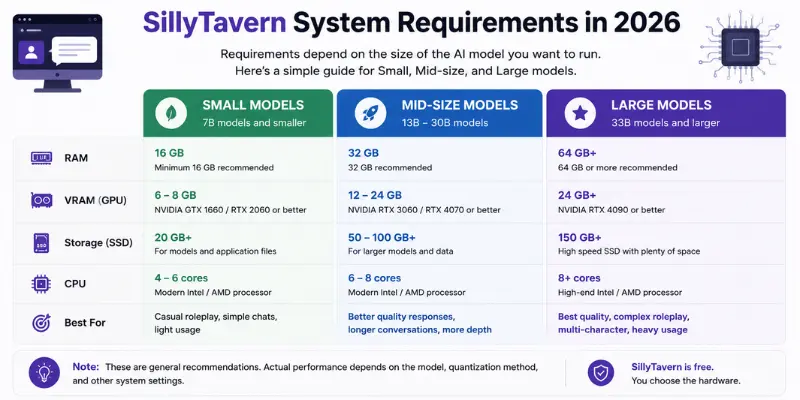
If you only plan to use a cloud API, your hardware barely matters. Any recent laptop with Windows 10 or later, macOS 12 or later, or a modern Linux build will run SillyTavern fine. A stable internet connection matters more than your processor here.
If you want to run models locally, the requirements grow with model size:
- Small models (7B–13B): 8GB RAM, a GPU with 6GB VRAM, 20GB of free storage
- Mid-size models (34B): 32GB RAM, a GPU with 12–16GB VRAM, 40GB of storage
- Large models (70B): 64GB RAM, 24GB VRAM, 80GB or more of storage
SillyTavern also runs on Android through Termux. iOS support stays limited. If your machine cannot handle a local model, a cloud API is still a solid path. It often gives better writing quality than a weak local setup anyway.
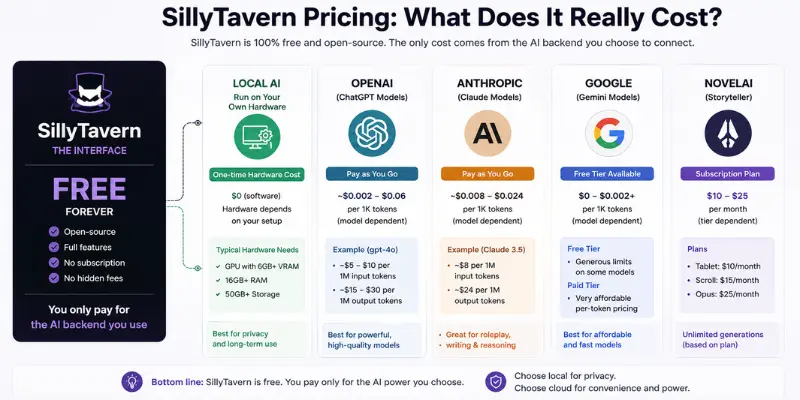
SillyTavern Pricing: What Does It Really Cost?
One of the best things about SillyTavern is that the software itself is free and open-source. There is no SillyTavern subscription or paywall for its core features.
However, using SillyTavern can still cost money because you may need to pay for the AI backend you connect to.
| Backend | Typical Cost |
| Local AI model | Free after setup, but requires your own hardware |
| OpenAI models | Usage-based API pricing |
| Claude models | Usage-based pricing, depending on the model |
| Gemini | Free and paid options available |
| NovelAI | Paid subscription |
Your actual cost depends mostly on the model you choose and how much you use it. Short conversations with a lower-cost model can be inexpensive, while long roleplay sessions with larger models can use more credits.
For this SillyTavern review, the important point is that you are not paying for SillyTavern itself. You are mainly paying for the AI backend, unless you run a local model on your own hardware.
If you plan to use SillyTavern regularly, a local model can reduce ongoing API costs, but it requires suitable hardware and some additional setup.
Privacy and Safety: What Happens to Your Data
This is a fair question, and it deserves a straight answer.
Run SillyTavern with a local model, and nothing leaves your computer. There is no server logging your conversations, no company storing your chat history, and no account tied to what you type. That is about as private as AI roleplay gets.
Connect a cloud backend instead, like OpenAI or Claude, and the usual rules apply. Your messages travel to that provider’s servers, and their privacy policy takes over from there. SillyTavern itself does not add any extra tracking on top of that. It just relays what you type to whichever model you picked.
One more thing worth knowing: since content limits sit entirely with your backend, you carry more responsibility for what you generate than you would on a moderated platform. There is no safety net catching things for you. That freedom is the whole appeal for a lot of users, but it only works well when you treat it seriously.
Who Should Use SillyTavern?
- Fiction writers and worldbuilders who want lorebooks and steady memory for long stories
- Roleplay fans who have outgrown the limits on hosted platforms
- Privacy-focused users who want their chats to stay on their own machine
- Technical hobbyists who enjoy tweaking settings and do not mind a little troubleshooting
- Game developers testing NPC voices before locking them into a project
Who Should Skip SillyTavern?
- Anyone who wants instant results with no setup at all
- Casual users who chat once in a while, where setup time never pays off
- People who hate managing API keys or budgets
- Mobile-first users, since there is no polished native app
If that second list sounds like you, hosted companion apps such as Candy AI or CrushOn AI trade away SillyTavern’s depth for something you can open and use in under a minute.
SillyTavern Pros and Cons
Pros
- Free interface with no subscription
- Full control over which AI model powers your characters
- Deep customization through lorebooks, personas, and prompt settings
- Active community sharing character cards and tips
- Group chats for multi-character scenes
- Works fully offline with a local model, keeping your data private
Cons
- Setup needs comfort with a terminal and a few technical steps
- Official documentation is thin; you will lean on community wikis often
- No polished mobile app
- Updates sometimes bring bugs
- Backend costs or hardware needs add up for heavy users
- More configuration than hosted AI chat apps
- Performance depends heavily on your chosen backend
SillyTavern vs Character.ai
People compare these two all the time. The honest answer is that they are not really built for the same moment in your journey.
Character.ai gets you talking to a character in under two minutes. No install, no API key, no setup. The tradeoff is a strict content filter that shapes what your characters can say.
SillyTavern asks for an afternoon of setup in exchange for full control. You choose the model. You set the rules. Nothing gets cut off mid-scene by a moderation layer.
Most people who move from Character.ai to SillyTavern do it for that reason. They hit a wall on the hosted platform and went looking for a way around it. If you want a closer look at that starting point, the Character.ai review walks through what that platform offers and where its filters tend to get in the way.
Common SillyTavern Problems and Fixes
“Context too long” errors: Lower your context size in settings. Or switch to a backend with a bigger context window.
Character breaking out of persona: Strengthen the system prompt in the card. A simple line like “Always respond as [Character Name], never break character” fixes this more often than you would think.
Backend will not connect: Check your API key. Confirm your local server is actually running. Re-enter the endpoint URL in the connection settings.
Slow or laggy responses: This is almost always a hardware issue with local models. Try a smaller model. Or switch to a cloud API while you sort it out.
SillyTavern Alternatives Worth Knowing
A fair SillyTavern review has to mention where else you could look. SillyTavern is not the only option here, and it helps to know what else is out there before you give up an afternoon to set up.
If setup itself is the problem, hosted platforms like JanitorAI and Candy AI give you a working character chat in seconds. You trade away lorebooks, group chats, and real backend freedom to get that speed. Unlucid AI takes a similar hosted route with fewer content limits than mainstream apps. It is worth a look if you want less friction than SillyTavern but more freedom than Character.ai.
Writers who care more about prose than character personas sometimes skip roleplay tools entirely. They reach for dedicated AI writing tools instead, since those are built around long-form output rather than back-and-forth chat.
None of these fully replace what SillyTavern does. They just sit at a different point on the same scale. SillyTavern sits at the “maximum control, maximum effort” end. Hosted apps sit closer to “instant access, less depth.” Where you land depends on how much you value ownership over convenience.
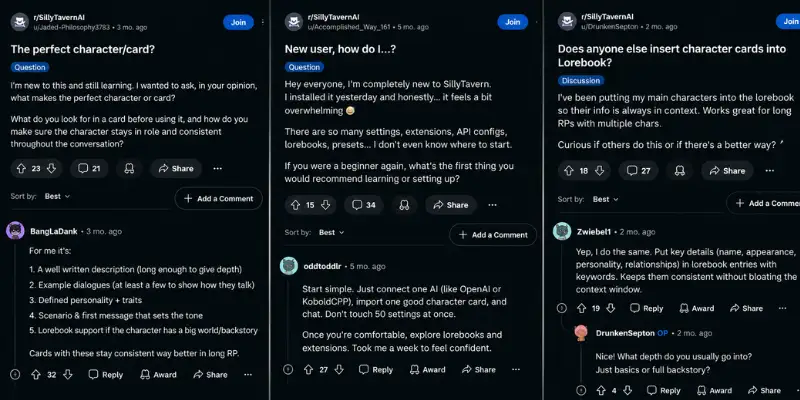
What SillyTavern Users Actually Say
SillyTavern gets a lot of positive attention from its community, especially from users who value customization and control. Discussions around the platform often highlight its character cards, lorebooks, model flexibility, and ability to support long-running roleplay sessions.
What Users Like
- Deep customization: Users can fine-tune characters, prompts, memory, and other settings.
- Model freedom: You can connect different cloud or local AI models instead of relying on one provider.
- Long-term roleplay: Character cards and lorebooks make it easier to maintain details across longer stories.
- Active community: Users regularly share character cards, settings, guides, and troubleshooting tips.
Common Complaints
The biggest complaints are usually about the learning curve rather than the core roleplay experience.
- Setup can feel technical for beginners.
- Documentation is not always easy to follow.
- New users may need community guides to troubleshoot problems.
- Character cards from other platforms sometimes need editing to work well.
Overall, the community feedback supports the main finding of this SillyTavern review: the platform is rewarding once you understand the setup, but it asks for more effort than most hosted roleplay apps.
My Personal Take on SillyTavern
Here is the honest part of this SillyTavern review. SillyTavern is not built to impress you in the first five minutes. It is built to reward you after you stick with it.
The first time I opened a terminal window to clone a repository, it felt like more work than a roleplay tool should ask for. But once the character cards were loaded and the lorebook started pulling in details on its own, the payoff was clear. Nothing else lets you swap models mid-story or keep every detail exactly where you left it.
If you already use Character.ai or a hosted companion app and feel boxed in, SillyTavern is the natural next step. If you just want to chat with a character tonight with zero effort, this is not that tool. And that is fine. SillyTavern was never trying to be everyone’s first choice. It was built for the people who stayed.
Final Verdict: Is SillyTavern Worth It in 2026?
SillyTavern earns its reputation, and after spending real hours with it, I get why people talk about it the way they do. Give it one afternoon of setup, and you get a level of control over your AI characters that almost nothing else offers. The lorebook system, the character card depth, and the freedom to pick your own backend put it well ahead of hosted alternatives for anyone serious about roleplay or long-form fiction.
It is not for everyone, and it does not try to be. If you want to chat with a character right now with zero friction, SillyTavern will test your patience before you reach the good part. But for writers, roleplay veterans, and anyone who wants to own their setup instead of renting it from a platform, SillyTavern still stands as one of the best tools out there in 2026.
if you can survive the install, SillyTavern will likely become the only roleplay tool you keep coming back to.
Frequently Asked Questions
No. SillyTavern does not think on its own. It is an interface that connects to a model like GPT, Claude, Gemini, or something running locally. The model does the thinking. SillyTavern handles the character, the memory, and the screen you type into.
Only if you connect to a cloud model such as OpenAI or Claude. Run a local model through KoboldCPP or Ollama, and SillyTavern works with no outside key at all.
That comes down to your backend, not SillyTavern itself. A local model has no outside moderation layer watching it. A cloud provider still enforces its own rules, since SillyTavern cannot override limits baked into the model.
It asks more of you than opening an app and signing in, yes. You will install Node.js, pull a project folder, and maybe manage an API key. Community launchers have made this easier over the past year, but plan on spending real time on your first try.
Not an official one. The web interface loads in a mobile browser on Android through Termux, but there is no dedicated app for Android or iOS.
Ollama running a Llama 3 model is a common starting point for a fully local, free setup. Gemini also offers a usable free tier through Google AI Studio if local hardware is not an option for you.
Yes, though it will be slower. A CPU-only machine with around 16GB of RAM can run a smaller quantized model through KoboldCPP. It works fine for casual chats. It just will not feel as snappy as a GPU-backed setup.
Most people get comfortable within their first week of regular use. The install is the hard part. Once characters are loaded and a lorebook or two is set up, the day-to-day use of SillyTavern feels a lot like any other chat app.
Yes. SillyTavern itself is free and open-source. However, you may pay for the AI backend you connect to, such as a paid API or subscription service.
SillyTavern is an interface, so the privacy and safety of your conversations depend largely on the backend and model you use. A local setup gives you more control over where your data is processed, while cloud providers have their own policies and restrictions.






- Be Respectful
- Stay Relevant
- Stay Positive
- True Feedback
- Encourage Discussion
- Avoid Spamming
- No Fake News
- Don't Copy-Paste
- No Personal Attacks
- Be Respectful
- Stay Relevant
- Stay Positive
- True Feedback
- Encourage Discussion
- Avoid Spamming
- No Fake News
- Don't Copy-Paste
- No Personal Attacks
