AI for Non-Technical Founders: Complete Practical Guide
Published: 8 Jan 2026
When people talk about tech, tools, and systems, it can make you feel lost, especially when you feel like you have to keep up. Many founders worry that they might fall behind just because they don’t have a technical background. This guide is here to help you understand things better and stop being afraid. We’ll go over simple ideas, real-life examples, and straightforward steps so you can use AI for Non-Technical founders without stress or confusion.
What Does ‘AI for Non-Technical Founders’ Really Mean?
AI for Non-Technical Founders means using smart tools without needing to know coding or difficult technology. These tools help you work faster and make better decisions. Focus on your business. We take care of the tech. The goal is to keep everything simple, useful, and easy to use.
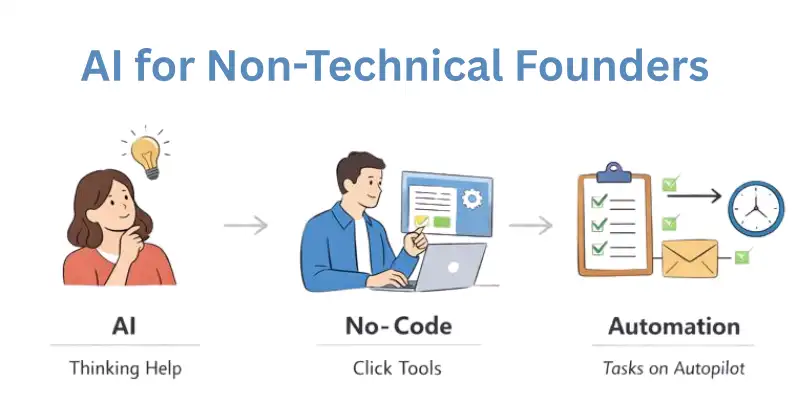
- AI means smart software that can think, learn, and help with tasks like writing, planning, or sorting data in a simple way.
- No-Code means tools that work with clicks and forms, not programming or coding skills.
- Automation means tasks happen on their own after you set simple rules.
- AI helps with thinking tasks, no-code helps with building systems, and automation helps save time.
- These three work together to reduce effort and speed up daily work.
Example 1:
A non-technical founder uses an AI tool to write social media posts and email content in minutes instead of hours.
Example 2:
A founder uses a no-code tool to connect forms, emails, and spreadsheets. Customer data updates automatically, and no coding is needed.
What AI Can (and Cannot) Do for Non-Technical Founders
It is important to know both the strengths and limits of AI. Many founders expect too much and feel disappointed later. When you understand the real role of AI for non-technical founders, you make better choices. This balance helps you use tools with confidence and control.
What AI Can Do for Non-Technical Founders
- AI saves time by handling repeat tasks like emails, reports, and scheduling.
- AI helps create content, marketing ideas, and simple plans quickly.
- AI supports decisions by showing clear patterns from data.
- AI works without coding when founders use easy no-code tools.
What AI Cannot Do for Non-Technical Founders
- AI cannot replace human thinking or business judgment.
- AI cannot fully understand your business vision or market reality.
- AI cannot run a business alone without clear guidance.
- AI cannot fix a weak strategy automatically.
Real-life example:
A founder uses AI for non-technical founders to draft social media posts and review sales numbers. The founder checks the output, adjusts the message, and makes final decisions.
Best AI Tools for Non-Technical Founders (Categorized)
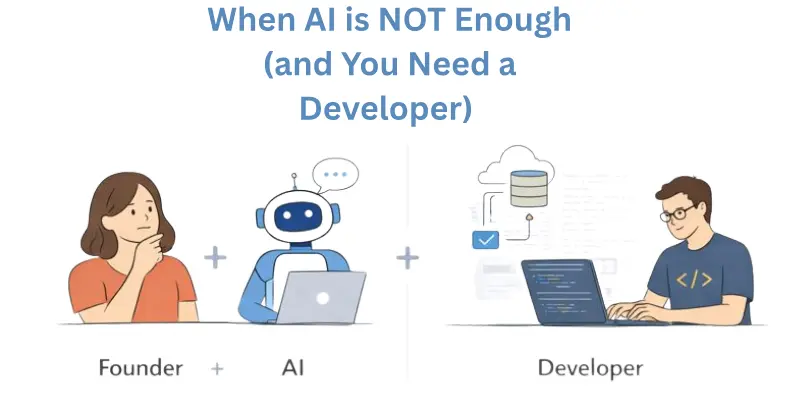
Choosing the right tool matters more than choosing many tools. Non-technical founders often feel confused by too many options. The right choice saves time, money, and stress. Using the right AI for non-technical founders can make starting and growing a business much easier.
AI for Content & Marketing
- This category helps create blogs, emails, and social posts.
- These tools save time on writing and planning content.
- They help founders market without hiring a full team.
Light Comparison Table
| Tool | Best For | Why It’s Good for Non-Technical Founders |
| ChatGPT | Writing content | Easy prompts and fast results |
| Jasper | Marketing copy | Ready-made templates |
| Canva AI | Visual content | Simple drag-and-drop design |
Example:
A non-technical founder uses ChatGPT and Canva AI to create weekly content instead of hiring a writer and designer. This shows how AI simplifies content creation for non-technical founders
AI for Automation
- This category helps connect apps and make daily work easier.
- These tools reduce routine tasks like data entry.
- They help founders focus on growth instead of routine work.
Light Comparison Table
| Tool | Best For | Why It’s Good for Non-Technical Founders |
| Zapier | App automation | No coding needed |
| Make | Workflow setup | Visual step builder |
| Notion AI | Task management | Smart summaries and notes |
Example:
A service business founder uses Zapier to auto-save leads from forms into a CRM. This demonstrates the practical benefits of AI for non-technical founders in daily operations.
AI for MVP / Product Building
- This category helps build basic products without coding.
- These tools support fast testing of ideas.
- They work well for early stage startups.
Light Comparison Table
| Tool | Best For | Why It’s Good for Non-Technical Founders |
| Bubble | App building | Visual editor |
| Glide | Simple apps | Uses spreadsheets |
| Softr | Web apps | Easy setup |
Example:
A SaaS founder builds a simple MVP in Bubble to test user interest before hiring developers. AI for non-technical founders makes testing ideas faster and cheaper.
AI for Customer Support
- This category helps answer customer questions faster.
- These tools reduce support work.
- They improve response time and user experience.
Light Comparison Table
| Tool | Best For | Why It’s Good for Non-Technical Founders |
| Tidio | Live chat | Easy setup |
| Intercom | Support automation | Smart replies |
| Freshdes | Ticket support | Simple dashboard |
Example:
An online store founder uses a chatbot to answer common questions 24/7. This is a clear example of how AI for non-technical founders can improve customer support efficiently.
Key Points
- Choose tools based on your business stage.
- Start with one category, not all at once.
- Focus on tools that save time and effort.
- AI for non-technical founders simplifies tasks, marketing, and customer interactions.
- Simple tools bring faster results for beginners.
Real-World Examples of Non-Technical Founders Using AI
Real examples make AI easy to understand for non-technical founders. Many founders think AI is only for experts, but these stories show that anyone can use AI in simple ways. You will see practical ideas you can start using today to improve your business.
Content Creation
- A solo founder writes blog posts and marketing emails using AI tools.
- They schedule posts without touching any code.
Example:
A service-based founder uses AI for non-technical founders to draft weekly newsletters and blog ideas. This saves hours of writing time.
Automation
- A founder sets up AI to post on social media automatically.
- Emails to customers are sent on time without work.
Example:
A small online store founder uses AI for non-technical founders to post product updates and promotions. This keeps engagement high while they focus on orders.
Customer Support
- A founder uses a simple AI chatbot for common customer questions.
- They focus on growing the business instead of answering the same questions repeatedly.
Example:
A startup founder sets up a chatbot using AI for non-technical founders on their website to guide visitors and answer FAQs 24/7. Customers get help instantly.
Could AI handle routine support in your business?
Product Ideas / MVP
- A founder tests product features with AI-generated mockups.
- They gather user feedback without building full versions first.
Example:
A founder uses AI for non-technical founders to create app mockups and sends them to early users for feedback. This speeds up product testing and improves ideas. Could AI help you test your product faster?
Key Takeaways
- AI helps non-technical founders create content, handle daily work, support customers, and test products.
- These examples show practical, easy ways to start using AI.
- You don’t need coding skills to see real results.
- Start small and focus on one area first.
- AI can save time, reduce stress, and let you focus on growing your business.
When AI is NOT Enough (and You Need a Developer)
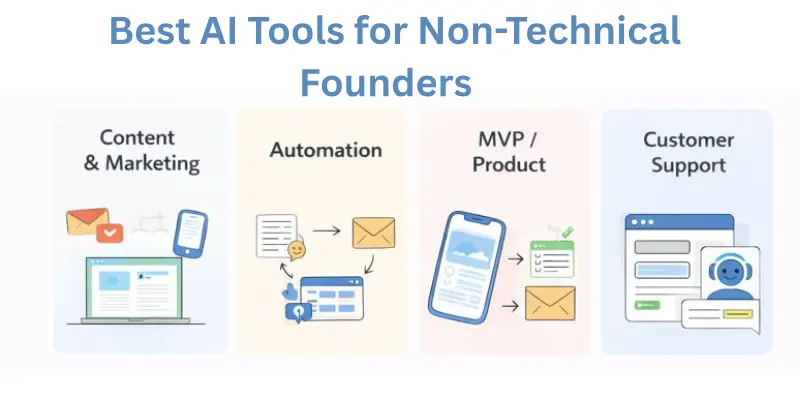
AI can do a lot for non-technical founders, but it has limits. Even tools built for beginners can’t handle every custom task. Knowing when to call a developer is important for success. These tips show when AI for non-technical founders is enough—and when expert help is needed.
Complex Custom Features
- AI tools cannot build fully unique features on their own.
- Custom apps, advanced dashboards, or specific business logic often need coding.
- AI may suggest ideas, but it cannot fully implement them without a developer.
Example:
A non-technical founder wanted a unique subscription system with special pricing rules. They used AI to plan the idea, but a developer built the system to make it work.
Integrations That AI Can’t Handle Alone
- Some software integrations are too complicated for AI tools that are easy to use.
- You might need to know how to code to connect more than one database or special API.
- AI can help or make the process easier, but it can’t do it all by itself.
Example:
AI helped a founder start the setup, but a developer was needed to make everything work smoothly.
High-Security or Regulatory Tasks
- AI can’t make sure that strict security or legal rules are followed.
- Experts must handle things like PCI payments, healthcare data, or GDPR-sensitive operations.
- Non-technical founders need to hire professionals to stay safe
Example:
A founder used AI to help non-technical founders plan a healthcare app, but they hired a developer to make sure that patient data was safe.
Key Points
- AI for non-technical founders is powerful for content, automation, and testing ideas.
- AI alone cannot handle difficult features, hard integrations, or high-security tasks.
- Know when to call a developer to save time, reduce errors, and protect your business.
- Start with AI where it works best and add expert help when needed.
Real-World Use Cases of AI for Non-Technical Founders
Seeing how AI works in real life helps non-technical founders understand its value. Practical examples show what you can do without coding and how to save time. These stories highlight how AI for non-technical founders can simplify work and grow a business.
Content Creation
- A founder used AI to write blog posts, social media captions, and marketing emails.
- They saved hours each week by not writing everything manually.
- The AI helped them stay regular with messaging and tone.
Example:
A solo founder running an online coaching business used AI to draft weekly newsletters. This allowed them to focus on client calls instead of writing content.
Automation
- AI scheduled social media posts and email sequences automatically.
- It reminded the founder about deadlines and upcoming campaigns.
- It reduced mistakes and helped campaigns run on time.
Example:
A founder of a small e-commerce shop set up AI to post new product updates every week. The shop saw better engagement without extra work.
Customer Support
- AI chatbots answered common customer questions instantly.
- They organized inquiries and forwarded difficult cases to the founder.
- Freed up the founder to focus on growth and product development.
Example:
A founder running an online learning platform used an AI chatbot for FAQ support. Students got faster responses, and the founder had more time to create courses.
Product Testing / MVP
- AI quickly created mockups and early versions.
- Helped the founder test ideas without hiring developers.
- Made it easy to get quick feedback and make changes to product ideas.
Example:
A founder testing a new app idea used AI to create clickable mockups. They shared the early versions with users and improved the design using their feedback.
Key Takeaways
- AI for non-technical founders can handle content, automation, customer support, and MVP testing.
- Using AI saves time, reduces mistakes, and allows focus on growth tasks.
- Start small with one practical use case and expand as you get comfortable.
- Seeing real examples helps beginners feel confident and inspired to try AI themselves.
Step-by-Step Roadmap for Non-Technical Founders Using AI
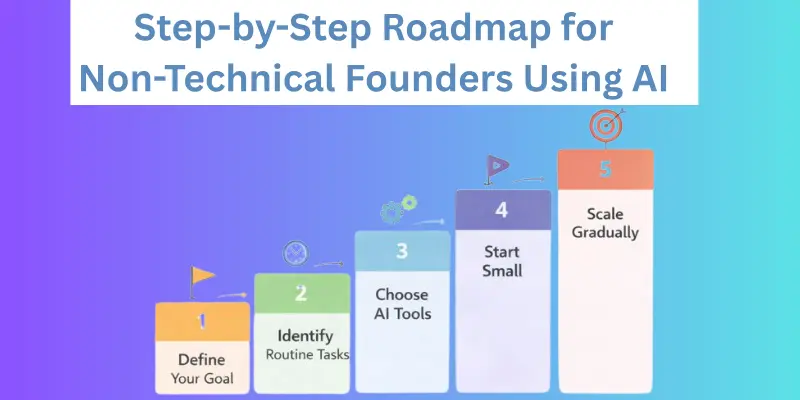
Having a clear roadmap is essential for non-technical founders to use AI effectively. Without guidance, it’s easy to get overwhelmed or waste time on tools that don’t fit your needs. This roadmap shows simple, practical steps to start small, gain confidence, and grow. Using AI for non-technical founders tasks becomes much easier when you follow a structured path.
Define Your Business Goal
- Decide what you want AI to help you achieve, such as saving time, growing sales, or improving customer support.
- Write down clear goals to measure progress later.
- Focus on one main goal at the start.
Example:
A founder wants to increase email newsletter sign-ups, so they aim to automate content creation and sending schedules.
Identify Routine Tasks AI Can Help With
- List tasks that take a lot of time but don’t need creative thinking.
- Examples: sending emails, posting on social media, or tracking customer questions.
- Prioritize tasks with the biggest time savings.
Example:
A founder manually sends order confirmation emails daily. Using AI to automate this saves hours each week.
Choose Beginner-Friendly AI Tools
- Pick tools that are easy to use and don’t require coding.
- Look for no-code platforms for content, marketing, or automation.
- Test a few tools to see which one fits your workflow.
Example:
A founder uses a no-code AI tool to write blog posts and schedule social media automatically
Start Small – One Task at a Time
- Don’t automate everything at once; start with one task.
- See how AI works and make changes as needed.
- Don’t make your setup too complicated right away.
Example:
A founder starts by letting AI handle only email responses before adding social media scheduling.
Monitor, Measure, and Improve
- Track results to see if AI is meeting your goals.
- Note what works well and what needs improvement.
- Adjust AI settings or try different tools as needed.
Example:
A founder notices AI-written emails get better click rates after changing the subject lines suggested by the AI.
Scale Gradually with AI
- Add more tasks once the first ones are working smoothly.
- Introduce new AI tools slowly to avoid confusion.
- Keep reviewing results and optimizing processes regularly.
Example:
A founder uses AI to make weekly reports and customer insights after automating emails and social media.
Key Takeaways
- Start by defining clear business goals before using AI for non-technical founders tasks.
- Focus on routine tasks to save time and reduce effort.
- Choose beginner-friendly, no-code AI tools for easy adoption.
- Start small, monitor results, and improve step by step.
- Scale slowly as you gain confidence and see positive results.
Future of AI for Non-Technical Founders
AI is becoming easier to use, and it’s a big opportunity for non-technical founders. In the future, AI for non-technical founders will help them work faster, save time, and grow their businesses. If you’re a founder without a technical background, it’s important to know how AI can help you now and in the coming years.
AI Agents for Founders
AI agents are tools that can do tasks for you automatically.
- They can answer customer questions
- They can track sales or website visits
- They can help you with data analysis
Example:
A founder uses an AI agent to answer customer questions on the website and send sales updates by email.
Fully Automated Startups
Soon, some businesses will run mostly with AI.
- AI will handle daily tasks like sending emails and updates
- It can track orders and follow up with customers
- Founders can focus on bigger ideas and growth
Example:
A founder uses AI to manage an online store, where AI sends order confirmations, tracks inventory, and answers basic customer questions.
Founder + AI Collaboration
AI will work with founders, not replace them.
- AI will help you make decisions by showing data
- Founders will still make the final choices
- AI helps find patterns but can’t replace human judgment
Example:
A founder uses AI to look at customer feedback, then makes a decision on which product to improve next.
Key Points
- AI will handle repeat tasks like emails and data updates
- Founders will focus on growing their business and big ideas
- AI will be easy to use for non-technical founders
- AI will help, not replace, human decision-making
- Start small with AI and grow over time
Conclusion
To finish, we’ve talked about how AI for Non-Technical founders can use AI for non-technical tasks, including how to understand what it can and can’t do, how to choose the right tools, how to see real-world examples, and how to follow a clear step-by-step plan. I recommend starting small, focusing on tasks that you do over and over again, and then slowly adding more AI to your work. This will save you time and make your job much easier. Keep trying new things and learning, everyone. Soon you’ll see how much these tools can help your business grow. More useful tips will be coming your way
It means using AI tools in your startup even if you cannot code. You can automate tasks, create content, or analyze data without technical skills. It makes business operations easier for founders who don’t have a tech background. AI becomes your assistant rather than a tool that requires programming knowledge.
Start small by picking one task, like writing emails or generating social media posts. Use beginner-friendly AI tools with drag-and-drop or simple prompts. Gradually, you can add more tasks as you gain confidence. The key is to focus on practical results, not technology.
AI can handle many routine or simple tasks, but it cannot replace difficult coding for custom products. It helps non-technical founders save time and test ideas quickly. For advanced apps or integrations, hiring a developer is still important. AI is a helper, not a full replacement.
AI can help create content, manage social media, respond to customer questions, and analyze business data. It can also automate repetitive routines like scheduling or report generation. These tasks free up time so founders can focus on growth and strategy.
Yes, AI cannot make difficult decisions or fully understand your business context. It may make mistakes if instructions are unclear. You still need human judgment for strategy, product design, or personalized customer interactions.
Look for tools with simple interfaces, drag-and-drop features, and ready-to-use templates. Examples include AI writing assistants, chatbot builders, and automation platforms. The goal is to minimize learning time while achieving real business results.
AI can replace hiring for simple tasks like writing, data analysis, or scheduling. This reduces costs for freelancers or full-time staff. Using AI strategically allows founders to focus funds on growth areas rather than routine work.





- Be Respectful
- Stay Relevant
- Stay Positive
- True Feedback
- Encourage Discussion
- Avoid Spamming
- No Fake News
- Don't Copy-Paste
- No Personal Attacks
- Be Respectful
- Stay Relevant
- Stay Positive
- True Feedback
- Encourage Discussion
- Avoid Spamming
- No Fake News
- Don't Copy-Paste
- No Personal Attacks
