9 Best Poe AI Alternatives in 2026 (More Models, Real Memory, Fair Pricing)
Published: 3 Jul 2026
If you opened Poe recently and found your daily usage disappearing twice as fast as it used to, you are not imagining things. On March 30, 2026, Poe cut its daily free points allocation from 3,000 down to 300, a 90 percent reduction that turned roughly 20 to 30 meaningful conversations a day into just 2 or 3. Then on May 25, 2026, Poe shut down its Knowledge Base feature entirely, permanently deleting every file users had uploaded to power their custom bots. Bots that once pulled answers from your own documents became bare prompts overnight.
Poe’s official explanation was that bigger context windows make the Knowledge Base unnecessary. For anyone who actually relied on persistent files and memory across conversations, that framing did not hold up. Context is not memory, and a fresh chat with no history is still a fresh chat, no matter how large the window is.
If either of these changes push you toward the exit, this piece walks through the best poe ai alternatives available right now, what each one does differently, and how to figure out which one actually solves your specific problem.
Why People Are Leaving Poe AI
Before getting into the list, it helps to understand exactly what is driving the switch. These are not vague complaints, they are specific, dated changes to the platform.
The 90 percent points cut. Free users used to get 3,000 daily points, enough for a genuinely usable free tier. That dropped to 300 points with minimal warning, which most users burn through in a handful of messages, especially with heavier models. The pattern was hard to miss: fewer free points push people toward the $200 a month Max tier or out of the platform entirely.
The Knowledge Base shutdown. As of May 25, 2026, every file ever uploaded to a Poe Knowledge Base is permanently deleted, and any bot that depended on one is now just a prompt with no documents behind it. There is no recovery after the fact, so anyone who built bots around uploaded reference material lost that work.
No persistent memory between chats. Poe runs on a session based model. Every new conversation starts from zero, with no memory carried over from past chats. For long running projects, this means re-explaining context every single time, something competitors have solved in different ways.
Limited depth on complex tasks. Poe is strong for quick, conversational use, but it lacks the deeper tool integrations, calendar and email connections, and workflow automation that heavier users eventually want.
None of this makes Poe useless. It is still one of the easiest ways to try dozens of models under one login. But once the free tier stops being generous and your files disappear without warning, a Poe AI alternative starts to make a lot of sense.
How These Poe AI Alternatives Were Evaluated
Every platform on this list was judged against what actually matters to someone leaving Poe:
- Model access: how many AI models are available, and how current they are
- Memory and persistence: whether context and files survive between sessions
- Pricing transparency: real free tiers versus vague credit systems
- Ease of switching models: how smooth it is to compare or swap models mid task
- Extra tools: web search, document handling, team features, and integrations
With that out of the way, here are the strongest Poe AI alternatives worth trying in 2026.
Best Poe AI Alternatives Compared
Poe AI makes it easy to access multiple AI models, but it is no longer the only option. Several platforms now offer better pricing, stronger productivity features, broader model support, or more flexible workflows. Below are the best Poe AI alternatives, each compared based on its key features, strengths, pricing, and the type of user it suits best.
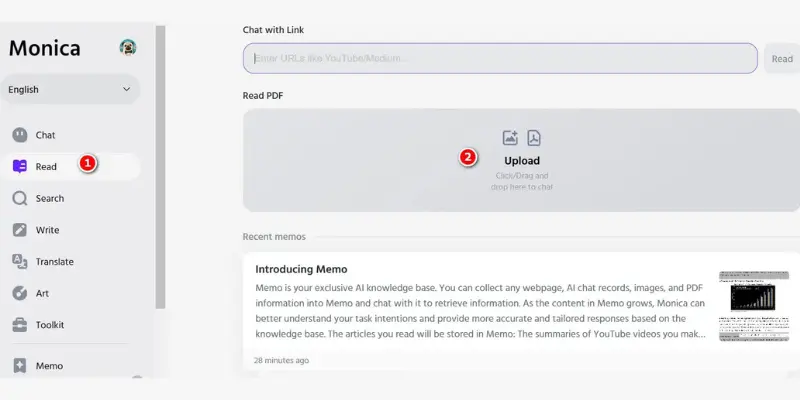
Monica AI
Monica AI rannts foks first because it combines access to multiple leading AI models, real-time web search, browser integration, and competitive pricing in a single platform, making it one of the most practical replacemer Poe AI.
Monica AI takes a different approach from Poe by living inside your browser rather than a separate tab. It is a browser extension and web app that gives you access to GPT, Claude, Gemini, and image and video models like Nano Banana and Sora, right alongside whatever site you are already on.
The sidebar and smart toolbar let you summarize pages, draft replies, translate text, or ask questions without breaking your workflow. For anyone who mainly used Poe for quick research and writing, Monica AI often feels faster in day-to-day use.
If GPT is the model you use most, comparing ChatGPT alternatives can also help you decide whether you really need a multi-model platform like Monica AI.
Key features:
- AI sidebar and smart toolbar available on any webpage
- Access to major models including GPT, Claude, Gemini, and Sora
- Custom bots you can build or choose from ready-made options
- Real-time web access built into responses
Pros:
- Available as browser extension, web app, desktop, and mobile
- Faster for quick tasks since it sits inside your workflow
- Real-time web research built in, not bolted on
Cons:
- Free tier is more limited than the paid plans
- Browser extension format is not for everyone
- Less suited for long, structured research sessions
Pricing: Free tier available. Pro at $9.9/month, Unlimited at $24.9/month, Ultra at $99.9/month.
Best for: Users who want AI assistance built into their everyday browsing rather than a separate destination.
Aymo AI
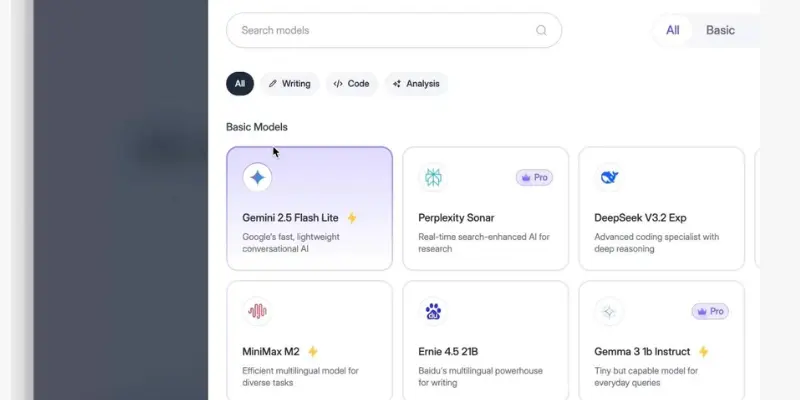
Aymo AI is an all-in-one AI platform that gives you access to more than 45 models, including GPT, Claude, DeepSeek, Perplexity, and Qwen, from a single dashboard. One of its biggest advantages is Bring Your Own Key (BYOK) support, which lets you connect your own API keys and manage usage costs instead of relying entirely on a credit-based system.
Team collaboration is built in as well, making it easy to share chats, prompts, and documents with others working on the same project. That makes Aymo AI a stronger choice than Poe for users who regularly collaborate with colleagues or clients.
If Claude is the model you rely on most for writing and reasoning, exploring Claude AI alternatives can help you decide whether you need a dedicated Claude experience or a multi-model platform like Aymo AI.
Key features:
- Access to 45+ AI models in one dashboard
- Bring Your Own Key (BYOK) support for direct usage control
- Real-time web search and prompt presets
- Team collaboration with shared chats and documents
Pros:
- Budget-friendly pricing across all tiers
- BYOK gives more control than Poe’s points system
- PDF upload, analysis, and editing built in
Cons:
- Smaller model count than some larger aggregators
- Team features matter less for solo users
- Newer platform with a smaller community than Poe
Pricing: Free at $0/month, Basic at $4/month, Premium at $12/month, Business at $25/month.
Best for: Users who want BYOK flexibility and team features at a lower price than Poe’s paid tiers.
TypingMind
TypingMind is built for people who want a clean, chatbot-style interface without sacrificing model depth. It connects to 93 different models, including GPT, DeepSeek, Claude, Grok, Mistral, and Llama, and lets you switch between them mid conversation to compare answers side by side.
Since it runs on a one-time payment rather than a subscription, heavy users who got frustrated watching Poe’s points system chip away at their usage may find the pricing model itself the biggest relief.
Key features:
- Access to 93 AI models through your own API connections
- 25+ plugins and prompt presets
- Model switching mid-conversation for direct comparison
- Custom AI agents for repeatable, automated tasks
Pros:
- One-time pricing instead of a recurring subscription
- No points system to manage or run out of
- Strong fit for developers and prompt engineers
Cons:
- Requires managing your own API keys and their costs
- Less beginner friendly than plug-and-play platforms
- No dedicated mobile app
Pricing: Standard at $39 one-time, Extended at $79 one-time, Premium at $99 one-time.
Best for: Developers and heavy users who want to escape recurring points systems entirely.

ChatHub AI
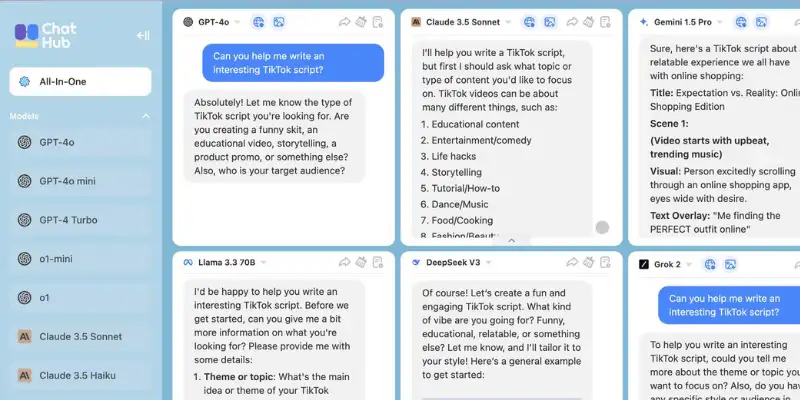
ChatHub AI is built around one specific need: comparing how different AI models respond to the same prompt without constantly switching between tabs. You can send a single prompt to up to four models at once and compare their tone, accuracy, and reasoning side by side.
With access to more than 20 models, including GPT, Claude, Gemini, and Mistral, ChatHub AI focuses less on offering the biggest model library and more on making comparisons fast and practical. That makes it a strong choice for users who regularly test multiple AI models before deciding which response to use.
If your work depends more on fact-checking, web search, and cited answers than comparing models, Perplexity AI alternatives may be a better fit than a general AI aggregator like ChatHub AI.
Key features:
- Send one prompt to up to 4 models simultaneously
- Access to 20+ AI models including GPT, Claude, and Gemini
- Document and image upload and analysis
- Available as web app and browser extension
Pros:
- Best-in-class side-by-side model comparison
- Clean interface built specifically for that use case
- Works well for researchers testing model quality
Cons:
- No free tier with full access
- Fewer total models than the largest aggregators
- Pricing runs higher than some competitors for similar access
Pricing: ChatHub Pro at $19/month, ChatHub Unlimited at $39/month.
Best for: Users whose main use case is comparing how different models answer the same question.
Mammouth AI
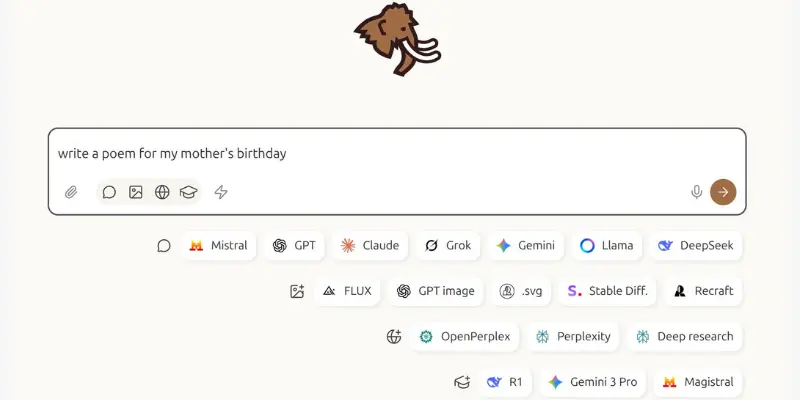
Mammouth AI covers GPT, Claude, Grok, DeepSeek, Gemini, Flux, and Mistral under one roof, with a one-click prompting feature that sends the same message to another model without retyping anything. It also supports over 200 file extensions, which matters if you regularly work with formats beyond plain text and PDFs.
Voice chat and broad file support make it a strong fit for research-heavy workflows where you are testing outputs across multiple models rather than settling on just one.
Key features:
- One-click prompting across multiple connected models
- Support for 200+ file extensions
- Voice chat, image, and file upload support
- Available on web, desktop, and mobile
Pros:
- Wide file format support beyond most competitors
- Easy side-by-side model testing
- Real-time AI-powered web search included
Cons:
- No free plan or trial available
- Pricing is in euros, which adds conversion friction for some users
- Interface has a steeper learning curve than simpler tools
Pricing: Starter at €10/month, Standard at €20/month, Expert at €60/month.
Best for: Heavy users who work across many file types and want to test multiple models per task.
T3 Chat
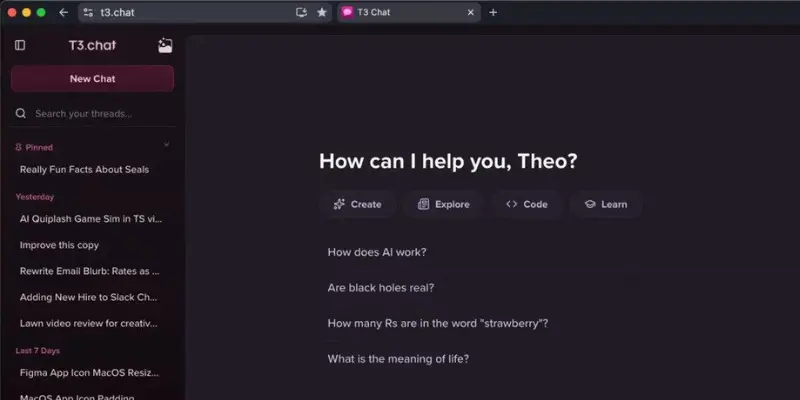
T3 Chat strips things down to what most casual users actually need: fast, accurate answers from around 10 leading models including GPT, Grok, DeepSeek, Gemini, Kimi, and Llama, without the complexity that comes with larger platforms. Model switching happens without losing conversation context, and the interface stays simple enough for anyone to pick up immediately.
For users who found Poe’s interface cluttered once it added group chats and Canvas Apps, T3 Chat’s minimalism can feel like a return to basics.
Key features:
- Access to 10+ leading AI models
- Smooth model switching without breaking conversation flow
- Real-time web search integration
- Save, organize, and export chat history
Pros:
- Simple, beginner-friendly interface
- Generous free tier for lightweight daily use
- Fast, reliable output without unnecessary features
Cons:
- Fewer total models than larger aggregators
- Not built for complex, multi-step workflows
- Limited team or collaboration features
Pricing: Free at $0/month, Pro at $8/month, Premier at $50/month.
Best for: Users who want a fast, no-frills alternative without Poe’s growing feature complexity.
ChatLLM by Abacus AI
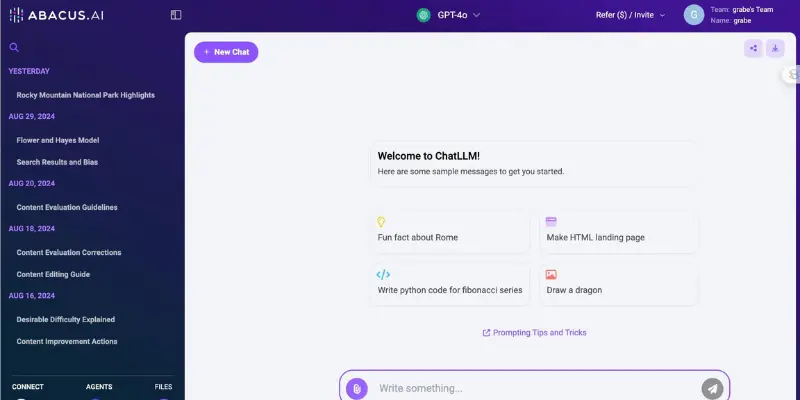
ChatLLM leans toward enterprise and professional use, offering access to more than 100 models including GPT, Claude, Grok, Nano Banana, and Veo-3 under a single subscription. Beyond chat, it includes tools for text-to-speech, video editing, document generation, and custom automations for repetitive workflows.
The pricing structure, a flat monthly rate per user, tends to appeal to teams that found Poe’s points system difficult to predict or budget around.
Key features:
- Access to 100+ AI models in one platform
- Custom AI bots for automating repetitive tasks
- Built-in tools for text-to-speech, video editing, and document creation
- Code generation and execution support
Pros:
- Predictable per-user pricing instead of a points system
- Broadest model count of any option on this list
- Strong fit for professional and enterprise workflows
Cons:
- No free plan available
- Overkill for casual or occasional users
- Interface leans toward business use cases over casual chat
Pricing: $10 per month per user.
Best for: Teams and professionals who want predictable pricing and the widest possible model access.
EaseMate AI
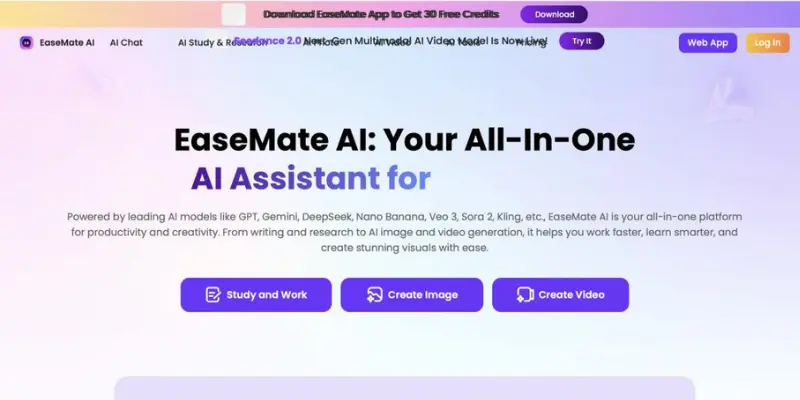
EaseMate AI focuses on everyday productivity rather than raw model count, with around 28 models covering GPT, Gemini, DeepSeek, Claude, and Grok. Built-in tools handle summarizing, email drafting, math problem solving, and flashcard creation, which makes it a comfortable fit for students and content creators rather than developers.
It is available as both a browser extension and standalone app, and works across Windows, macOS, iOS, and Android without any noticeable gaps in functionality.
Key features:
- Access to 28+ AI models for everyday tasks
- Built-in tools for summaries, email drafts, and flashcards
- Side-by-side comparison of model responses
- Works as browser extension and native app across platforms
Pros:
- Strong free tier to test before paying
- Purpose-built tools beyond plain chat
- Good balance of simplicity and capability
Cons:
- Does not support coding tasks well
- Fewer models than the largest aggregators
- Less suited for advanced technical workflows
Pricing: Basic at $0/month, Lite at $8.9/month, Pro at $19.9/month.
Best for: Students, writers, and marketers who want productivity tools alongside multi-model chat.
MagAI
MagAI is built with agencies and marketing teams in mind, offering more than 50 models plus over 50 custom personas designed around specific content and marketing workflows. You can research with one model, outline with another, and generate content with a third, all inside the same conversation thread.
Document editing, export, and team collaboration round out a platform clearly aimed at people managing multiple clients or projects at once, a use case Poe was never really built for.
Key features:
- Access to 50+ AI models with seamless mid-chat switching
- 50+ custom personas for specific workflows
- Document editing, management, and export tools
- Instant credit top-ups without a plan upgrade
Pros:
- Purpose-built for agency and marketing workflows
- Strong persona library saves setup time
- Flexible credit system for variable workloads
Cons:
- No free plan available
- Pricing is steep for solo users
- Learning curve for users unfamiliar with persona-based workflows
Pricing: Starter at $20/month, Pro at $40/month, Ultra at $200/month.
Best for: Agencies and marketing teams managing multiple clients or content workflows at once.
Poe AI Alternatives Comparison Table
We tested these platforms by comparing model availability, pricing, free plans, document handling, memory, and overall ease of use. We also reviewed recent product updates to make sure every recommendation reflects the current experience rather than outdated features.
| Platform | Models | Free Plan | Starting Price | Best For |
| Monica AI | Multiple leading models | Yes | $9.9/month | Browser-based everyday AI use |
| Aymo AI | 45+ models | Yes | $4/month | BYOK flexibility and team features |
| TypingMind | 93 models | No | $39 one-time | Developers avoiding points systems |
| ChatHub AI | 20+ models | No full free access | $19/month | Side-by-side model comparison |
| Mammouth AI | Multiple top models | No | €10/month | Heavy users, wide file support |
| T3 Chat | 10+ models | Yes | $8/month | Simple, budget-friendly daily use |
| ChatLLM by Abacus AI | 100+ models | No | $10/user/month | Enterprise and professional teams |
| EaseMate AI | 28+ models | Yes | $8.9/month | Students and everyday productivity |
| MagAI | 50+ models | No | $20/month | Agencies and marketing workflows |
Which Poe AI Alternative Is Best for Different Users?
If you are still unsure which platform to choose, here is a quick recommendation based on different needs.
- Best overall: Monica AI
- Best free Poe AI alternative: T3 Chat
- Best for GPT and Claude together: Aymo AI
- Best for comparing multiple AI models: ChatHub AI
- Best for developers: TypingMind
- Best for document analysis: Mammouth AI
- Best for teams: ChatLLM by Abacus AI
- Best for marketers: MagAI
- Best for students: EaseMate AI
How to Choose the Right Poe AI Alternative
The best Poe AI alternative depends on the feature you use most. Instead of choosing the platform with the highest number of AI models, focus on the one that fits your daily workflow.
If pricing matters most
Choose a platform with a generous free plan or predictable pricing.
- T3 Chat is ideal if you want a simple free experience.
- Aymo AI offers affordable plans with access to multiple AI models.
- TypingMind is ideal if you prefer a one-time purchase instead of paying a monthly subscription. If you mainly use AI for coding, Cursor AI alternatives are also worth comparing.
If document support is your priority
If you regularly upload PDFs or reference files, pick a platform with stronger file handling.
- Aymo AI includes built-in PDF analysis.
- Mammouth AI supports more than 200 file formats.
If you compare AI models
Some users like testing the same prompt across different models before choosing an answer.
- ChatHub AI lets you compare multiple AI models side by side.
- Monica AI also makes switching between leading models quick and convenient.
If you work with a team
Collaboration features become more important than model count.
- MagAI is well suited for agencies and content teams.
- ChatLLM by Abacus AI includes shared workspaces and business-focused tools.
If you want the simplest switch
If you just want to start chatting again without changing your workflow too much:
- Monica AI offers a familiar browser-based experience.
- T3 Chat keeps the interface clean and easy to use.
If your focus is AI character chat apps rather than productivity or comparing multiple AI models, a dedicated character platform may be a better fit than a general AI aggregator.
The good news is that most Poe AI alternatives offer a free plan or trial. Testing two or three platforms yourself is the easiest way to find the one that matches your workflow before paying for a subscription.
Conclusion
Poe was genuinely useful for a while, an easy way into multi-model AI without juggling five different subscriptions. But the 90 percent points cut and the Knowledge Base shutdown were not small adjustments, they changed what the platform is actually good for, and for a lot of users, that shift was the final push.
The best Poe AI alternatives is not necessarily the one with the most models. It is the one that fixes the specific thing that broke your workflow, whether that is disappearing free usage, lost files, or the lack of any real memory between sessions.
FAQs
Poe made two major changes in 2026. On March 30, it cut daily free points from 3,000 to 300, a 90 percent reduction. On May 25, it permanently shut down the Knowledge Base feature, deleting every file users had uploaded to power their custom bots. Both changes pushed a large number of users to look for alternatives.
T3 Chat and Aymo AI both offer genuinely usable free tiers. T3 Chat is free with no credit card required for basic use, while Aymo AI’s free tier includes access to multiple models without an aggressive paywall
TypingMind uses one-time pricing instead of a recurring points system, which removes the anxiety of watching usage drain. Platforms like ChatLLM by Abacus AI use flat per-user monthly pricing rather than variable credits.
ChatLLM by Abacus AI offers access to more than 100 models, the largest count among the platforms covered here. TypingMind follows closely with 93 models.
No. Poe’s Knowledge Base shutdown on May 25, 2026 was permanent, and there is no official way to recover files uploaded before that date. If you still have access to a Poe account with an active Knowledge Base, back up your source files immediately, since the deletion cannot be reversed once it happens.
MagAI is built specifically around agency and marketing workflows with custom personas and client management features. ChatLLM by Abacus AI is the stronger pick for larger enterprise teams that need predictable per-user pricing.
Most of them overlap heavily with Poe’s model lineup, including GPT, Claude, Gemini, and DeepSeek. The differences come down to how many total models each platform supports, how pricing is structured, and whether memory and file handling work differently than Poe’s session-based approach.






- Be Respectful
- Stay Relevant
- Stay Positive
- True Feedback
- Encourage Discussion
- Avoid Spamming
- No Fake News
- Don't Copy-Paste
- No Personal Attacks
- Be Respectful
- Stay Relevant
- Stay Positive
- True Feedback
- Encourage Discussion
- Avoid Spamming
- No Fake News
- Don't Copy-Paste
- No Personal Attacks
