AI in Marketing : Strategies, Tools, & Use Cases
Published: 7 Jan 2026
Are you having trouble keeping up with all the new marketing tools and strategies? It’s easy to get mixed up about what really works. This guide will show you how to use AI in marketing in real life to find the right people, save time, and grow your business. We’ll discuss tips, examples, and easy things you can do right now. You will also learn how to make your campaigns smarter and more effective without spending more time. You will feel sure that you can use these strategies in your marketing and get real results by the end.
What is AI in Marketing?
Marketing today can feel confusing with so many tools and strategies. Understanding ai in marketing helps businesses reach the right customers and make smarter decisions.
- AI in marketing helps businesses handle tasks on its own and choose better options
- It can analyze customer behavior, suggest content, or personalize messages.
- AI tools help marketers save time and improve results without guessing.
Real-life example:
- An online shop uses AI in marketing to suggest products customers are likely to buy.
- This increases sales automatically without the owner checking each customer manually.
Difference Between AI, Machine Learning & Generative AI
- AI (Artificial Intelligence): Machines or tools that perform tasks like humans.
- Machine Learning (ML): A type of AI that learns from past data to make better predictions.
- Generative AI: A type of AI that can create new content, such as images, text, or ads.
Real-life example:
- A clothing brand uses ML to predict which items will sell best next month.
- They use generative AI to design ad images automatically without a designer.
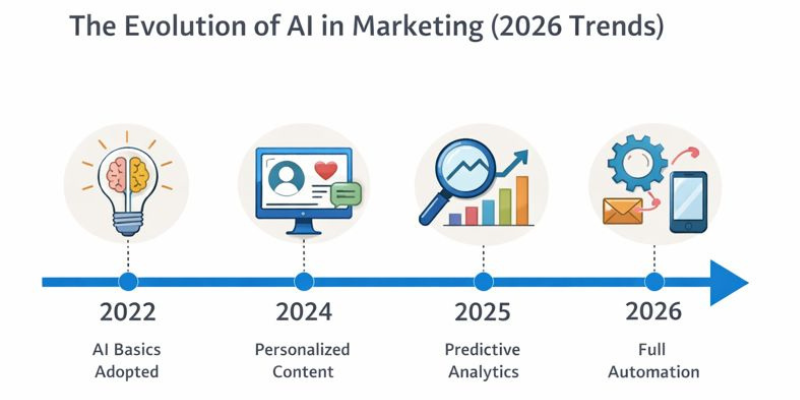
How AI is Changing Marketing (2026 Trends)
By 2026, AI in marketing is making campaigns faster, smarter, and more personal than ever. Businesses can reach the right customers and make better decisions quickly. These changes matter because they save time, increase sales, and improve customer experience.
Understanding these trends gives marketers a real advantage in planning effective campaigns.
Personalized Content at Scale
- AI in marketing automatically generates content relevant to each customer.
- It can suggest products, emails, or ads based on past behavior.
- Businesses can reach thousands of people with messages that feel personal.
Real-life example:
- An online clothing store uses AI to send personalized emails to 10,000 customers. Each email shows items the customer is likely to buy. This increased click rates by 25%.
Predictive Analytics
- AI in marketing decides what customers will do next using previous data.
- It can forecast sales, turnover, and product interest.
- Before customers ever choose action, businesses can take action.
Real-life example:
- A subscription box company used machine learning to determine which subscribers might cancel the next month. They sent specific offers to 500 high-risk consumers, keeping 60% of them.
Marketing Automation
- AI in marketing automates posting content, updating campaigns, and organizing leads.
- It reduces routine work and allows teams to focus on strategy.
- Automation helps run campaigns 24/7 without extra staff.
Real-life example:
- A small business uses AI to schedule social media posts for the week.
- They also organize incoming customer messages automatically. This saved 10 hours of work per week.
Real-Time Audience Engagement
- AI in marketing adjusts messages or offers instantly based on user actions.
- It can show discounts, suggest products, or answer questions immediately.
- This creates a better experience and higher conversions.
Real-life example:
- An online shop shows a special discount when a visitor adds items to their cart but is unsure about buying
- Conversion rates improved by 15% within a month.
AI Decision Support
- AI in marketing provides data-driven suggestions for campaigns and strategies.
- It helps marketers choose the best channels, offers, or content quickly.
- Teams can make smarter decisions without guessing.
Real-life example:
- A marketing team used AI to analyze past email campaigns.
- The tool suggested the best send times and subject lines, increasing open rates by 20%.
Key Points
- AI in marketing helps create personalized content for many customers quickly.
- It predicts customer behavior to make planning easier.
- Automation saves time by handling routine tasks.
- Real-time engagement improves satisfaction and sales.
- AI tools guide marketers to make quick, good decisions.
Key AI Tools & What They Do
Knowing the right ai in marketing tools can make a huge difference for your campaigns.
The right tools save time, increase results, and help you focus on strategy.This list shows the top tools and what they do in simple words.You can use it to pick the tool that fits your business needs best
ChatGPT
- Helps create content for blogs, ads, and social posts quickly.
- Can write SEO-friendly text and suggest headlines or ad copy.
- Works for small businesses, freelancers, and content teams.
Example:
- A small online shop uses ChatGPT to write weekly blog posts in minutes. This saves 5 hours per week.
Generative AI Platforms (like Jasper)
- Creates visuals, ads, and videos automatically.
- Can generate images, graphics, and video content for campaigns.
- Helps marketing teams produce creative content faster.
Example:
- A social media manager uses Jasper to make ad visuals for Instagram. The process that took hours now takes 15 minutes.
Analytics AI Tools
- Analyze data to predict customer behavior and trends.
- Provide insights to improve campaigns and marketing strategies.
- It can predict sales, customer interest, or product demand
Example:
- A shop uses AI to guess which products will sell next month. They order those items early and avoid wasting stock.
Marketing Automation AI
- Automates email campaigns, social media posting, and workflows.
- Helps manage routine tasks and reach audiences regularly.
- Saves time for teams by running campaigns automatically.
Example:
- A local cafe uses automation AI to send daily offers via email. Customer engagement increased by 20% in one month.
Key Points
- ChatGPT is great for fast content generation and SEO.
- Generative AI platforms help create visuals, ads, and video content quickly
- Analytics AI tools predict trends and customer behavior for smarter decisions.
- Marketing automation AI handles routine tasks like emails and social posts.
- Using the right ai in marketing tools saves time, improves results, and makes campaigns more effective.
Practical AI Marketing Strategies
Using AI in marketing is powerful, but many guides only talk about tools or theory.
Practical strategies show you exactly how to apply AI to improve results. These methods save time, increase engagement, and make your campaigns smarter. This section gives clear steps and examples beginners can follow today to get real results with AI in marketing.
AI Workflows for Email Automation
- AI can send emails automatically based on customer actions.
- It can personalize subject lines and content for each user.
- It helps keep your audience interested without doing the work yourself
Steps to apply:
- Choose an AI email tool like Mailchimp or HubSpot.
- Set triggers (e.g., sign-up, purchase, abandoned cart).
- Create email templates personalized for different segments.
- Try out your campaigns and set them to run automatically
Real-life example:
- An online store uses AI in marketing to send follow-up emails when customers leave items in their cart. Sales increased by 18%.
Use AI to Analyze Customer Behavior
- AI studies customer actions to find trends and preferences.
- Helps predict what products or content customers want next.
- Helps make better decisions for marketing campaigns
Steps to apply:
- Collect data from websites, email, and social media.
- Use an AI analytics tool to identify patterns.
- Segment customers by interest or behavior.
- Tailor marketing campaigns to each segment.
Real-life example:
- A subscription box company used AI in marketing to track popular products. They promoted high-demand items first, increasing revenue by 12%.
AI for SEO Content Planning
- AI helps find topics your audience searches for.
- It suggests keywords, headlines, and content ideas.
- Makes SEO planning faster and more effective.
Steps to apply:
- Use an AI content tool like ChatGPT or Jasper.
- Enter your niche or topic to get keyword ideas.
- Plan blog posts and social content around high-interest keywords.
- Update content regularly based on AI suggestions.
Real-life example:
- A small business used AI in marketing to find trending blog topics. Their site traffic grew 30% in three months.
AI to Optimize PPC Campaigns
- AI can manage ads automatically and suggest better targeting.
- It analyzes which ads perform best and adjusts budgets.
- Helps increase ROI without human work.
Steps to apply:
- Connect your PPC account to an AI tool.
- Set goals like clicks, conversions, or leads.
- Let AI test different ads and adjust campaigns.
- Watch the results and make changes if needed.
Real-life example:
- A digital marketer used AI in marketing to run Google Ads. Click-through rates increased by 22% while spending stayed the same.
AI to Improve the Customer Journey
- AI guides customers through the buying process smoothly.
- It can suggest products, answer questions, and make things easier for customers
- Creates a better experience and higher satisfaction.
Steps to apply:
- Map your customer journey from discovery to purchase.
- Identify where AI can help (chatbots, recommendations, follow-ups).
- Implement AI tools to assist at each step.
- Track results and refine the journey over time.
Real-life example:
- An online store used AI in marketing chatbots to answer product questions instantly. Customer satisfaction scores increased by 25%.
Key Points
- AI email workflows save time and improve engagement.
- Analyzing customer behavior with AI in marketing helps make smarter choices.
- AI content planning helps your SEO and brings more visitors
- Optimizing PPC campaigns with AI increases ROI automatically.
- AI improves the customer journey, boosting satisfaction and conversions.
- Applying these practical AI in marketing strategies today gives beginners results they can see quickly.
Case Studies & Examples
Many guides only explain theory, but real AI in marketing examples show what works.
Case studies help you see practical results and understand how to apply tools yourself.
They reveal mistakes to avoid and strategies to copy. This section gives clear, real-world examples you can use today.
Brands Using AI for Ads & Creatives
- Brands use AI to create visuals, videos, and ads automatically.
- AI tests multiple ad versions to find the best performers.
- Saves time and improves campaign results without hiring extra staff.
Real-life example:
- A small fashion brand used AI in marketing to generate Instagram ads for new collections. The AI created 5 ad versions daily, increasing click-through rates by 30%.
ChatGPT for Marketing Content
- Companies use ChatGPT to write blogs, email newsletters, and social posts.
- AI suggests headlines, keywords, and content ideas.
- Reduces time spent writing while improving content quality.
Real-life example:
- An online bookstore used ChatGPT to write weekly blog posts. They published 4 posts per week instead of 1, doubling their website traffic in two months.
AI for Personalization at Scale
- AI checks customer information to deliver messages and offers that fit their needs
- Can personalize emails, recommendations, and promotions automatically.
- Improves engagement and increases conversion rates.
Real-life example:
- A subscription meal service used AI in marketing to send weekly personalized recipes based on user preferences. Orders increased by 20% in three months.
AI in Customer Engagement & Support
- AI chatbots and virtual assistants answer questions instantly.
- AI handles routine questions so people can work on more difficult tasks
- Provides faster support and improves customer satisfaction.
Real-life example:
- A tech company implemented AI chat support to handle troubleshooting questions. Response times dropped from hours to seconds, and customer satisfaction rose by 25%.
Key Points
- Real brands use AI in marketing to create ads, content, and visuals efficiently.
- AI personalizes campaigns at scale, increasing engagement and sales.
- ChatGPT and other tools save time writing blogs, emails, and social posts.
- AI chatbots improve support, giving customers faster responses.
- Studying these examples helps marketers apply strategies they might otherwise miss.
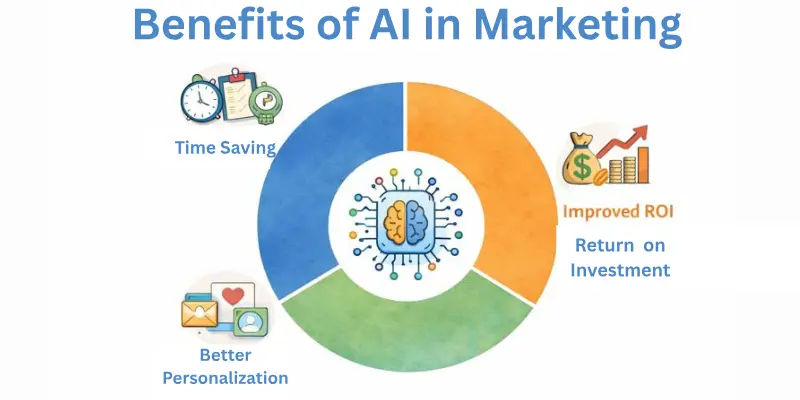
Benefits of AI in Marketing
Understanding the benefits of AI in marketing helps businesses make smarter decisions.AI saves time, improves results, and helps marketers focus on strategy. It provides measurable results that competitors often skip showing clearly. This section explains key advantages you can apply to your campaigns today using AI in marketing.
Reduced Manual Work
- AI automates routine marketing tasks like emails, social posts, and data organizing.
- Helps teams focus on strategy and creative work.
- It lowers mistakes that happen when people do tasks by hand.
Stats/Data:
- Companies using AI automation report up to 30% time saved on routine marketing tasks (Source: McKinsey).
Real-life example:
- A small e-commerce store used AI in marketing to schedule daily social media posts automatically. The team saved 10 hours per week previously spent on manual posting.
Better ROI (Return on Investment)
- AI analyzes campaigns in real time and suggests adjustments.
- Helps marketers spend budget on the best-performing channels.
- Reduces wasted spending on low-performing campaigns.
Stats/Data:
- Businesses using AI for marketing optimization see an average 20% increase in ROI
Real-life example:
- A digital marketing agency used AI in marketing to track ad performance and shift budgets automatically. Conversions increased by 25% without increasing ad spend.
Improved Personalization
- AI sends messages, emails, and offers based on what customers do
- Provides a personalized experience for each customer automatically.
- Increases engagement, click-through rates, and sales.
Stats/Data:
- Personalized campaigns powered by AI increase conversion rates by 15–20%
Real-life example:
- AI helped the subscription box business suggest items users like. Customer interest and repeat sales went up.
Key Points
- AI in marketing reduces manual tasks and saves valuable time.
- It improves ROI by optimizing campaigns and spending smartly.
- AI helps marketers send messages for each customer to many people, which increases interest and sales.
- Using these benefits helps marketers do better than competitors
How to Get Started with AI Marketing (Beginner Steps)
Starting with ai in marketing can feel confusing for beginners.But simple, clear steps make it easy to get results fast.You don’t need to know everything at once.This section shows a low-risk roadmap to begin using AI in marketing today.
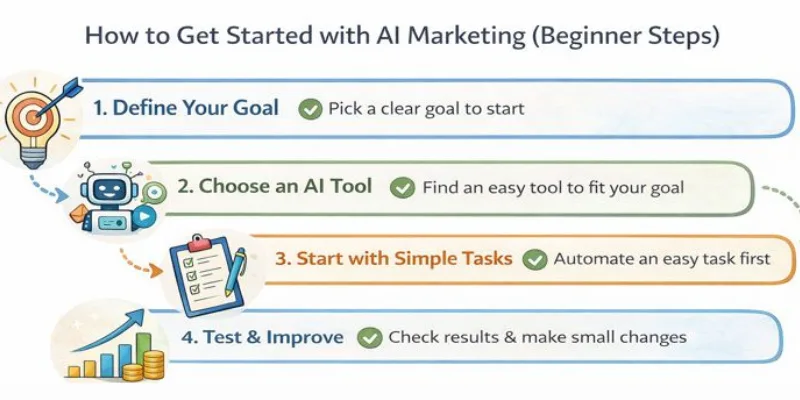
Define Your Marketing Goal
- Decide what you want to achieve first: more traffic, higher sales, or better engagement.
- Focus on one goal at a time for clarity.
- Write your goal down and keep it measurable.
Tip: Start with a goal you can track easily, like email clicks or social engagement.
Real-life example:
- A local bakery set a goal to increase online orders by 15% using AI in marketing. They tracked clicks on their website ads to measure success.
Choose the Right AI Tool
- Pick a beginner-friendly AI tool that fits your goal.
- Look for free trials or simple interfaces.
- Check if it integrates with tools you already use (email, social, analytics).
Tip: Don’t try to use all tools at once. Start small.
Real-life example:
- A small online shop chose an AI email tool to automate welcome emails. The tool was easy to use and connected with their existing email list.
Start with One Simple Task
- Begin with a task you do often, like scheduling posts or writing emails.
- Use AI to automate just that task at first.
- Keep it simple to build confidence.
Tip: Avoid difficult projects until you feel comfortable.
Real-life example:
- A freelance designer used AI in marketing to schedule Instagram posts for one week. They saved 5 hours and learned how the tool works.
Test, Measure, and Improve
- Track results to see what works.
- Adjust your approach based on performance data.
- Repeat and improve slowly
Tip: Keep testing small changes instead of changing everything at once.
Real-life example:
- A fitness coach used AI in marketing to test two email subject lines. The version with emojis had a 12% higher open rate.
Scale Slowly
- Once a task works well, expand to other tasks or channels.
- Don’t rush; growing step by step avoids mistakes.
- Create a workflow you can use again and again to save time
Tip: Focus on quality first, not quantity.
Real-life example:
- A small clothing brand used AI to post on social media. Seeing good engagement, they also used AI for ads.
Key Points
- Begin with a clear, simple marketing goal.
- Choose one easy AI tool that fits your needs.
- Start small and focus on one task at a time.
- Test results, measure impact, and make improvements.
- Scale gradually as you gain confidence.
- Using these steps, beginners can start ai in marketing safely and effectively.
Challenges & Risks of AI in Marketing
Talking only about benefits gives an incomplete picture.Every smart tool also brings risks and limits.AI in marketing can help a lot, but it also needs care.This section explains common challenges so beginners can stay safe and confident.
Data Privacy Concerns
- AI uses customer data like emails, clicks, and behavior.
- Poor data handling can expose private customer information.
- Laws require businesses to protect user data carefully.
- Marketers must choose tools that follow privacy rules.
How to reduce the risk:
- Use trusted tools with clear privacy policies.
- Collect only the data you truly need.
Real-life example:
- A company put customer emails into an AI tool without asking. Customers complained, and the brand lost trust.
AI Bias and Fairness Issues
- AI learns from past data that may contain bias.
- If the data is biased, ads may treat people unfairly.
- This can exclude certain groups of people.
- Brands can damage their image without knowing it.
How to reduce the risk:
- Review AI outputs regularly.
- Use different types of data and keep it fair when possible.
Real-life Example
- A job ad system mostly showed ads to men because past data was biased. The company had to change its targeting rules.
Skill Gaps in Marketing Teams
- Many teams lack AI knowledge.
- People may trust AI too much without checking results.
- Poor understanding can lead to wrong decisions.
How to reduce the risk:
- Train teams with basic AI skills.
- Start with simple tools and tasks.
Real-life example:
- A marketing team used AI reports without review and cut a campaign that was actually performing well.
Ethical Concerns in AI Usage
- AI can make content that seems fake or confusing.
- Overuse can remove the human touch in marketing.
- Customers value honesty and transparency.
How to reduce the risk:
- Use AI as support, not replacement.
- Always review content before publishing.
Real-life example:
- A brand sent AI-written emails that sounded robotic. Customers felt disconnected and unsubscribed.
Key Points
- AI in marketing brings risks along with benefits.
- Data privacy needs strong protection.
- Bias can affect fairness and brand trust.
- Skill gaps can lead to poor decisions.
- Ethical use keeps marketing human and honest.
- Smart marketers manage risks instead of ignoring them.
Future of AI in Marketing
The future of ai in marketing is coming faster than many expect. Marketers who prepare early will stay ahead of others. New tools will change how daily marketing work happens.
AI Agents for Marketing Tasks
- AI agents are like helpers that do tasks on their own
- They handle tasks like posting content, replying to leads, and tracking results.
- These agents do the work while marketers give instructions
- Beginners save time and focus on ideas, not tools.
Real-life future example:
- A small business uses one AI agent to run email campaigns, reply to leads, and update reports every day without manual work.
Fully Automated Campaign Creation
- AI creates full campaigns from start to finish.
- It plans ads, writes content, and selects channels automatically.
- Marketers review and approve instead of building everything.
- Teams launch campaigns faster with fewer errors.
Real-life future example:
- A brand enters a goal like “increase sales,” and AI creates ads, emails, and landing pages in minutes.
Multimodal AI in Marketing (Text, Image, Video, Voice)
- Multimodal AI works with text, images, videos, and voice together.
- One tool creates blogs, ads, videos, and voice messages.
- Marketing stays the same on all platforms
- Beginners create rich content without extra skills.
Real-life future example:
- A marketer writes one message, and AI turns it into a blog post, a video ad, a podcast clip, and social posts.
Key Points
- The future of ai marketing focuses on automation and speed.
- AI agents will handle daily marketing tasks.
- Campaigns start with very little work from people.
- This AI can produce different kinds of content together.
- Marketers who prepare early will lead with confidence.
Conclusion
Guys, in this guide we covered everything you need to know about AI in marketing, from basic ideas to real examples, benefits, risks, tools, and future trends. We explored how marketers use it today, how it saves time, improves results, and helps teams make better decisions. We also talked about challenges and how to avoid common mistakes so you can stay safe and confident. My honest recommendation, buddies, is to start small, focus on one goal, and grow step by step instead of trying everything at once. Folks, keep learning, keep improving, and stay tuned for more helpful guides ahead.
AI in marketing helps businesses understand customer actions better. It helps write emails, suggest content ideas, and show the right ads to the right people. Marketers also use it to automate repeated tasks like posting and reporting. This saves time and improves results
Yes, ai in marketing works very well for small businesses. It helps small teams do more work with less effort and budget. Tasks like email sending, customer replies, and basic analysis become easier. This helps small businesses compete with bigger brands
No, ai in marketing cannot replace marketers. It supports them by handling routine and boring tasks. Humans still create ideas, plan strategy, and make final decisions. The best results come when people and tools work together.
AI in marketing can cause problems if people use it without care. Poor data handling can harm customer trust. Sometimes results can be unfair or inaccurate. That is why human review and clear rules are important.
Beginners should start small with ai in marketing. They can begin with one task like email automation or content planning. Free or easy tools help reduce risk at the start. Learning step by step builds confidence and skill.



- Be Respectful
- Stay Relevant
- Stay Positive
- True Feedback
- Encourage Discussion
- Avoid Spamming
- No Fake News
- Don't Copy-Paste
- No Personal Attacks
- Be Respectful
- Stay Relevant
- Stay Positive
- True Feedback
- Encourage Discussion
- Avoid Spamming
- No Fake News
- Don't Copy-Paste
- No Personal Attacks
