What is Data Annotation? A Beginner-Friendly Guide
Published: 25 Dec 2025
Do you have any doubts about how AI systems develop and learn? Data annotation is the key. We will examine how data annotation is an important component of creating AI models in this guide. Large volumes of accurately labeled data are necessary for AI systems to properly train and learn. We will examine its importance, especially in supervised learning, where models are trained on datasets with annotations. You will understand the importance of data annotation for creating more intelligent and dependable AI systems by the end of this guide.
What is Data Annotation?
The process of labeling data to make it machine understandable is known as data annotation, and it helps AI systems in learning and decision making.
- Data Labeling: Data annotation is the process of adding labels or tags to raw data such as text, audio, or images.
- AI training: It enables AI systems to make predictions by identifying patterns in labeled data.
- Crucial for Supervised Learning: To learn from examples, models in supervised learning rely on documentation.
- Used in Many Industries: Data annotation is important in industries like finance, self-driving cars, and healthcare.
- Enhances Accuracy: AI models can make more intelligent and reliable choices when they have access to well-annotated data.
Example of Data Annotation:
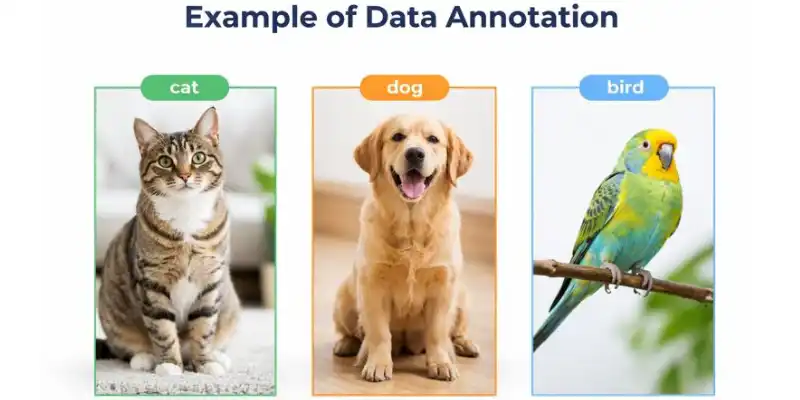
Imagine you’re training an AI model to recognize animals in pictures. You have a collection of images, but the AI doesn’t know what’s in them. To help the AI learn, you label the images.
- In one picture, you label a cat with the tag “cat.”
- In another, you label a dog with the tag “dog.”
- You might label a bird image with the tag “bird.”
Each of these labels (cat, dog, bird) helps the AI system learn to recognize similar animals in other pictures. This is how data annotation works; it provides the necessary labels that allow AI to understand and learn from data.
Why Data Annotation Matters for AI
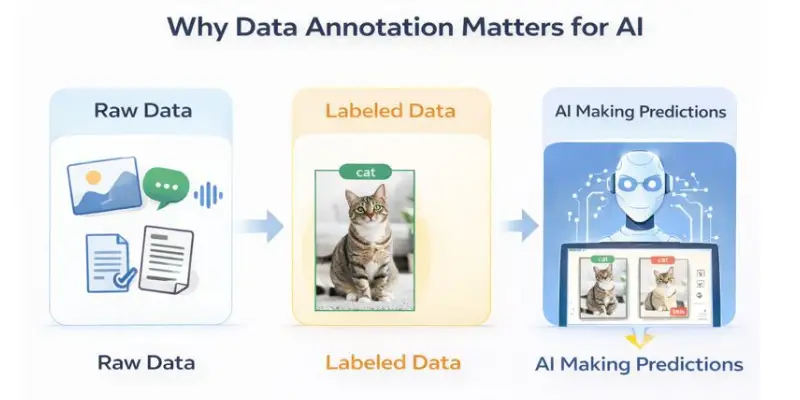
The process of labeling or tagging data to help in machine learning and understanding is known as data annotation. For machine learning (ML) and artificial intelligence (AI) models to be trained, this step is essential. AI systems cannot correctly understand or respond to data without proper tags.
- Improves Accuracy:Data annotation helps AI systems make better predictions by showing them what to look for in data.
- Boosts Model Training:Annotated data is important for teaching AI models how to spot patterns and make decisions.
- Enhances Performance: Correctly labeling data makes AI and ML models work better in the real world.
- Enables Automation: With the right annotations, AI can do tasks that would normally need human help, which saves time and money.
- Drives Business Growth:Businesses can grow by using AI models trained on high-quality annotated data to make better decisions, give customers a better experience, and work more efficiently.
- Supports Continuous Learning:Annotated data helps AI models learn and adapt as new data comes in. This makes sure they work well for a long time
Data annotation plays a key role in ensuring AI and ML models are accurate, reliable, and impactful in delivering valuable business results.
How Data Annotation Works
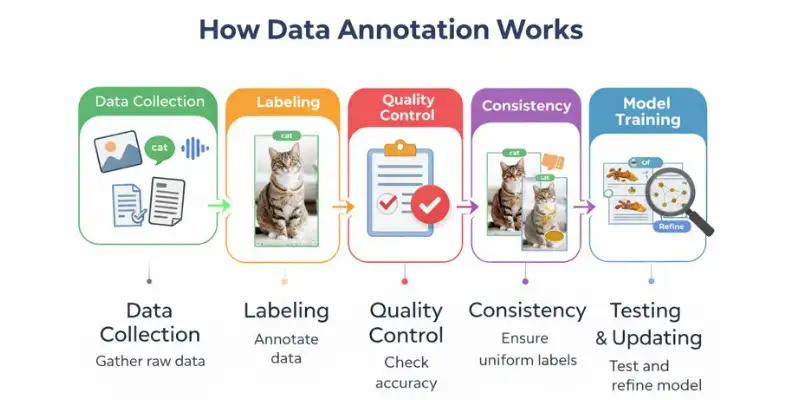
Data annotation is the process of tagging data so that computers can understand it. This is crucial for teaching AI and machine learning models how to find patterns and make choices. To train the AI, you must ensure that the tagged data is accurate and consistent.
- Data Collection: First, raw data (images, text, audio, etc.) is collected from various sources. For example, a set of images may be gathered for a computer vision project.
- Labeling: Each piece of data is then labeled by experts. For example, an image of a cat will be tagged with the label “cat.” This helps the AI system understand what’s in the data.
- Quality Control:The most important thing is quality! The data is checked for accuracy after it has been labeled. They fix any mistakes or things that don’t make sense. This step is very important because incorrect annotations make the AI model work poorly.
- Consistency: Consistency is maintained by following strict guidelines and using the same labeling approach for every piece of data. For example, if one image is labeled “cat,” all similar images must be labeled the same way to ensure the AI learns correctly.
- Model Training: Once the data is labeled, it’s used to train AI models. The machine learns from the labeled data, improving its ability to recognize patterns and make predictions.
- Testing and Updating: The AI model is tested with new data after it has been trained. If the results aren’t satisfactory enough, the annotations are improved and the model is trained again.
Why Quality and Consistency Matter:
It is critical to keep annotations of high quality and consistency. AI models can make wrong predictions if the labels aren’t correct and consistent. For instance, in an AI system thatAnalyzing medical images with incorrect labels could lead to inaccurate diagnoses, which may have serious consequences.Consistent labeling ensures that the model receives accurate learning signals, resulting in trustworthy outcomes.
Types of Data Annotation
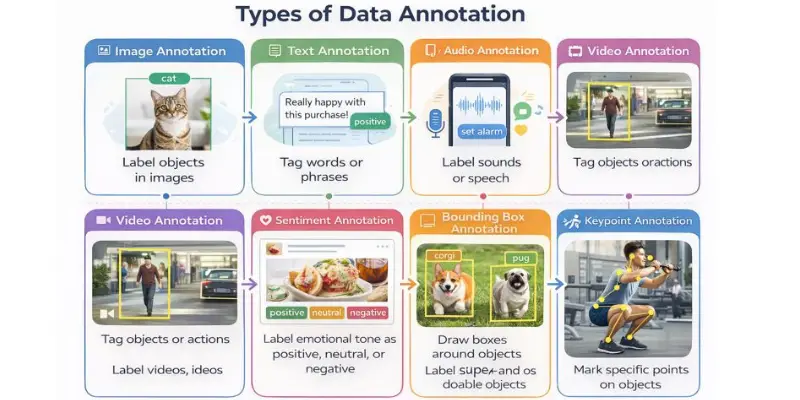
Data annotation is the process of labeling or tagging data to help machines understand it. This step is important for training AI and machine learning models, as accurate data is needed to make the right decisions. Here are the different types of data annotation:
Image Annotation
- Labels objects in images so AI can recognize them.
- Example: In self-driving cars, images of roads are annotated to identify traffic signs, pedestrians, and other vehicles.
- Helps in object detection: Security systems use image annotation to find people or things in video footage.
Text Annotation
- Tags parts of text, such as words or sentences, to help AI understand meaning.
- Example: A chatbot uses text annotation to recognize phrases like “order status” or “refund request.”
- Improves search results: Text annotation is used to help search engines provide more relevant results based on keywords.
Audio Annotation
- Labels sounds or speech in audio files to train AI on recognizing specific words or noises.
- Example: Voice assistants use audio annotation to recognize commands like “play music” or “set alarm.”
- Helps in speech-to-text systems: Audio annotation helps transcription tools turn spoken words into written text more accurately.
Video Annotation
- Labels objects, actions, or events in video clips to help AI understand movements.
- Example: In video surveillance, AI uses video annotation to detect actions like “person walking” or “vehicle entering.”
- Used in behavior analysis: Video annotation helps AI systems monitor and understand behaviors in videos for training or security.
Sentiment Annotation
- Labels text based on its emotional tone, such as positive, negative, or neutral.
- Example:Sentiment annotation is used in social media analysis to figure out if posts are joyful, angry, or sad.
- Improves customer insights: Sentiment annotation helps businesses understand customer feedback and improve services.
Bounding Box Annotation
- Involves drawing boxes around objects in images to define their location.
- Example: In facial recognition systems, bounding boxes are used to highlight faces in images to identify individuals.
- Supports object tracking: Bounding boxes are used in video tracking systems to follow moving objects, like cars or people.
Keypoint Annotation
- Labels specific points on an object, often for tracking its movement or position.
- Example: Sports analytics use keypoint annotation to track a player’s joints and movements during a game.
- Helps with gesture recognition: Key point annotation is used in gaming to track hand movements and create interactive experiences.
Industry Applications of Data Annotation
Data annotation is important because it helps machines understand information. This helps businesses use AI to make better decisions and work more efficiently. Below are some real world ways data annotation is used in different industries:
Healthcare
- Medical Image Labeling: AI can identify indicators of diseases like cancer by annotating medical images like MRIs and X-rays.
Example: Labeling parts of X-ray images to highlight tumors so doctors can spot them faster. - Faster Diagnoses: Doctors can diagnose patients more quickly and provide the proper therapy sooner if the labels are more accurate..
Retail
- Product Recommendation Systems: Annotating product descriptions and reviews helps AI recommend items to customers.
Example: Labeling reviews and product features to suggest products based on what the customer likes. - Better Shopping Experience: With good annotations, customers see more relevant product suggestions, making shopping easier and faster.
Automotive
- Self-Driving Cars: Data annotation helps self-driving cars understand their surroundings, like roads and other cars.
Example: Labeling road signs and pedestrians in images so the car can make safe driving decisions. - Improved Safety: Proper annotations allow self-driving cars to avoid accidents and respond to real world situations safely.
Finance
- Fraud Detection: Annotating financial transactions helps AI find and stop fraud.
Example: As an example, marking specific transactional patterns as unusual can assist banks in identifying fraud - Less Mistakes: Accurate labels help reduce mistakes in fraud detection, making the system work more effectively.
E-commerce
- Search and Categorization: Annotating product images and descriptions helps AI organize products correctly.
Example: Labeling images and descriptions to improve search results, making it easier for customers to find what they need. - Better Product Discovery: Properly labeled products make it easier for customers to find exactly what they’re looking for, increasing sales.
Agriculture
- Crop Monitoring: Data annotation helps farmers spot problems with crops, like pests or diseases.
Example: Annotating satellite images of crops to find areas that need attention. - Better Crop Planning: Data annotation helps predict crop health and growth, so farmers can plan better for the future.
Security
- Video Surveillance: Annotating videos helps AI recognize activities like people moving or vehicles entering.
Example: Labeling videos to track movement helps security systems detect threats faster. - Faster Response:Clear annotations improve safety by enabling security teams to respond quickly to issues.
Entertainment and Media
- Content Recommendations: Data annotation helps streaming platforms suggest shows or movies based on user preferences.
Example: Labeling movie genres or user preferences to recommend similar content. - Keeps Viewers Engaged: With better recommendations, users can find content they enjoy, which keeps them coming back.
Manufacturing
- Quality Control: In factories, data annotation helps spot defects in products.
Example: Annotating images of products on an assembly line to find defects and ensure quality. - Improves Efficiency: Accurate labeling helps find problems early, reducing waste and speeding up production.
Data annotation helps AI systems learn and become smarter across many industries. With clear and correct labeling, businesses can work more efficiently, improve customer experience, and create better AI systems.
Common Challenges & Ethical Considerations in Data Annotation
Data annotation is key for training AI, but it comes with some difficulties. It’s also important to think about ethical issues to make sure everything is fair and private. Let’s look at these challenges and ethical concerns with examples.
Common Challenges in Data Annotation
- Takes a Lot of Time: Annotating large amounts of data can take a lot of time and effort.
Example: Annotating thousands of product images for an online store could take days, slowing down the project. - Inconsistent Labels: Different people may label data in different ways, leading to mistakes.
Example: One person might label a picture of a dog as “dog” while another labels it as “puppy,” causing confusion in the AI model. - Handling Big Datasets: Large amounts of data can be overwhelming to handle and annotate correctly.
Example: A video surveillance company might have a lot of videos to label, and doing it by hand can be very hard. - Complex Data: Some data, like medical images or voice recordings, can be hard to label correctly.
Example: Annotating a medical scan to find small tumors requires expert knowledge, and a mistake could lead to incorrect diagnoses.
Ethical Considerations in Data Annotation
- Bias in Data: If the data doesn’t represent all groups of people, the AI model can become biased.
Example: If a facial recognition system is only trained on white faces, it might not work well for darker-skinned people, which could lead to unfair results. - Privacy Issues: Using personal or sensitive data without care can lead to privacy problems.
Example: Annotating customer feedback with personal details like names or addresses could risk violating privacy if the data isn’t properly anonymized. - Lack of Transparency: People may not trust the AI if they don’t know how the data is labeled.
Example: If users don’t understand how a social media platform’s content review works, they might think the system is unfair or biased. - Informed Consent: People should know and agree to how their data is used.
Example: Before collecting health data from patients, a hospital should explain how the data will be used for AI research to get proper consent. - Fair Pay for Annotators: Annotators should be paid fairly for their work, especially when working online.
Example: If a company hires workers to label thousands of images but pays them very little, it can lead to low-quality work and dissatisfaction.
How to Get Started with Data Annotation
Data annotation is very important when building AI and machine learning models. It helps the AI understand the data better and make more accurate predictions. If you’re new to data annotation, here’s a simple guide to help you get started.
Choose the Right Type of Annotation for Your Project
- Decide what kind of data you have: Is it images, text, audio, or video? The type of data will decide how you annotate it.
Example: For images, you’ll need to label objects (like “cat” or “dog”). For text, you might need to mark keywords or emotions (like “happy” or “sad”).
Pick the Right Tools for Annotation
- Use tools to make it easier: Choose tools based on the type of data you are working with.
Example: For images, try tools like LabelImg or VGG Image Annotator. For text, Prodigy or TextRazor are great options.
Set Clear Guidelines for Annotation
- Create simple rules for labeling: Make sure everyone knows how to label the data the same way. This keeps things consistent.
Example: If you’re labeling pictures of animals, decide whether to use “dog” or “puppy” and stick with it for all the images.
Organize Your Data
- Prepare your data before you start: Clean up and organize your data so it’s easier to work with.
Example: If you have a lot of pictures, sort them into folders like “dogs” and “cats” to make the labeling faster.
Start Annotating the Data
- Begin labeling the data: Start applying the labels to the data according to the rules you set.
Example: If you’re labeling medical images, highlight areas that show problems like tumors.
Check for Mistakes and Consistency
- Review your work: After annotating, double check your labels to make sure they are correct and consistent.
Example: If you’ve labeled several pictures of cats, make sure all of them are labeled as “cat,” not “kitten” or “puppy.”
Train Your AI Model
- Use your annotated data to teach the AI: Once the data is labeled, you can use it to train your machine learning model.
Example: If you’ve labeled medical images, the AI will learn to find similar problems in new images.
Test and Improve the Model
- Test the AI model: After training, see if the model works well. If it’s not right, fix the labels or train the model again.
Example: If the AI is making mistakes in recognizing faces, you may need to add more images or adjust the labeling
Why Choose Us Data Annotation
Picking the right data annotation service is important for your AI and machine learning projects. You need a partner who understands your needs and gets the job done on time. Here’s why we’re the best choice for your business:
- Fast Turn arounds: We work quickly to get your tasks done on time, so you don’t have to wait long.
- Highly Accurate Results: We make sure your data is labeled correctly, so your AI models perform well and make accurate decisions.
- Tailored to Your Needs: Every business is different, and we provide solutions that fit your specific needs whether it’s a small job or a large project.
- Affordable Pricing: We provide excellent quality at a great price. Our rates are affordable, so you get outstanding service without breaking the bank.
- Experienced Team: Our team knows data annotation inside and out. With years of experience, we handle your data carefully and deliver the best results.
- Great Customer Support: We’re here for you every step of the way. From the start of your project to after it’s finished, we make sure you’re happy with the work.
We’re committed to building long lasting relationships with our clients by offering fast, reliable, and high quality data annotation services. Choose us, and let’s take your AI projects to the next level
Case Studies & Testimonials
Real stories from our clients are the best way to show how we help businesses succeed. Here’s how our data annotation services have made a difference:
- Client X: After using our services, Client X saw a 30% improvement in their AI model accuracy. This helped them make better decisions and improved their overall business.
- Company Y: Company Y needed fast results for their big project. With our help, they cut their turnaround time by 50%, so they were able to finish on time and stay ahead of their competition.
- Client Z: Client Z had a medical imaging project and needed precise labeling. We helped them achieve accurate annotations, which helped their AI model reduce diagnostic errors by 20%, improving patient care.
- Startup A: Startup A had problems with inconsistent labeling. After working with us, they saw a 25% increase in efficiency because their AI was better at identifying objects consistently.
- Client B: Client B was working on an e-commerce recommendation system. With our help, their AI model’s recommendation accuracy improved by 40%, leading to more sales and happier customers.
The Future of Data Annotation in AI
Data annotation is a key part of building accurate and reliable AI systems. As AI continues to grow and develop, data annotation will only become more important. The need for high-quality labeled data is increasing as AI is used in more industries, from healthcare to finance. In the future, we can expect several exciting trends and advancements that will change how data annotation is done.
Increased Automation
AI tools will play a bigger role in helping annotate data more quickly and accurately.
- Faster Annotation: AI-powered tools can automatically label data, which will speed up the annotation process.
- More Accurate Results: AI can reduce human error by ensuring labels are applied correctly across large datasets.
- Less Human Work:With more automation, less human effort will be needed, letting teams focus on other important tasks.
Example: Imagine a tool that can automatically identify and label objects in an image. This will allow AI models to train faster, saving time for businesses and AI developers.
The Rise of Synthetic Data
Fake data is artificially created to look like real-world data. It will be used more often to train AI models in the future.
- Cost-Effective:Creating fake data is often cheaper than collecting real-world data.
- More Data Variety: Fake data can be made in different conditions and situations, offering more diverse data for training.
- Safe to Use: Using fake data helps avoid privacy issues because it doesn’t use real personal information.
Example:In self-driving cars, instead of labeling thousands of real driving images, AI can use fake images to simulate different driving conditions like heavy rain or fog. This saves time and resources.
Crowdsourcing and Distributed Workforces
Online platforms allow a large number of people around the world to help with data annotation, making the process faster and more affordable.
- Global Workforce: Crowdsourcing allows businesses to tap into a global pool of annotators, speeding up the annotation process.
- Lower Costs: By using distributed workers, businesses can get data annotated at a lower cost than hiring a full-time team.
- Increased Flexibility: Crowdsourcing offers businesses flexibility, as they can scale up or down based on their project needs.
Example: Platforms like Amazon Mechanical Turk allow businesses to hire annotators from all over the world. This makes it easier and faster to label data in a short amount of time.
Improved Annotation Tools and Platforms
As annotation tools improve, it will become easier to annotate data correctly and efficiently, even for beginners.
- Smarter Tools: New annotation tools will come with built-in AI to help guide annotators and reduce mistakes.
- Better User Interfaces: Future tools will have easier-to-use interfaces, making it simpler for anyone to annotate data, even without special training.
- More Complex Data: Tools will be able to handle more complex tasks, like annotating 3D images or virtual reality environments.
Example: New software could include AI assistants that help guide annotators through complex labeling tasks, ensuring high-quality annotations with less effort.
Focus on Ethics and Fairness
Ethical considerations in data annotation will become more important, especially as AI plays a bigger role in everyday life.
- Bias-Free Data: Companies will ensure that data is labeled fairly to avoid bias in AI models.
- Diverse Representation: Future datasets will focus on representing all groups, so AI systems work for everyone.
- Privacy Protection: Ethical annotation practices will include efforts to protect personal data and privacy.
Example: In facial recognition technology, companies will ensure their data includes faces from various racial and ethnic backgrounds to avoid bias and make AI predictions fairer.
Conclusion
So, guys, we’ve covered a lot about data annotation today. We’ve explored its importance in AI development, how it helps businesses build accurate models, and the exciting trends shaping the future, like automation, synthetic data, and better tools. It’s clear that data annotation is key to making sure AI systems work well and can make smart decisions. As you dive deeper into your AI projects, I highly recommend staying focused on getting your data annotation right. It’s one of the most important steps to make sure your models perform at their best and give you the results you’re aiming for.
Data annotation means labeling data so that computers can understand it. It helps machines know what things in the data are, like naming objects in a picture. This is important for teaching machines how to work with data.
Data annotation is important because it helps AI understand data better. Without labels, machines can’t tell what’s in the data. When data is labeled correctly, AI can make better decisions.
In data annotation, people or tools add labels to data, like pictures, text, or sound. For example, you might label an image with the word “cat.” These labels teach AI to recognize similar things in the future
Data annotation can be used for images, videos, text, and audio. For example, pictures can be labeled to show objects, and text can be tagged with emotions or meaning. Each type of data needs different labeling methods
Yes, data annotation is a real job. Companies often hire people to label data for AI projects. Some people do this work online and get paid for it, but the pay and experience can vary.





- Be Respectful
- Stay Relevant
- Stay Positive
- True Feedback
- Encourage Discussion
- Avoid Spamming
- No Fake News
- Don't Copy-Paste
- No Personal Attacks
- Be Respectful
- Stay Relevant
- Stay Positive
- True Feedback
- Encourage Discussion
- Avoid Spamming
- No Fake News
- Don't Copy-Paste
- No Personal Attacks
