Edge AI: Smart Technology That Changes Life Instantly
Published: 8 Feb 2026
Many people feel confused when they hear about new smart technologies and how they actually work in daily life. It can seem complex or hard to understand at first, but don’t worry, folks. In this guide, we will break down edge ai, explore how it works in real situations, look at its devices, uses, benefits, and how you can choose the right solutions. By the end, you will have a clear and simple understanding of how this technology is shaping modern systems.
What is Edge AI?
Edge AI means running artificial intelligence right on devices like phones, cameras, or sensors instead of sending data to a distant server.
This makes devices smarter and faster because they can act instantly. For example, a security camera can spot motion and alert you immediately, without waiting for the cloud.
Embedded AI brings intelligence to the edge of your network, close to where things happen. This makes technology quicker, safer, and more efficient.
How Edge AI Works
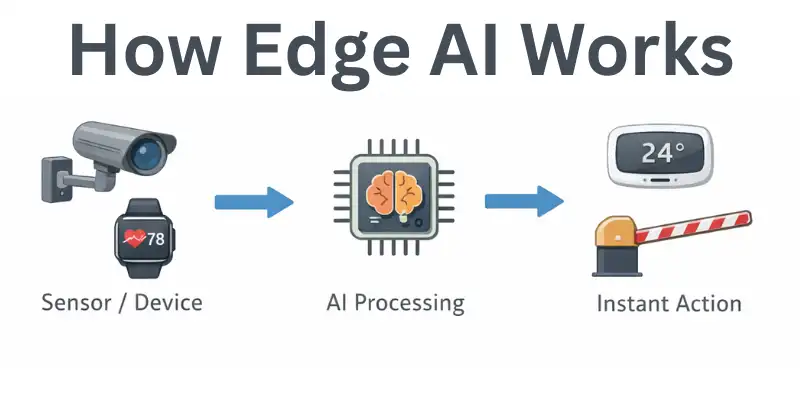
Edge AI allows devices to act smartly on their own. Instead of sending every piece of data to the cloud, the AI processes information right on the device. This is important for things that need fast decisions.
- Devices like smart cameras or sensors can respond instantly.
- Reduces delay because data doesn’t travel far.
- Example: A smart thermostat adjusts temperature immediately based on your habits.
Examples:
- A smart camera can detect motion instantly.
- A smart thermostat changes temperature based on your habits.
Benefits:
- No long delays—data doesn’t travel far.
- Devices respond immediately.
Why Edge AI Matters Today
Edge AI is growing because it solves real problems.
Benefits:
- Speed: Devices make decisions instantly.
- Cost: Less data goes to the cloud, saving money and bandwidth.
- Privacy: Sensitive information stays on your device.
Example:
- Fitness trackers can alert you if your heartbeat is irregular in real time.
Embedded AI makes technology faster, cheaper, and safer for everyday life.
Key Concepts to Know
Here are some terms to understand Edge AI better:
- Edge computing: Processing data near the device instead of far away.
- Artificial intelligence: Machines making smart decisions automatically.
- Edge AI: Using AI on devices to act quickly and locally.
Understanding Edge AI
Edge AI is technology that lets artificial intelligence work directly on devices instead of sending data to far-away servers. This means devices like cameras, sensors, or smart gadgets can make decisions instantly and locally. Example: A security camera can spot unusual movement and alert you right away.
Why it matters:
- Faster responses: Devices act immediately.
- Better privacy: Your data stays on the device.
- Lower costs: Less cloud usage saves money.
Embedded AI is changing how devices work, making AI more practical and powerful in daily life.
Edge AI vs. Cloud AI
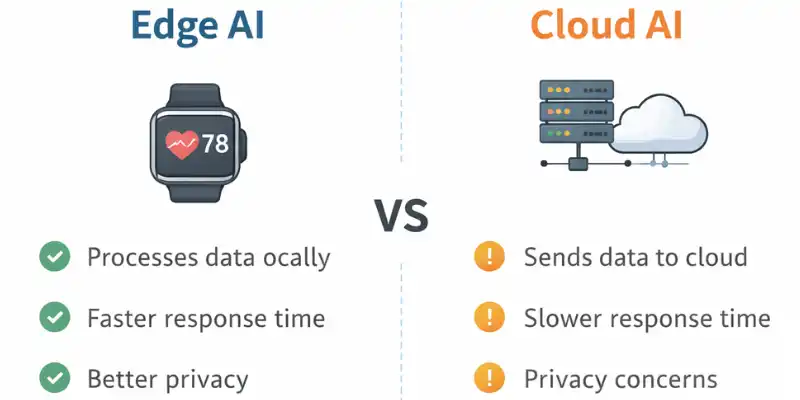
Edge AI and Cloud AI both use artificial intelligence, but they work differently.
- Edge AI: Works directly on the device.
- Cloud AI: Sends data to servers far away to process.
Key Differences:
- Speed: Edge AI is faster because it processes data locally.
- Privacy: Sensitive data stays on your device.
- Cost: Less cloud usage saves money.
Example: A smart home camera using Edge AI can detect a stranger immediately. Cloud AI might take longer to analyze the footage.
Edge AI vs. Traditional AI Deployment
Traditional AI usually depends on centralized servers or the cloud. Embedded AI brings AI to the device itself, making it more efficient.
Benefits:
- Real-time decisions: Devices act instantly without waiting for cloud feedback.
- Reduced network load: Less data travels to servers.
- Flexible use: Works on phones, industrial machines, and more.
Example: A factory sensor with Edge AI can detect equipment failures instantly and prevent downtime.
Edge AI Technology & Infrastructure
Edge AI uses smart devices, special processors, and systems to run artificial intelligence directly on devices. This lets machines process data quickly and make decisions without using the cloud. From smart cameras to factory sensors, Embedded AI improves speed, privacy, and cost-efficiency.
The infrastructure includes:
- Edge AI devices
- Edge AI computers
- Processors
- Software and platforms
These parts work together to make AI fast and local.
Edge AI Devices, Processors, and Computers
These are the physical parts that let AI work right on the device. They make devices quick and smart.
- Edge AI devices: Cameras, sensors, drones, and robots that can think and respond instantly.
- Edge AI processors: Special chips built to handle AI tasks faster.
- Edge AI computers: Small computers that run AI on-site without sending data to the cloud.
Example: A smart security camera uses an Edge AI processor to detect motion immediately.
AI Edge Nodes & Embedded Edge AI
Edge nodes and embedded AI help devices process data locally.
- AI edge node: A device or sensor that runs AI near where data is collected.
- Embedded edge AI: AI built directly into a device’s hardware or software.
Example: A smart thermostat with embedded edge AI adjusts the temperature in real-time.
Platforms, Software, and Systems for Edge AI
Edge AI needs software and platforms to manage devices and data efficiently.
- Edge AI platform: Tools to deploy and control AI on many devices.
- Edge AI software: Programs that let AI run on devices.
- Edge AI system: Full setups combining hardware, software, and networks.
Example: Factories use Edge AI systems to monitor machines and prevent failures instantly.
Edge AI Deployment & Implementation
Edge AI deployment is the process of putting AI directly on devices so they can work quickly and locally. This allows businesses and users to get real-time insights and actions without relying on the cloud. By combining edge computing for AI with smart devices, companies can save bandwidth, improve privacy, and make systems faster. Embedded AI deployment involves planning the right devices, platforms, and strategies to ensure AI works efficiently at the edge.
By combining AI with edge computing, companies can:
- Save bandwidth
- Protect privacy
- Make systems faster
Successful deployment needs careful planning of devices, platforms, and strategies so AI works efficiently at the edge.
Edge AI Deployment Strategies
Deploying Edge AI needs the right approach and tools to run AI on devices.
- Device-focused deployment: Installing AI on individual devices like cameras, drones, or sensors.
- Network-focused deployment: Using multiple edge nodes connected in a network for coordinated AI.
- Platform-based deployment: Using an Edge AI platform to manage and monitor all devices.
Example: A retail chain uses Embedded AI on in-store cameras to track customer traffic in real-time.
How Edge Computing and AI Work Together
Edge AI combines AI algorithms with edge computing to process data locally.
- Data is analyzed on the device instead of sending it far away.
- This reduces delays and makes responses immediate.
Example: Smart traffic cameras use AI at the edge to detect accidents and alert authorities instantly.
Local Edge vs. Cloud-Edge Hybrid
There are two main deployment models for Edge AI:
- Local edge: All AI processing happens on the device. It is fast and private.
- Cloud-edge hybrid: Some AI tasks run on the device, while others use the cloud for complex tasks.
Example: A factory machine uses Edge AI locally for quick decisions but sends complex data to the cloud for long-term analysis.
Edge AI Applications & Use Cases
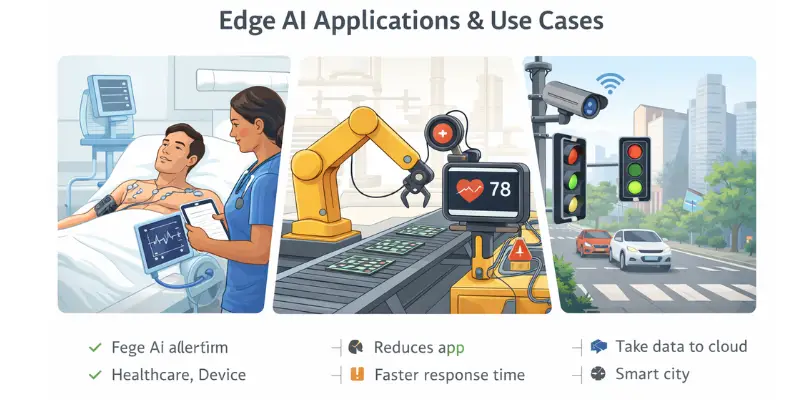
Edge AI has become essential across industries because it allows devices to process data and make decisions locally. From healthcare to smart cities, AI on edge devices provides faster responses, improves efficiency, and enhances privacy. Companies are using edge AI applications to monitor systems, detect problems in real-time, and improve user experiences. Real-life edge AI use cases show how devices and embedded AI computers are transforming the way we live and work.
Healthcare Monitoring
Edge AI helps monitor patients in real-time for faster care.
- Wearables track heart rate, blood pressure, and oxygen levels instantly.
- Alerts nurses immediately if readings are abnormal.
- Edge AI computers analyze trends locally for early detection.
- Portable devices reduce delays by processing data without the cloud.
Example: A smartwatch alerts a nurse when a patient’s heart rate spikes suddenly.
Medical Imaging
Edge AI improves diagnosis by analyzing scans on-site.
- Embedded AI computers detect abnormalities in X-rays and MRIs.
- Portable imaging devices process results immediately.
- Reduces time to diagnosis for critical patients.
- Keeps patient data private because analysis stays local.
Example: A clinic uses an Edge AI tablet to check X-rays instantly.
Manufacturing Maintenance
Edge AI prevents machine breakdowns and improves efficiency.
- Sensors detect unusual vibrations or temperature immediately.
- Embedded AI computers predict failures before they happen.
- Alerts maintenance staff for fast action.
- Reduces downtime and saves costs.
Example: A factory uses sensors to spot a failing motor and fix it before it stops production.
Quality Control in Factories
Edge AI ensures products meet quality standards efficiently.
- Smart cameras inspect items on the assembly line in real-time.
- Devices detect defects or missing components.
- Improves product consistency and reduces waste.
- Sends alerts to operators when problems occur.
Example: A smartphone factory uses Embedded AI cameras to catch scratches before packaging.
Autonomous Vehicles
Edge AI helps cars make fast and safe decisions.
- AI edge devices process sensor data instantly.
- Detects obstacles, traffic signals, and pedestrians.
- Enables self-driving cars to react in real-time.
- Reduces accidents with faster responses.
Example: A self-driving car stops immediately when a pedestrian steps onto the road.
Driver Assistance
Edge AI supports safer driving.
- Dashcams detect lane departures and collisions.
- Edge AI vision monitors driver alertness.
- Provides real-time warnings to prevent accidents.
- Analyzes traffic conditions locally for smarter driving decisions.
Example: A car dashboard alerts the driver when they drift out of their lane.
Smart City Traffic Management
Edge AI optimizes urban traffic and public services.
- Cameras monitor vehicle flow in real-time.
- Traffic lights adjust automatically based on congestion.
- Edge AI devices detect accidents immediately.
- Reduces traffic delays and improves city safety.
Example: Smart traffic lights reduce jams during rush hour.
Public Safety Monitoring
Edge AI enhances security and emergency response.
- AI edge devices detect unusual activity instantly.
- Smart cameras alert authorities to accidents or crimes.
- Edge AI analyzes crowds and movements.
- Enables faster emergency responses in critical areas.
Example: A city camera spots a fire and notifies firefighters immediately.
Retail Customer Insights
Edge AI helps stores understand and serve customers better.
- Smart cameras track foot traffic.
- Edge AI computers monitor product interactions.
- Detects popular areas or items in real-time.
- Alerts staff to restock shelves or adjust layouts.
Example: A store adjusts displays instantly based on shopper behavior.
Agriculture & Farming
Edge AI improves crop management and yields.
- Sensors monitor soil moisture, nutrients, and temperature.
- Drones detect crop diseases early.
- Edge AI devices guide irrigation and fertilization efficiently.
- Reduces water usage and increases harvest quality.
Example: A farm uses sensors and drones to water only dry areas and spot plant disease early.
Benefits & Challenges of Edge AI
Edge AI, also called intelligent edge, allows devices to process data locally instead of sending it to the cloud. This brings many advantages, like faster responses, better privacy, and lower costs. Understanding the edge AI benefits and its challenges is important for companies and users. By combining edge intelligence with the right edge infrastructure, organizations can make smarter decisions and improve system performance
Key Benefits of Edge AI
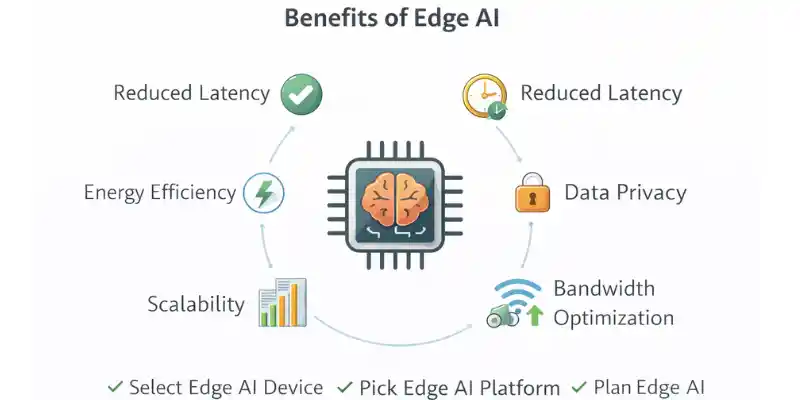
Edge AI brings smart processing directly to devices. This helps businesses and users get faster, safer, and smarter solutions.
Main advantages:
- Reduced latency: Decisions happen instantly because data is processed on the device.
- Data privacy: Sensitive information stays on the device, keeping personal or company data safe.
- Bandwidth optimization: Less data goes to the cloud, saving network costs.
- Real-time insights: Devices act immediately, improving safety and performance.
- Energy efficiency: Local processing uses less energy than constant cloud communication.
- Scalability: You can add more Embedded AI devices across locations without overloading central servers.
- Enhanced reliability: Devices keep working even if the network or cloud is down.
Examples:
- A smart traffic camera detects accidents instantly and alerts authorities without waiting for the cloud.
- Wearable health monitors track vital signs in real-time and notify doctors immediately.
Limitations and Considerations
Edge AI is powerful, but it has some challenges:
- Limited processing power: Edge devices may struggle with very complex AI tasks.
- Higher initial costs: Buying hardware and software for edge AI can be expensive.
- Device management: Maintaining many intelligent devices can be difficult.
- Security risks: Even local AI needs protection from cyber threats.
Example: A factory using Edge AI computers must perform regular updates to keep machines running smoothly.
Edge AI Hardware & Devices
Edge AI relies on special hardware and devices to run AI locally and efficiently. These devices process data at the source, which reduces delays and improves performance. Choosing the right hardware is critical for each application whether it’s a smart camera, wearable, or industrial sensor.
The main building blocks include:
- AI processors
- Edge AI chips
- Neural Processing Units (NPUs)
- Edge AI computers
Together, they form reliable and intelligent edge systems.
Top Edge AI Chips, Processors, NPUs, and Edge AI Computers
The heart of Edge AI is the processing unit that lets devices make decisions locally.
- Edge AI chips: Special chips designed to handle AI tasks efficiently.
- AI processors: Process large amounts of data quickly for real-time applications.
- NPUs (Neural Processing Units): Speed up AI calculations to make devices smarter.
- Edge AI computers: Compact computers that run AI models without relying on the cloud.
Examples:
- A security camera with an Edge AI chip detects motion instantly.
- An industrial sensor with an AI processor predicts equipment failures in real-time.
Comparison of Edge AI Devices for Different Applications
Different devices work best depending on speed, power, and complexity.
- Smartphones & wearables: Use Edge AI chips for fitness tracking and notifications.
- Cameras & drones: Rely on NPUs and AI processors for real-time object detection.
- Industrial Edge Computers: Handle large volumes of data for factories and predictive maintenance.
- IoT sensors: Lightweight devices process basic AI tasks locally without heavy hardware.
Example: A smart drone with Edge AI hardware detects obstacles instantly during flight.
Edge AI Market & Trends
The edge AI market is growing rapidly as more businesses and industries adopt embedded AI solutions. Emerging startups, advanced platforms, and cutting-edge AI models are making it easier to deploy AI at the edge. With faster devices, smarter processors, and innovative platforms, advanced edge AI is transforming industries and creating new opportunities for businesses worldwide.
Emerging Startups and Platforms
Many startups are building Edge AI platforms and solutions for different industries.
- Startups focus on healthcare, retail, and manufacturing.
- They provide local AI processing for faster results.
- Platforms make deployment easier, reducing technical challenges.
- Collaboration with large companies drives innovation and growth.
Examples:
- A startup offers an Embedded AI platform for smart city traffic management.
- Retail-focused startups provide real-time customer analytics in stores.
Cutting-Edge AI Technologies and Models
Embedded AI uses advanced AI models and technologies to improve speed and accuracy.
- Lightweight AI models run efficiently on edge devices.
- Neural network optimizations allow real-time processing on small hardware.
- AI accelerators and NPUs enhance performance for complex tasks.
- Platforms integrate multiple AI models for better predictions.
Examples:
- Smart drones use advanced Edge AI for real-time obstacle detection.
- Industrial machines run Embedded AI models for predictive maintenance.
Market Growth and Future Opportunities
The Edge AI market is growing fast across industries.
- More adoption in healthcare, automotive, manufacturing, and smart cities.
- High demand for low-latency, real-time AI drives growth.
- New startups and platforms create investment opportunities.
- Advanced devices and processors enable broader Edge AI deployment.
Examples:
- The global Embedded AI market is projected to grow rapidly over the next five years.
- Smart city projects invest in startups for traffic and safety solutions.
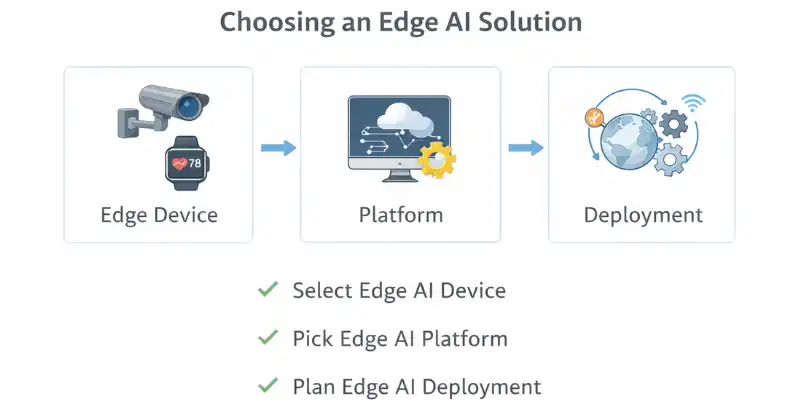
How to Choose an Edge AI Solution
Choosing the right edge AI solution is crucial to ensure your devices and platforms work efficiently. The solution should match your use case, whether it’s for healthcare, smart cities, retail, or industrial automation. Selecting the right embedded AI computer, device, and platform helps you achieve faster performance, better accuracy, and lower latency. Understanding the edge AI foundation and available tools makes deployment easier and more reliable.
Selecting the Right Edge Device
The edge device is where your AI will run, so picking the right one is key.
- Consider processing power: Can the device handle your AI workload efficiently?
- Check compatibility with your platform and AI models.
- Evaluate size and energy use for mobile or embedded applications
- Look for built-in embedded AI computing capabilities.
- Example: Smart cameras with edge device AI detect motion and send alerts instantly.
- Example: Wearables use low-power edge AI tools to track health data continuously.
Choosing the Best Embedded AI Computer
Embedded AI computers run models locally and handle intensive AI tasks.
- Check compute performance: CPU, GPU, or NPU for AI workloads.
- Ensure support for AI frameworks and deployment tools.
- Consider network connectivity for hybrid or cloud-edge systems.
- Evaluate durability and environmental resistance for industrial settings.
- Example: A factory uses edge AI computers to monitor machinery in real-time.
- Example: Autonomous drones rely on best edge computing for low latency AI processing.
Picking the Right Platform
The platform helps you manage devices, AI models, and deployment.
- Ensure software compatibility with your AI models.
- Look for centralized device management for multiple deployments.
- Check for real-time monitoring and analytics.
- Evaluate security and privacy features to protect sensitive data.
- Example: Retail stores use an embedded AI platform to track customer behavior in real-time.
- Example: Smart city systems rely on platforms that integrate multiple edge AI tools.
Conclusion
So far, we’ve explored Edge AI how it works, its devices, deployment strategies, applications, and benefits. We saw how Edge AI helps devices act fast, keeps data safe, and makes life easier in healthcare, factories, smart cities, and more. My recommendation, folks: if you’re thinking about smart devices or improving business operations, focus on using Embedded AI technology the right way. Choosing the right devices, platforms, and strategies can make a huge difference in speed, reliability, and efficiency
Keep exploring, stay curious, and guys, keep learning about the ways Edge AI can make technology work smarter for you!
Edge AI is when devices like cameras, sensors, or wearables process data locally instead of sending it to the cloud. This helps devices act faster and make instant decisions. It also keeps data private and saves network costs.
Edge AI works by running AI models directly on the device. Devices analyze data themselves, detect problems, and take action instantly. Examples include smart thermostats adjusting temperature or cameras detecting motion.
Edge AI is used in healthcare, factories, smart cities, retail, and agriculture. It powers smart cameras, wearables, drones, industrial sensors, and autonomous vehicles. Anywhere fast decisions or privacy are needed, Edge AI can help.
Edge AI makes devices faster, safer, and more reliable. It reduces delays, keeps sensitive data private, saves bandwidth, and can work even if the network is down. It also helps businesses make real-time decisions.
Pick devices with enough processing power for your AI tasks. Make sure they work with your AI models and platform. Also check size, energy use, and durability for your setting like cameras for security or computers for factories.






- Be Respectful
- Stay Relevant
- Stay Positive
- True Feedback
- Encourage Discussion
- Avoid Spamming
- No Fake News
- Don't Copy-Paste
- No Personal Attacks
- Be Respectful
- Stay Relevant
- Stay Positive
- True Feedback
- Encourage Discussion
- Avoid Spamming
- No Fake News
- Don't Copy-Paste
- No Personal Attacks
