“How AI Works: The Future You’ve Been Waiting For”
Published: 16 Dec 2025
Have you ever wondered how your phone knows exactly what music you want to listen to, or how Netflix always offers the ideal show? That is the wonder of AI, or artificial intelligence, working in the background. But, if you’re like most people, you’re very interested about how it all works. Do not worry! In this article, we will explain how AI works in a simple, step-by-step way that anybody can learn. There will be no complex technical speak, just plain insights. By the conclusion of this tutorial, you’ll have a better understanding of how Artificial intelligence is making your daily life simpler, whether it’s shopping, driving, or living healthy. Ready to learn more? Let’s get started!
What is AI?
Artificial Intelligence (AI) is a technology that enables machines to think and act like humans. It allows computers to learn from data, understand information, and make decisions on their own. AI is used in tasks such as image recognition, voice assistants, and smart recommendations. Today, AI is part of our daily lives through smartphones, apps, and smart devices. It helps make work faster, easier, and more efficient. As AI continues to learn, it becomes better at supporting and improving everyday activities.
Key Points about AI:
- AI can learn, think, and solve problems exactly like humans, but much faster.
- Machine learning improves AI by analyzing and learning from data.
- AI is used in practical applications such as early health detection and forecasts for weather.
- AI improves choices through analyzing patterns and data.
- Personal suggestions and self-driving cars are examples of how it is becoming more typical.
How AI Works: A Step-by-Step Breakdown
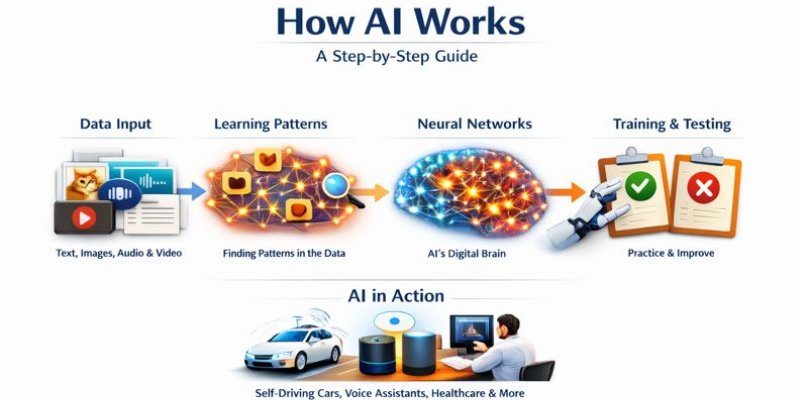
Understanding how AI works does not need to be difficult. Think of it as educating your child to see things. You provide examples; it learns patterns, practices, and then enhances its analytical skills. This fundamental movement is at the heart of how AI works in real life.
- First, AI processes a large amount of data.
- Then it searches for patterns.
- After that, it learns via practice.
- Finally, it follows what it has learnt to make decisions.
Data Input Showing AI the World
AI begins by collecting information. This can include text, photos, audio, and video. Consider this phase to be providing the computer a large number of real-world examples so that it learns how things appear and sound.
- AI analyzes hundreds of examples.
- It detects minor things.
- It begins with determining what makes things similar or distinct.
Real-Life Example:
You give thousands of photographs to AI to educate it how to tell between cats and dogs. Some are branded “cat,” while others “dog.” The AI develops features such as sharp ears, fluffy tails, and different facial forms.
Learning Patterns: How AI Works to Recognize Patterns
Next, AI begins to identify patterns in the data. It compares what it has seen and determines what each object has in common. This process is powered by Machine Learning, which helps AI learn from examples and improve over time
- It can detect forms, colors, words, and noises.
- It over time connects the dots.
- It learns what generally goes together.
Real-Life Example:
When Netflix offers movies that are similar to what you’ve already seen, it’s because AI has noticed your watching habits what you enjoy, what you skip, and what you watch often.
Neural Networks — How AI Works like a brain
This is where the “smart” part works. Neural networks function similarly to tiny digital brain cells, passing information from one to another.
- Every stage learns something little.
- All layers at once learn something significant.
- More practice brings greater outcomes.
Real-Life Example:
Your phone’s face unlock feature makes use of neural networks. It scans many small pieces of information on your face and learns about you. Every unlock makes it smarter and more precise.
Training & Testing — How AI Works
AI does not become intelligent instantly. It requires practice, much as students do before tests. Following learning, it is evaluated on fresh cases to determine how well it performs.
- If it makes mistakes, it returns and trains again.
- The more it practices, the better it gets.
- This cycle repeats until the AI becomes dependable.
Real-Life Example:
Self-driving vehicles learn to drive by going through millions of virtual and real-world scenarios: traffic lights, customers, wet roads and improving each time.
How AI Works in Different Types:
AI is classified into several categories, each with its own set of skills. Some are already useful in our daily lives, while others are still being developed. Let’s look at each category and see how AI works in each situation.
Narrow AI (Weak AI)
The most common sort of AI with which we interact is narrow AI. It is built to do one thing really well, but it cannot perform any other tasks. For example, while your voice assistant, such as Siri or Alexa, can help you set reminders or play music, it cannot handle buying food or make advanced choices. Narrow AI has been used across multiple fields, assisting physicians, teachers, and companies in many ways.
Examples of Narrow AI:
- Voice Assistants: Siri, Alexa, and Google Assistant all assist with simple tasks such as playing music, setting alarms, or answering inquiries.
- Healthcare: AI systems are used to analyze medical pictures, allowing clinicians to diagnose disease like cancer more quickly and correctly.
- Self-driving cars: Autonomous vehicles use AI to navigate roadways by identifying traffic signs, pedestrians, and other vehicles.
Key Points:
- Narrow AI focuses on a single job and does it effectively.
- It is already aiding us in our daily lives, such as via voice assistants and medical apps.
- It is unable to execute activities beyond its intended role.
General AI (Strong AI)
General AI is a type of AI that can do any task a human can, like learning new things and solving problems. Unlike Narrow AI, which can only do specific jobs, General AI can adapt and learn new skills. For example, a robot could cook, play chess, drive, and write an essay. This shows how AI could grow and change on its own.
Examples of General AI :
- Human-like assistants: A future AI might do human-like functions such as corporate management, creative creation, and complicated decision-making.
Key Points:
- General AI is capable of performing every work that a person can.
- It is currently in development and does not exist yet.
- General AI can learn new tasks without being retrained.
Superintelligence
Superintelligence is an AI that is smarter than humans in every way. It could solve problems, make decisions, and understand the world better than any person. While it’s still far off, experts debate when, or if, it will ever happen. Superintelligent AI could change fields like healthcare, engineering, and space exploration faster and on a larger scale than humans can. Understanding how AI works now helps us imagine a future where AI can do even more.
Examples of Superintelligence:
- Global Problem Solving: AI might solve climate change, world hunger, and perhaps treat diseases faster than humans.
- Super-fast computing: An artificial intelligence system capable of doing activities such as data processing at speeds that humans could never match.
Key Points:
- Superintelligence would outperform human intelligence in all domains.
- For the time being, it is only a theory and remains a remote possibility.
- It has the potential to impact the world in ways we cannot now comprehend.
How AI Learns
AI is supposed to learn from experience, much as people do by seeing, listening, and practicing over time. But how can AI learn? It follows a basic method of breaking down activities and gradually improving itself, similar to how a toddler learns from the environment.
Learning from Data
The first stage in how AI learns is to look at a number of samples. For example, if you want to teach an AI to identify your face, you would show it several photographs of yourself, much as a kid learns to recognize faces by seeing them repeatedly. The more photographs the AI sees, the more accurate it becomes at recognizing you.
Real-life Example: Every time you unlock your phone, the facial recognition feature learns to recognize you by scanning multiple angles of your face.
Recognizing Patterns
When AI has seen enough samples, it begins to discern patterns. For example, if an AI is learning to propose songs, it examines your listening history and determines the sorts of music you enjoy. Just like a toddler detects patterns in the environment, such as how a ball bounces when dropped, the AI learns what to predict based on prior data.
Real-life Example: Music programs such as Spotify propose music based on your listening behavior, finding trends in the genres and artists you like.
Improving Over Time
AI improves its decision-making abilities as it learns more. The more data it analyzes, the smarter it grows, much as a kid improves at activities with experience. AI may make blunders at first, but it improves as it learns from prior events.
Real-life Example: Self-driving cars learn how to prevent accidents by testing on various roads and traffic settings. They gradually improve their ability to drive safely.
Summary
The AI learning process is similar to how humans learn: by seeing, practicing, and improving over time. AI works by learning from data and becoming better with experience, whether it’s recognizing people, recommending tunes, or driving safely. Artificial intelligence’s ability to learn is altering the future, making technology more intuitive and sensitive to human needs.
Real-World Applications of How AI Works
AI is more than just a future notion; it is already influencing our society in several practical ways. AI is making life smarter and more efficient, from assisting doctors in diagnosing ailments to simplifying daily activities. Here are some real-life instances of how AI is used in various domains:
Healthcare:
- Helping Doctors: AI assists doctors in analyzing medical pictures such as X-rays or MRIs in order to detect illnesses like cancer earlier, resulting in improved therapy.
- Personal Health Assistants: AI may provide health recommendations based on your medical information, similar to a virtual doctor that you can contact at any time.
Business:
- Customer Service: Many businesses utilize AI-powered chatbots, similar to those seen on websites, to answer client queries 24 hours a day, seven days a week.
- Predicting Trends: AI enables businesses to forecast what things consumers will want to buy in the future, allowing them to plan ahead.
Daily Life:
- Voice Assistants: Siri, Alexa, and Google Assistant enable us to set alarms, play music, and manage smart home devices simply by speaking.
- Smartphones: AI helps make our phones smarter, such as recognizing our faces to unlock them or arranging images based on our preferences.
Transportation:
- Self-Driving Cars: AI enables automobiles to drive themselves by making judgments about steering, stopping, and avoiding obstacles, as shown in Tesla vehicles.
- Traffic Help: AI can analyze traffic trends and help make traffic signals smarter, reducing wait times and traffic bottlenecks.
Entertainment:
- Suggestions for Shows: AI suggests movies or series to watch depending on what you’ve already viewed, such as on Netflix or YouTube.
- Smart Opponents in Games: AI is utilized in video games to produce smarter opponents, making the games more enjoyable and difficult.
Science:
- Faster Discoveries: AI enables scientists to examine massive volumes of data more quickly, allowing them to make discoveries in disciplines such as space, genetics, and the environment.
- Simulating Complex Processes: By studying historical data, AI can anticipate weather and disease transmission.
Security:
- Surveillance Systems: AI may monitor security cameras and notify law enforcement if anything unexpected occurs, so assisting in crime prevention efforts.
- Detecting Fraud: Banks utilize AI to detect anomalous behavior in bank accounts, therefore preventing fraud before it occurs.
Finance:
- Smart Investing: AI analyzes real-time data to assist banks and investors in making better judgments on where to spend their money.
- Personal Finance Advice: Some applications employ artificial intelligence to provide individualized financial advice or recommendations for the best investments.
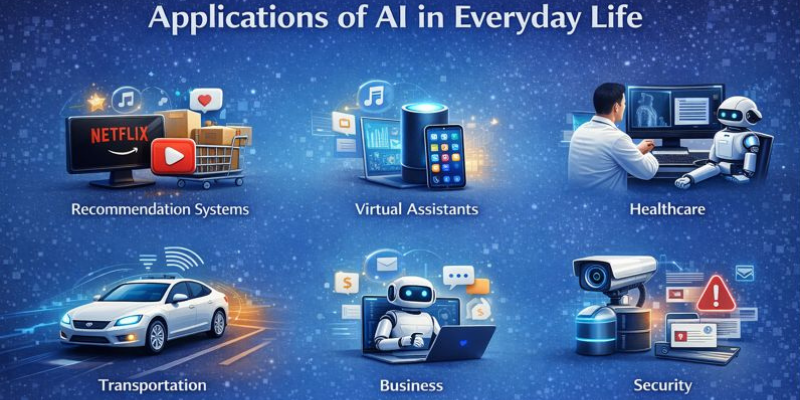
These examples demonstrate how artificial intelligence (AI) makes many jobs easier, faster, and more efficient, whether in everyday life, at business, or in complex sectors such as healthcare and research.
The Future of AI: What’s Next?
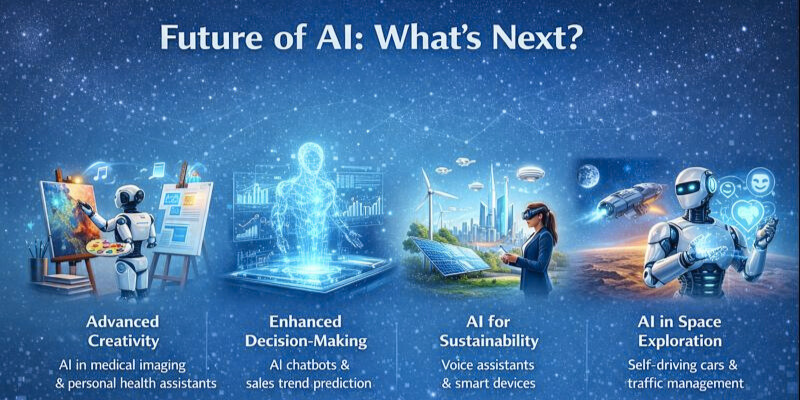
In this part, we explore possible breakthroughs in AI and how they may influence the world in the coming years. Understanding how AI works today helps us imagine the innovations of tomorrow. These advances could improve every area of our lives, from personal experiences to global solutions.
- Advanced Creativity: AI will grow more creative, producing art, music, and even literature that is indistinguishable from human-created works, presenting new opportunities for artists and innovators.
- Better Decision-Making: AI can study lots of data very fast. It can help people make smarter choices in areas like banking, healthcare, and government. Learning how AI works helps us use it in the right way.
- AI for Sustainability: AI will assist in addressing environmental challenges by optimizing energy use, minimizing waste, and providing long-term solutions to climate change.
- Human-AI Collaboration: AI will help people at work, making tasks faster and more creative without taking their jobs. Understanding how AI works helps us work with AI better.
- AI in Space Exploration: AI will play an important part in future space missions, assisting in the analysis of space exploration data and the administration of complicated tasks like autonomous navigation and resource allocation.
- Emotional Intelligence: Future AI systems may learn to comprehend and respond to human emotions, enhancing interactions in areas such as customer service, mental health treatment, and personal assistants.
- Healthcare Breakthroughs: AI will improve medicine. It can help with surgeries, monitor health in real-time, and help people live healthier lives.
- AI in Mobility: From self-driving cars to drones, AI will transform transportation, making it safer, more efficient, and lowering traffic congestion.
- AI in Governance: AI can help governments give better services, manage resources, and understand citizens’ needs.
- Security and Privacy: AI can protect computers and networks from attacks. But we also need rules to keep personal data safe.
Conclusion
“Congratulations! By following these steps, you’ve learned how AI works and why it’s important. You now have a strong knowledge of how AI makes judgments, learns from data, and improves many parts of our life, ranging from healthcare to daily activities. Now that you’ve covered the fundamentals, you’re ready to go deeper and see how these ideas might be used in real-world scenarios.”
AI (Artificial intellect) refers to machines that can execute activities that would normally need human intellect, such as comprehending speech or identifying pictures. It learns from data and improves its abilities over time
There are three varieties of AI: narrow AI (performs specialized tasks), general AI (can accomplish a range of jobs, similar to humans), and super intelligent AI (a future notion in which AI outperforms human intellect).
AI analyzes data, recognizes patterns, and makes judgments. It learns from experience, much as people do via practice.
While AI may manage routine jobs, it cannot completely replace humans. It is most effective when used in concert with people to increase productivity and creativity.
AI is utilized in voice assistants, movie suggestions, self-driving cars, and other applications to simplify and customize processes.
No, you may begin by learning the essentials. Many materials help novices understand AI and how it works.
You can begin with online classes, articles, and tutorials. Start with simple explanations and expand as you learn.





- Be Respectful
- Stay Relevant
- Stay Positive
- True Feedback
- Encourage Discussion
- Avoid Spamming
- No Fake News
- Don't Copy-Paste
- No Personal Attacks
- Be Respectful
- Stay Relevant
- Stay Positive
- True Feedback
- Encourage Discussion
- Avoid Spamming
- No Fake News
- Don't Copy-Paste
- No Personal Attacks
